PMEGP (Prime Minister Employment Generation Program) Explained: How the Government Is Quietly Funding Thousands of First-Time Entrepreneurs Every Month

Last updated: July 2026
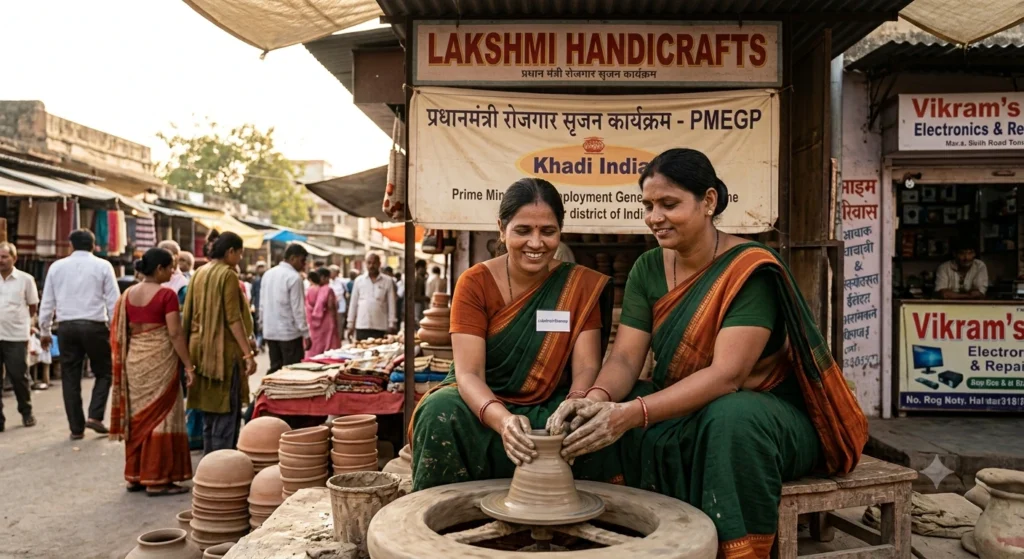
A few months ago, a friend’s cousin messaged me asking for help “understanding some government loan scheme” she’d heard about from a neighbour who’d just opened a small stitching unit with almost no money of her own. That neighbour hadn’t taken a personal loan, hadn’t pledged gold, and hadn’t gone through a moneylender. She’d used something called PMEGP — and honestly, most people I know have heard the name in passing without really knowing what it does or how generous it actually is.
So let’s fix that properly. The Prime Minister’s Employment Generation Programme, or PMEGP, is one of the largest and longest-running self-employment schemes run by the Government of India — and yet it remains one of the most underused, simply because people assume “government scheme” means endless paperwork and low odds of approval. The reality is more interesting than that, and the numbers back it up: as of early March 2026, PMEGP had sanctioned over 5.73 lakh projects worth close to ₹58,979 crore in bank loans, disbursed more than ₹13,219 crore in subsidy, and generated an estimated 31.5 lakh jobs. That’s not a pilot scheme. That’s infrastructure for India’s small business economy.
In this post, I want to break down exactly what PMEGP is, who it’s for, how much money you can actually get, what’s changed in 2026, and how to avoid the common mistakes that get applications rejected.
What Is PMEGP(Prime Minister Employment Generation Program), Really?
PMEGP was created in 2008-09 by merging two older schemes — the Prime Minister’s Rojgar Yojana (PMRY) and the Rural Employment Generation Programme (REGP) — into a single, streamlined framework. It’s a central sector scheme run by the Ministry of Micro, Small and Medium Enterprises (MSME), with the Khadi and Village Industries Commission (KVIC) acting as the national nodal agency. At the state and district level, it’s implemented through KVIC directorates, State Khadi and Village Industries Boards, District Industries Centres, and partner banks.
Here’s the part that trips people up: PMEGP is not a direct government loan. It’s a credit-linked subsidy scheme. That means a bank actually lends you the money to start your business, and the government’s role is to subsidise a portion of that loan — called margin money — once your unit is verified and running. You contribute a small share yourself, the bank funds the rest, and the government’s subsidy effectively reduces your real loan burden once it’s adjusted into your account.
The scheme’s core purpose is simple: help first-time entrepreneurs — especially in rural areas, among artisans, and among unemployed youth — set up micro-enterprises in the non-farm sector, so they don’t have to migrate to cities in search of work.
How Much Money Can You Actually Get Under PMEGP?
This is usually the first question everyone asks, so let’s get straight into the numbers.
Maximum project cost:
- Manufacturing sector projects: up to ₹50 lakh
- Service and business/trading sector projects: up to ₹20 lakh
Subsidy rates (as a percentage of project cost):
| Category | Urban Areas | Rural Areas |
|---|---|---|
| General category | 15% | 25% |
| Special category (SC, ST, OBC, Women, Minority, Ex-Servicemen, Divyang, Transgender, Hill/Border areas, NER) | 25% | 35% |
Your own contribution (beneficiary’s share):
- General category: 10% of project cost
- Special category: 5% of project cost
The remaining amount is financed by the bank as a term loan and working capital combined.
So, for example, if a general-category applicant in a rural area sets up a ₹20 lakh manufacturing unit, they’d contribute ₹2 lakh themselves, the government subsidy would cover ₹5 lakh (25%), and the bank would finance the balance ₹13 lakh — a real loan, but a significantly lighter one than going the traditional route alone.
Read About Government Schemes For Startups:
- DPIIT Recognition: The One Government Certificate Every Indian Startup Needs Before Anything Else
- Startup India Seed Fund Scheme (SISFS): The Complete Guide Every Indian Founder Should Read Before Applying
- Government Schemes for Startups and Small Businesses in India: The Complete 2026 Guide to Funding, Tax Breaks and Ease of Doing Business
Who Can Apply — And Who Can’t
Eligibility is refreshingly simple compared to most credit-linked government schemes:
- Any Indian citizen aged 18 years or above can apply
- There’s no upper age limit
- For projects above a certain cost threshold, a minimum educational qualification (Class VIII pass) may apply — check current DIC/KVIC guidance for the exact threshold applicable to your project category
- Only new units are eligible. If you’re already running a business, or you’ve availed a subsidy under PMRY, REGP, or any other Central or State government scheme, you won’t qualify under PMEGP
- Only one person per family can avail assistance under the scheme — “family” here includes self, spouse, and unmarried children
- Self Help Groups (that haven’t availed benefits under other schemes), registered societies, and production cooperatives are also eligible in addition to individual applicants
Existing PMEGP or MUDRA unit owners aren’t shut out completely, though — there’s a well-defined second-loan route for upgradation, which we’ll get to shortly.
What’s New in PMEGP for 2026
The scheme has quietly gotten more entrepreneur-friendly over the past couple of years. Here’s what’s changed:
1. Collateral-Free Loans Up to ₹10 Lakh
In line with RBI and CGTMSE guidelines reinforced for 2026, banks are not permitted to demand collateral security for PMEGP loans up to ₹10 lakh. For a first-time entrepreneur with no property or fixed assets to pledge, this single rule is often the difference between starting a business and not starting one at all.
2. Entrepreneurship Training Has Gone Fully Digital
Completing the mandatory Entrepreneurship Development Programme (EDP) — traditionally a 15-day in-person training — used to be a genuine bottleneck for applicants who couldn’t take that much time away from work or family. That training can now be completed entirely online through the “Udyomi” mobile app or the udyami.org.in portal, removing the need for physical attendance before your subsidy claim is processed.
3. A Real Second Loan for Growth
If you’ve already successfully run a PMEGP or MUDRA-financed unit — repaid your first loan on schedule and shown profitability for the last three years — you can now apply for a second loan of up to ₹1 crore for manufacturing units or ₹25 lakh for service units, with an additional subsidy of 15% (20% in Hilly and North Eastern Region states). This is a meaningful upgrade for entrepreneurs who’ve outgrown their first micro-enterprise and want to scale rather than start over from scratch.
4. Udyam Registration Is Now Mandatory
Every new unit set up under PMEGP must be registered on the Udyam Portal before physical verification of the unit and before margin money is adjusted into the loan account. This formalises the business right from the start and plugs it into India’s broader MSME data and benefits ecosystem.
What Kind of Businesses Actually Qualify?
PMEGP covers a genuinely broad range of activities across manufacturing, services, and specific business/trading categories, with a few notable rules:
- Manufacturing and processing units of almost any legitimate kind are eligible, barring activities specifically prohibited by local authorities or listed in the scheme’s negative list
- Service-sector businesses are covered, subject to the ₹20 lakh project cost cap
- Retail/trading activities are permitted in a limited way — mainly outlets selling Khadi or Village Industry products, or products manufactured by PMEGP/SFURTI-affiliated units, capped at ₹20 lakh project cost and restricted to a maximum of 10% of a state’s annual financial allocation
- Transport-related activities — purchasing a cab, van, boat, motorboat, or shikara for public or tourist transport — are allowed, though capped at 10% of financed projects in most regions (this cap doesn’t apply in the North Eastern Region, hilly regions, or LWE-affected districts)
- Projects without any capital expenditure component are not eligible — PMEGP is designed to fund asset creation, not pure working capital needs
- The cost of land cannot be included in your project cost, though the cost of a ready-built shed or a long-term lease/rental workshop can be included, capped at three years’ worth of such cost
How to Apply for PMEGP — Step by Step
- Register on the PMEGP e-Portal using your Aadhaar and basic personal details
- Prepare your Detailed Project Report (DPR) — this is genuinely the most important document in your application. It needs to clearly lay out your business model, machinery and equipment needs, total project cost, working capital requirement, expected revenue, and how many jobs your unit will create. KVIC’s portal provides model project reports for common business categories, which are worth studying even if your idea is different
- Fill out the online application form, upload your DPR, ID proofs, category certificates (if applying under a special category), and other required documents
- Wait for screening by the implementing agency — your application goes through the District Level Task Force Committee (DLTFC) or the relevant KVIC/KVIB office, which evaluates project viability
- Bank appraisal and loan sanction — once your application clears the initial screening, it’s forwarded to a bank for credit appraisal. You may be called for a brief interview
- Complete the EDP training (now available online) before your subsidy claim can be processed
- Physical verification and Udyam registration, followed by disbursal of the loan and adjustment of the government subsidy into your loan account
Applicants can track their status anytime by logging into the PMEGP portal with their application ID and registered mobile number.
Common Mistakes That Get Applications Rejected
Having gone through how the scheme actually works, here are the mistakes worth avoiding:
- A weak or generic Detailed Project Report. Banks and evaluating committees can tell instantly when a DPR has been copy-pasted from a template without any real thought behind the numbers. Take the time to build realistic cost and revenue projections specific to your business and location.
- Applying for an existing business. PMEGP is strictly for new units. If you’ve already started operating, even informally, this can disqualify your application.
- Overlapping with other government subsidies. If you or your family has already availed a subsidy under any Central or State scheme for a similar purpose, you’re not eligible — be upfront about this rather than risk rejection later in verification.
- Missing the Udyam registration step. Since it’s now mandatory before physical verification, delaying it can hold up your entire subsidy disbursal.
- Ignoring the negative list of activities. Certain business categories are restricted or excluded outright — check the current KVIC guidelines for your specific business type before investing time in a full application.
PMEGP vs Other Government Business Schemes
It’s natural to wonder how PMEGP compares to other well-known options like Pradhan Mantri Mudra Yojana (PMMY) or PM Vishwakarma Yojana. In broad terms, PMMY is a collateral-free loan scheme without a built-in subsidy, aimed at a wide range of micro and small businesses including existing ones. PM Vishwakarma is specifically targeted at traditional artisans and craftspeople working with tools of their trade. PMEGP sits in a distinct space: it’s specifically for new micro-enterprises, and its defining strength is the direct subsidy — real, non-repayable government money adjusted into your loan — rather than just cheaper or easier-to-access credit. If your priority is minimising how much you eventually repay, PMEGP’s subsidy structure is genuinely hard to beat among these options.
Frequently Asked Questions
1. Is PMEGP a loan or a subsidy scheme? It’s both, working together. A bank provides you a term loan and working capital to set up your business, and the government provides a subsidy (margin money) that’s adjusted into your loan account after your unit is verified, effectively reducing the amount you need to repay.
2. What is the maximum loan amount under PMEGP? Up to ₹50 lakh for manufacturing sector projects and up to ₹20 lakh for service and business/trading sector projects, under the current scheme guidelines.
3. Do I need collateral to get a PMEGP loan? No, not for loans up to ₹10 lakh. As per RBI and CGTMSE guidelines applicable in 2026, banks cannot demand collateral security for PMEGP loans up to this threshold.
4. Can I apply for PMEGP if I already run a small business? No. PMEGP funds only new units. If you’re running an existing business, or you’ve already availed a subsidy under PMRY, REGP, or any other government scheme, you’re not eligible for a fresh PMEGP loan — though you may be eligible for the separate second-loan upgradation route if your first loan was also under PMEGP or MUDRA.
5. How much subsidy can I get under PMEGP? Anywhere from 15% to 35% of your project cost, depending on your category and location — 15% for general category in urban areas, 25% for general category in rural areas or special category in urban areas, and 35% for special category applicants in rural areas.
6. What is the mandatory EDP training, and can I skip it? The Entrepreneurship Development Programme is compulsory for most approved applicants before your subsidy claim can be processed. You can’t skip it, but as of 2026, it can be completed entirely online through the Udyomi app or udyami.org.in, without needing to attend in person.
7. Can two people from the same family apply separately under PMEGP? No. Only one person per family is eligible for financial assistance under PMEGP, where “family” is defined as self, spouse, and unmarried children.
8. Is there a second loan available if my PMEGP business grows? Yes. Entrepreneurs who’ve successfully run and repaid a first PMEGP or MUDRA loan, and shown profitability for the preceding three years, can apply for a second loan of up to ₹1 crore for manufacturing or ₹25 lakh for service businesses, with an additional 15% subsidy (20% in Hilly and NER states).
Final Thoughts
What makes PMEGP genuinely worth your attention isn’t just the subsidy percentage or the loan ceiling — it’s the fact that it’s specifically designed for people who’ve never run a business before and don’t have collateral, credit history, or a financial cushion to fall back on. That’s a very different target audience from most bank lending products, and it’s exactly why the scheme has managed to fund over 5.7 lakh enterprises and an estimated 31 lakh jobs without most of India ever hearing much about it.
If you’ve got a genuine, viable business idea and you’ve been holding back purely because of funding, PMEGP is worth a serious look — not as a magic bullet, but as one of the more entrepreneur-friendly doors the government has actually built and kept open.
Disclaimer: This article is for general informational and educational purposes only and should not be treated as financial, legal, or business advisory advice. Subsidy rates, project cost limits, eligibility criteria, and scheme statistics mentioned above are based on publicly available information from the Ministry of MSME, KVIC, and other official and third-party sources current as of the stated dates, and are subject to change through future government notifications. Please verify the latest eligibility criteria, subsidy rates, and documentation requirements on the official PMEGP e-portal (pmegp.msme.gov.in) or with your nearest KVIC/District Industries Centre office before applying, and consult a qualified financial or business advisor for guidance specific to your situation.

Shuchi founded Finance Checks after spending 16+ years working in corporate, managing operations and distribution. She managed her own finances, learned and read regularly and helped people make sense of their savings, loans, insurance, and investments.
She started this site to offer the kind of clear, honest financial guidance she wished was more available when she was learning to manage her own money. Every article is researched personally, checked against official sources such as the Reserve Bank of India, SEBI, or the Income Tax Department, and revisited whenever regulations or figures change. She is upfront about how the site earns money through ads and select affiliate partnerships, and she does not let either influence what she actually recommends to readers.



[…] PMEGP (Prime Minister Employment Generation Program) Explained […]