
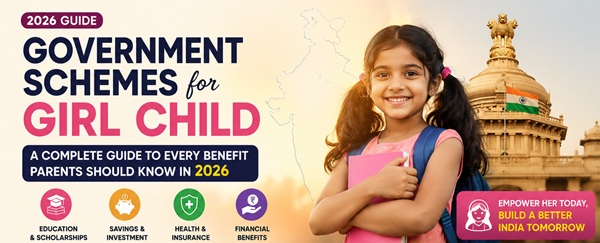
Government of India Schemes for the Girl Child: A Complete Guide to Every Benefit Parents Should Know in 2026

Ask any Indian parent raising a daughter today what worries them most, and the answer usually circles back to the same three things: her education, her safety, and whether they will have enough saved up by the time she needs it most. What a lot of families still do not fully realize is how much groundwork the government has already laid to help with exactly that. Between central schemes and state-run programs, there is now a genuinely wide safety net covering everything from the day a girl is born to the day she walks into an engineering college or gets married.
The problem is that this information is scattered across post office pamphlets, state government websites, and word of mouth from relatives who half-remember the details. This guide pulls it all together in one place, explains what each scheme actually does, who qualifies, and how to apply, so you are not left guessing which yojana for your girl child is worth your time.
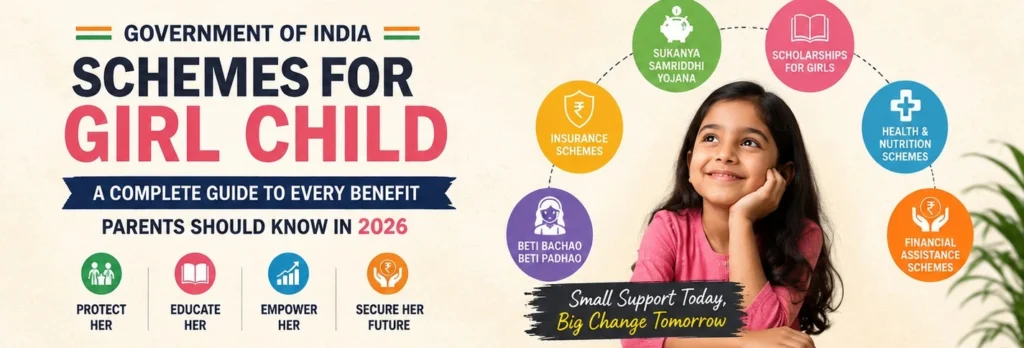
Why These Girls Child Schemes Exist in the First Place
India’s child sex ratio and female literacy numbers have historically lagged behind what a country of this size and ambition should be achieving. Deep-rooted social attitudes that treated daughters as a financial burden rather than an asset contributed directly to underinvestment in girls’ education, nutrition, and long-term financial planning. The Government of India, along with several state governments, responded with a layered approach: awareness campaigns to shift attitudes, direct financial incentives to reduce the economic pressure families feel, and education-linked scholarships to keep girls in school longer. Understanding this layered structure is the key to using these schemes well, since no single program is meant to solve everything on its own.
Beti Bachao Beti Padhao: The Campaign That Started It All
Launched on 22 January 2015 in Panipat, Haryana, Beti Bachao Beti Padhao, commonly shortened to BBBP, is the flagship initiative behind almost every other girl child scheme that followed. It is worth understanding clearly because a lot of parents assume it hands out direct cash, when in reality its real work happens at a policy and awareness level.
BBBP was originally targeted at roughly 640 districts identified as having a low child sex ratio, though its reach has since expanded nationwide. The program focuses on three broad pillars: preventing gender-biased sex selection, ensuring the survival and protection of the girl child, and promoting her education. It runs through community mobilization, training for frontline health and education workers, and multi-sectoral coordination between health, education, and women and child development departments at the district level.
While BBBP itself is not a direct cash transfer scheme, it created the policy umbrella under which Sukanya Samriddhi Yojana and several state-level cash benefit programs were subsequently launched.
Sukanya Samriddhi Yojana: The Most Popular Savings Scheme for a Girl Child
If there is one scheme almost every parent has heard of, it is Sukanya Samriddhi Yojana, widely known by its acronym SSY. It is a small savings scheme run through post offices and authorized banks, and it consistently ranks as one of the highest-yielding government-backed savings instruments available in India, currently offering an interest rate of 8.2 percent per annum, compounded annually.
Here is how it actually works in practice. A parent or legal guardian can open an SSY account in the name of a girl child who is below 10 years of age. Only one account is permitted per girl child, and a family can open accounts for a maximum of two daughters, with an exception made for twins or triplets in certain cases. The account matures 21 years after opening, or earlier if the girl marries after turning 18, and partial withdrawal is permitted once she turns 18 or for documented higher education expenses.
The financial appeal goes beyond the interest rate. Contributions qualify for a tax deduction under Section 80C of the Income Tax Act, and both the interest earned and the maturity amount are entirely tax-free under Section 10(11), making SSY one of the few investment options in India offering this triple tax benefit. According to government data, more than 4.1 crore SSY accounts have been opened since the scheme launched, which gives you a sense of just how widely adopted it has become among Indian families.
Balika Samridhi Yojana: Support for Families Below the Poverty Line
Established in 1997, well before BBBP existed, Balika Samridhi Yojana, or BSY, was designed specifically to support girl children from families living below the poverty line. Under this scheme, families receive a one-time cash benefit at the birth of a girl child, followed by annual scholarships that continue as she progresses through school, right up to the secondary level.
The funds are deposited into a savings account held in the girl’s own name, meaning she gains direct access to accumulated support once she turns 18. This structure was intentional. It gives young women a financial cushion they can use for higher education, vocational training, or even starting a small enterprise, rather than leaving that decision entirely in the hands of other family members.
CBSE Udaan Scheme: Opening the Door to Engineering Education
Female enrollment in engineering and technical colleges in India has historically remained lower than it should be, and the CBSE Udaan Scheme was created specifically to close that gap. Run by the Central Board of Secondary Education in coordination with the Ministry of Education, it targets girl students enrolled in the Physics, Chemistry, and Mathematics stream in Class 11 and 12 at CBSE-affiliated schools.
Selected students receive free study material and video resources, weekend contact classes conducted virtually, peer mentoring support, and a dedicated helpline to resolve academic doubts, all aimed at strengthening their preparation for competitive engineering entrance exams like JEE. Eligibility is merit-based, and the applicant’s annual household income typically needs to fall within a defined ceiling, currently set around 6 lakh rupees, though families should always confirm the latest threshold on the official CBSE portal before applying.
You May Also Like To Read:
- LIC vs SIP: Which Is the Better Investment Option in 2026?
- SIP vs SWP: Which Mutual Fund Strategy Is Right for You? (Complete Guide 2026)
- The 50-30-20 Rule for Indian Salaries: Does It Actually Work in 2026?
- Best Credit Cards in India Right Now: A Complete Guide for Students, Business Owners, Everyday Spenders, and Everyone in Between
- Understanding Stock Market Indices: The Complete Guide to How They Work, What They Measure, and Why They Matter to Every Investor
- PMEGP (Prime Minister Employment Generation Program) Explained
National Scheme of Incentive to Girl Child for Secondary Education
This scheme takes a more targeted approach to a very specific problem: girls dropping out of school right around the transition from elementary to secondary education. Under this program, a girl who continues her studies for at least two years after enrolling in Class IX becomes eligible for a financial incentive, which is designed to offset the immediate cost pressures that often push families to pull daughters out of school during this critical stage.
PM Matru Vandana Yojana: Support That Starts Before the Cash Schemes Do
While not exclusively a girl child scheme, PM Matru Vandana Yojana, or PMMVY, deserves a mention here because of how it is structured to favor families with daughters. The scheme provides five thousand rupees in direct cash assistance for the first child through a maternity benefit, paid in installments tied to pregnancy registration, delivery, and immunization milestones. If the second child born to the family is a girl, an additional six thousand rupees is disbursed, bringing total support for that birth to eleven thousand rupees. This design nudges the financial incentive structure in favor of daughters at a stage even before girl-specific savings schemes come into play.
State-Level Schemes for Girl Child Worth Knowing About
Beyond central government programs, several states run their own girl child welfare schemes, often layered on top of the central schemes rather than replacing them. A few of the most well-known examples include the following.
Mukhyamantri Kanya Sumangala Yojana, run by the Uttar Pradesh government, has recently increased its total grant to twenty-five thousand rupees, paid across six installments tied to key life stages including birth, immunization, entry into Class 1, Class 6, Class 9, and finally graduation. Eligibility requires UP domicile and an annual family income below 3 lakh rupees.
Ladli Lakshmi Yojana, primarily associated with Madhya Pradesh, offers a structured financial benefit to daughters through scholarships and a maturity payout designed to support higher education and reduce the incentive for early marriage.
Financial Assistance for Girl Children Scheme in Uttarakhand provides a fixed deposit in the name of a newborn girl from families below the poverty line, with the principal and accrued interest released once she turns 18 and completes her higher education, capped at two girls per household.
Because these state schemes vary significantly in eligibility, grant amount, and application process, it is worth checking directly with your state’s Women and Child Development department or visiting your nearest Anganwadi center for the most current details relevant to where you live.
How to Apply for These Schemes: A Practical Walkthrough
The application process differs slightly by scheme, but the general path looks similar across most of them. Start by identifying which scheme actually matches your goal, whether that is long-term savings through SSY, school-stage support through BSY or state cash transfer programs, or higher education assistance through CBSE Udaan. Once you know which scheme fits, gather the necessary documents in advance, which typically include the girl child’s birth certificate, address proof, parents’ or guardians’ identity proof, an income certificate where required, and a bank passbook with IFSC details.
Applications can usually be submitted at your nearest post office or authorized bank for savings-linked schemes like SSY, through your local Anganwadi center for maternity and early childhood benefits, or via the relevant state or central government online portal for education-linked schemes. After submission, most schemes allow you to track your application status either at the office where you applied or through the corresponding online portal.
My Take: Which Scheme Should You Actually Prioritize
Having gone through the details of each of these programs, my honest view is that most families overthink this decision. If your daughter is under 10 and you have not opened a Sukanya Samriddhi Yojana account yet, that should be your first move, simply because the combination of a high, government-backed interest rate and full tax exemption on both interest and maturity is genuinely hard to beat anywhere else in the market. It is not a scheme you need to research endlessly; it is one you open and then let compound quietly in the background for two decades.
Everything else should be treated as a layer on top of that foundation rather than a replacement for it. If you belong to a low-income household, actively check whether Balika Samridhi Yojana or your state’s cash transfer scheme applies to you, since that money genuinely reduces the financial pressure of the early years. And if your daughter is heading into Class 11 with an interest in science, do not let the CBSE Udaan Scheme slip under the radar purely because it is less talked about than SSY. The mistake I see most often is parents treating these schemes as a checklist to complete once, when really they work best as a layered plan that you revisit at each stage of your daughter’s life.
Frequently Asked Questions about Indian Government Schemes For Girl Child
Which government scheme is best for a girl child in India? For long-term financial security, Sukanya Samriddhi Yojana is widely regarded as the strongest option because of its high interest rate and full tax exemption. However, the “best” scheme genuinely depends on your specific goal, whether that is savings, school-stage support, or higher education assistance.
What is the age limit to open a Sukanya Samriddhi Yojana account? The account must be opened for a girl child who is below 10 years of age, and it can be opened at any post office or authorized bank across India.
Does Beti Bachao Beti Padhao provide direct cash benefits to families? No. BBBP is primarily an awareness and policy campaign rather than a direct financial assistance scheme. It works alongside other programs like SSY and state-level cash transfer schemes to create financial and social support for girl children.
Can a family open more than one Sukanya Samriddhi Yojana account? A family can open SSY accounts for a maximum of two daughters, with an exception typically made in cases involving twins or triplets.
Are the benefits of Sukanya Samriddhi Yojana taxable? No. Contributions qualify for deduction under Section 80C, and both the interest earned and the final maturity amount are fully tax-free under Section 10(11) of the Income Tax Act, making it one of the very few triple tax-exempt savings instruments in India.
Are state government schemes for the girl child available across all of India? No. Central schemes like SSY and BBBP apply nationwide, but state-specific schemes such as Mukhyamantri Kanya Sumangala Yojana or the Uttarakhand girl child scheme are only available to residents of that particular state, so eligibility depends on your state of domicile.
How can I check the current status of my scheme application? Status can typically be checked at the same office or center where the application was originally submitted, whether that is a post office, bank branch, Anganwadi center, or the relevant government online portal, depending on which scheme you applied for.
Disclaimer
This article is intended for general educational and informational purposes only and does not constitute financial, legal, or professional advice. Scheme names, eligibility criteria, interest rates, grant amounts, and application procedures mentioned in this article are subject to periodic revision by the Central Government and respective State Governments, and were accurate to the best of available information at the time of writing. Interest rates for small savings schemes such as Sukanya Samriddhi Yojana are revised quarterly by the Ministry of Finance. Readers are strongly advised to verify current details directly through official government sources such as india.gov.in, the National Savings Institute, your nearest post office, or your state’s Women and Child Development department before applying for any scheme. This article is not affiliated with or endorsed by any government body. The author and publisher accept no liability for any loss, denial of benefit, or inconvenience arising from reliance on the information provided in this article.

Shuchi founded Finance Checks after spending 16+ years working in corporate, managing operations and distribution. She managed her own finances, learned and read regularly and helped people make sense of their savings, loans, insurance, and investments.
She started this site to offer the kind of clear, honest financial guidance she wished was more available when she was learning to manage her own money. Every article is researched personally, checked against official sources such as the Reserve Bank of India, SEBI, or the Income Tax Department, and revisited whenever regulations or figures change. She is upfront about how the site earns money through ads and select affiliate partnerships, and she does not let either influence what she actually recommends to readers.


[…] Government of India Schemes for the Girl Child: A Complete Guide to Every Benefit Parents Should Kno… […]
[…] to a free, structured coaching ecosystem run by CBSE itself, built specifically to help meritorious girl child from modest income families compete for a seat in engineering colleges like the IITs and NITs on […]