
Old Tax Regime vs New Tax Regime in 2026: The Calculator Question Everyone’s Still Getting Wrong

Last updated: July 2026
About This Guide: Written by the Financechecks.com Editorial Team, Personal Finance Researchers. This article reflects income tax slabs and rules applicable for FY 2025-26 (AY 2026-27) under the Finance Act, 2025, and is reviewed for accuracy as new notifications are issued.
Here’s a bet. If you ask ten salaried people in India which tax regime they’re in right now, at least six will say “the new one, obviously, since income up to ₹12 lakh is tax-free.” Ask them why they picked it, and most will shrug and say something like “everyone says the new regime is better now.”
Here’s the twist: that answer is often right. And also, sometimes, completely wrong. Two people can earn the exact same ₹12 lakh salary, sit in the exact same office, and one of them should genuinely be in the old regime while the other is right to stay in the new one — and the difference between them isn’t luck, it’s three specific numbers almost nobody actually checks.
This is the “calculator question” everyone gets wrong: they plug in their salary, see the new regime’s lower slabs, and stop there. But the real comparison isn’t slabs versus slabs. It’s slabs versus slabs plus deductions. Skip that second half, and you could be quietly overpaying tax every single year without realising it.
Let’s fix that, one layer at a time — starting from zero, assuming you’ve never filed a return before.
The One-Line Version, For Anyone in a Hurry
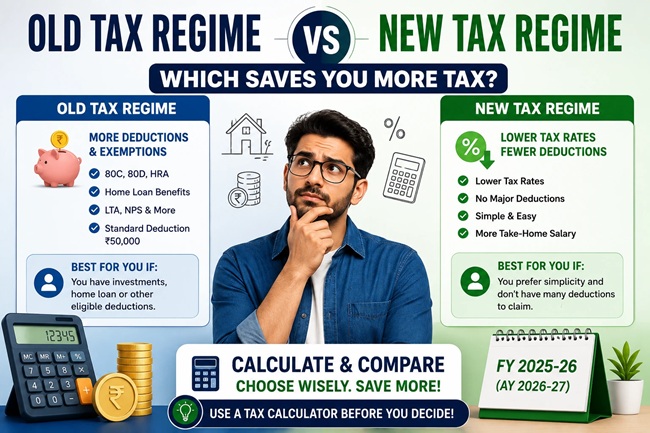
The new tax regime has lower tax rates but lets you claim almost no deductions. The old tax regime has higher tax rates but lets you claim a long list of deductions — HRA, Section 80C investments, health insurance, home loan interest, and more. Whichever regime results in a lower final tax number, after accounting for what you’d actually claim, is the one you should pick. There is no universal winner — it depends entirely on your income and how many genuine deductions you have.
Now let’s actually understand why, because the “why” is what stops you from guessing wrong next year.
Wait — I Get to Choose My Tax Regime?
Yes, and if this is news to you, you’re not alone. Since FY 2023-24, India runs two parallel tax systems side by side, and every individual taxpayer gets to pick which one applies to them, every single year, at the time of filing their ITR.
Here’s the part that trips people up the most: the new regime is now the automatic default. If you don’t actively tell your employer or the Income Tax Department that you want the old regime, you’re placed in the new one without anyone asking you. This is exactly opposite to how it worked a few years ago, when the old regime was the default and you had to actively opt into the new one. If you’ve been assuming your regime never changed, it’s worth double-checking — the ground shifted under everyone’s feet, quietly.
If you’re salaried, you generally declare your regime preference to your employer at the start of the financial year (this determines how much TDS is deducted from your salary each month), but you can still make a final, different choice when you actually file your ITR — so an early declaration to your employer isn’t locked in forever.
The New Regime: Lower Rates, Almost No Deductions
Here’s what the new regime’s tax slabs actually look like for FY 2025-26 (AY 2026-27):
| Income Slab | Tax Rate |
|---|---|
| ₹0 – ₹4,00,000 | Nil |
| ₹4,00,001 – ₹8,00,000 | 5% |
| ₹8,00,001 – ₹12,00,000 | 10% |
| ₹12,00,001 – ₹16,00,000 | 15% |
| ₹16,00,001 – ₹20,00,000 | 20% |
| ₹20,00,001 – ₹24,00,000 | 25% |
| Above ₹24,00,000 | 30% |
Two things make this regime look deceptively generous, and they’re both worth understanding properly:
The Section 87A rebate. If your total taxable income doesn’t exceed ₹12 lakh, you get a rebate of up to ₹60,000 that effectively wipes out your entire tax liability. This is not the same as an exemption limit — you’re technically taxed according to the slabs above, and then the rebate cancels out the tax, bringing your final bill to zero.
The standard deduction. Salaried employees and pensioners also get a flat ₹75,000 standard deduction under the new regime, deducted straight from gross salary before any tax calculation happens. Combined with the rebate, this pushes the real tax-free threshold for a salaried person up to ₹12.75 lakh, not just ₹12 lakh.
Beyond the standard deduction, the new regime allows very few other claims — mainly your employer’s contribution to NPS under Section 80CCD(2), and interest on a home loan specifically for a let-out (rented out) property, not your own home. HRA, the familiar ₹1.5 lakh Section 80C basket (PPF, ELSS, life insurance premiums), Section 80D health insurance premiums, and home loan interest on a self-occupied house are all off the table here.
You May Also Like To Read:
- Filing ITR After Selling Shares, Gold or Property? Here’s Exactly What to Check on Your Capital Gains
- NPS Explained: The Retirement Scheme That Could Save You ₹15,000 in Tax This Year
- Tax Planning for Salaried Employees: A Complete Guide to Saving More of What You Earn (FY 2026-27)
- New HRA Rules 2026
- Your First Salary, Your First ITR: A No-Nonsense Guide to Income Tax, Sections, and Smart Tax-Saving in 2026
The Old Regime: Higher Rates, But a Long Deduction Toolkit
The old regime’s slabs, by contrast, haven’t changed in years:
| Income Slab | Tax Rate |
|---|---|
| ₹0 – ₹2,50,000 | Nil |
| ₹2,50,001 – ₹5,00,000 | 5% |
| ₹5,00,001 – ₹10,00,000 | 20% |
| Above ₹10,00,000 | 30% |
At first glance this looks worse everywhere — and on the slabs alone, it is. But the old regime is built around one core idea: it rewards you for saving, investing, insuring, and borrowing responsibly, by letting you subtract a meaningful chunk of your income before any tax is calculated at all. The major deductions available include:
- Standard deduction of ₹50,000 for salaried individuals and pensioners
- Section 80C, up to ₹1.5 lakh, covering PPF, ELSS mutual funds, life insurance premiums, EPF contributions, and children’s tuition fees
- HRA (House Rent Allowance), exempting a portion of your rent if you live in rented accommodation — genuinely one of the largest deductions for people renting in metro cities
- Section 80D, for health insurance premiums paid for yourself, your family, and your parents
- Section 24(b), allowing up to ₹2 lakh in home loan interest deduction on a self-occupied property
- Section 87A rebate as well, though a much smaller one here — up to ₹12,500, applicable only if your taxable income doesn’t exceed ₹5 lakh
Stack enough of these together, and the old regime’s higher rates can end up taxing a much smaller number than the new regime does — sometimes small enough to beat the new regime’s lower rates on a bigger number.
Here’s the Part the Calculator Question Actually Misses
Most people compare regimes by asking “which one has lower tax rates for my income level?” That’s the wrong question. The right one is: “After I subtract my real, genuine deductions, which regime leaves me with the smaller final tax bill?”
This is where a rough concept called the break-even point becomes useful — the total amount of deductions at which the old regime starts winning over the new regime for a given income level. Below that break-even amount of deductions, stick with the new regime. Above it, the old regime pulls ahead.
As a general (not universal) pattern across recent tax years, once your total genuine deductions — HRA, 80C, 80D, home loan interest, and so on combined — start crossing somewhere in the range of ₹4-5.5 lakh, the old regime tends to become the better choice, particularly at higher income levels. Below that, the new regime’s lower rates and larger rebate usually win. This range isn’t a fixed rule — it shifts depending on your exact income — which is exactly why “everyone says new regime is better” is bad advice dressed up as good advice. It’s true for a lot of people. It’s not true for everyone.
Two Real Examples, Side by Side
Example 1: Rohan, ₹12 lakh salary, no major deductions
Rohan is a few years into his job, lives with his parents (no HRA claim), hasn’t started serious 80C investments yet, and has a basic health insurance policy through his employer.
- Under the new regime: with the ₹75,000 standard deduction, his taxable income is ₹11.25 lakh — comfortably under ₹12 lakh, so the Section 87A rebate wipes out his tax entirely. Tax payable: ₹0
- Under the old regime: with just the ₹50,000 standard deduction and no other significant claims, his taxable income remains close to ₹11.5 lakh, well above the old regime’s much smaller ₹5 lakh rebate ceiling, resulting in a real, substantial tax bill
For Rohan, the new regime isn’t just slightly better — it’s the obvious, overwhelming choice.
Example 2: Priya, ₹15 lakh salary, renting in a metro city with a home loan
Priya pays significant rent (large HRA claim), invests the full ₹1.5 lakh under Section 80C, pays a family health insurance premium claimable under 80D, and pays home loan interest on a self-occupied flat.
- Under the new regime: only her ₹75,000 standard deduction applies. Her taxable income stays high, and she’s taxed across the 5%, 10%, and 15% slabs on a large base
- Under the old regime: after stacking her HRA exemption, ₹1.5 lakh under 80C, her 80D premium, and up to ₹2 lakh in home loan interest, her taxable income can drop by several lakh rupees — potentially enough to bring her old regime tax bill below what she’d pay under the new regime’s lower rates on a much bigger taxable amount
For Priya, running both numbers actually matters, because the answer isn’t obvious just by looking at the slab tables.
How to Actually Check This for Yourself
You don’t need to do this math by hand. The Income Tax Department provides an official online tax regime comparison calculator, and most reputable financial platforms in India offer a similar tool. The process, either way, is the same:
- List your genuine deductions honestly — actual rent paid (if applicable), actual 80C investments already made or planned, actual health insurance premiums, actual home loan interest, if any. Don’t estimate optimistically; use real numbers
- Enter your gross salary and these deduction figures into a regime comparison calculator
- Compare the two final tax numbers it produces, side by side
- Pick the lower one — and if you’re salaried, communicate this choice to your employer for TDS purposes, then confirm it again at the time of actual ITR filing
Doing this once a year, rather than assuming last year’s answer still holds, is genuinely the single highest-leverage five minutes you can spend during tax season.
Common Mistakes People Make With This Decision
- Assuming the new regime is automatically better because it’s the default. Default doesn’t mean optimal — it just means what happens if you do nothing
- Estimating deductions optimistically instead of using real numbers. If you’re not actually going to invest the full ₹1.5 lakh under 80C or don’t genuinely have a home loan, don’t include it in your comparison — it’ll give you a misleading answer
- Forgetting that the choice can be revisited every year (for salaried individuals). Your circumstances change — a new home loan, a jump in rent, a new insurance policy — and last year’s optimal regime might not be this year’s
- Assuming business owners and salaried employees follow the same switching rules. Individuals with business or professional income face restrictions on how often they can switch back and forth between regimes, unlike salaried taxpayers who can choose freely each year
- Ignoring marginal relief near the ₹12 lakh threshold. If your taxable income is just slightly above ₹12 lakh under the new regime, a rule called marginal relief limits your tax so it doesn’t jump disproportionately — worth checking specifically if your income sits close to that line
Which One Should You Actually Choose?
If you have few or no significant deductions — you don’t pay rent that qualifies for HRA, you haven’t built up 80C investments, and you don’t have a home loan — the new regime is very likely your better option, largely because of the higher ₹12.75 lakh effective tax-free threshold for salaried individuals.
If you’re paying meaningful rent, actively investing under 80C, carrying health insurance premiums for your family, and paying interest on a home loan, don’t assume the new regime automatically wins just because everyone says so. Run the actual numbers — it takes a few minutes, and for a moderate-to-high income with real deductions, the old regime can still come out ahead.
Frequently Asked Questions
1. Which tax regime is better for a salary of ₹12 lakh? For most people with no major deductions, the new regime is better at this income level, since the ₹75,000 standard deduction plus the Section 87A rebate makes income up to ₹12.75 lakh effectively tax-free for salaried individuals. If you have significant HRA, 80C, or home loan interest claims, it’s still worth calculating the old regime figure before deciding.
2. Is income up to ₹12 lakh really tax-free under the new regime? Yes, for resident individuals, taxable income up to ₹12 lakh is effectively tax-free due to the Section 87A rebate of up to ₹60,000. For salaried individuals, the additional ₹75,000 standard deduction raises this effective threshold to ₹12.75 lakh of gross salary.
3. Does the new tax regime allow HRA and Section 80C deductions? No. HRA exemption, the Section 80C basket (PPF, ELSS, life insurance, etc.), and home loan interest on a self-occupied property are not available under the new regime. The new regime allows only a small list of deductions, primarily the standard deduction, employer’s NPS contribution under Section 80CCD(2), and interest on a home loan for a let-out property.
4. What is the break-even point between old and new tax regime? It’s the level of total deductions at which the old regime’s tax liability becomes equal to, and then lower than, the new regime’s. As a general pattern, once combined deductions (HRA, 80C, 80D, home loan interest) start crossing roughly ₹4-5.5 lakh, the old regime tends to become more favourable, though this varies by income level and should be checked with an actual calculator.
5. Can I switch between the old and new tax regime every year? Salaried individuals with no business or professional income can choose freely between the two regimes every financial year at the time of filing their ITR. Individuals with business or professional income face restrictions and generally get only a limited, one-time option to switch back to the new regime after opting for the old one.
6. What happens if I don’t choose a regime at all? You’re automatically placed under the new tax regime, since it has been the default option for individual taxpayers since FY 2023-24. If you want the old regime, you need to actively opt for it, either through your employer’s declaration process or at the time of filing your ITR.
7. Is the old tax regime being phased out? As of FY 2025-26, the old regime remains available as an active choice for individual taxpayers, though the new regime has been made progressively more attractive through recent budgets and is positioned as the primary regime going forward. It’s worth checking official government announcements each year, since tax policy can change.
8. How do I know which deductions I can actually claim under the old regime? The major ones include the ₹50,000 standard deduction, HRA (if you pay rent and receive a house rent allowance from your employer), up to ₹1.5 lakh under Section 80C for eligible investments, health insurance premiums under Section 80D, and up to ₹2 lakh in home loan interest under Section 24(b) for a self-occupied property. Each has its own specific eligibility conditions worth checking individually.
9. Does choosing a regime affect my monthly take-home salary? Yes, indirectly. The regime you declare to your employer determines how much TDS (Tax Deducted at Source) is withheld from your salary each month. Choosing incorrectly can mean either paying more tax upfront than necessary (recoverable as a refund when you file your ITR) or under-withholding, which could mean a larger tax outflow at filing time.
10. Is there a government tool to compare both regimes? Yes. The Income Tax Department provides an official online tax regime comparison calculator that lets you input your income and deductions to see the tax liability under both regimes side by side. Several reputable financial platforms also offer similar comparison calculators.
Final Thoughts
The old-versus-new regime question isn’t really about which system is “better” in some absolute sense — it’s about which one is better for the specific set of numbers that make up your financial life this year. A default exists precisely so that people who don’t want to think about it still end up somewhere reasonable. But “reasonable for most people” and “optimal for you” aren’t always the same thing.
The good news is that getting this right doesn’t require a finance degree — it requires five honest minutes with a calculator and your actual numbers, once a year, rather than carrying forward an assumption from a friend, a colleague, or last year’s decision. Do that once, and you’ll never have to wonder again whether you’re one of the people quietly leaving money on the table.
Disclaimer: This article is for general informational and educational purposes only and should not be treated as tax or financial advice. Income tax slabs, rebate limits, deduction rules, and thresholds mentioned above reflect the Finance Act, 2025 as applicable to FY 2025-26 (AY 2026-27), and are subject to change through future government notifications and Budget announcements. Please verify current provisions on the official Income Tax Department portal (incometax.gov.in) and consult a qualified Chartered Accountant or tax advisor before choosing a regime or filing your return.

Shuchi founded Finance Checks after spending 16+ years working in corporate, managing operations and distribution. She managed her own finances, learned and read regularly and helped people make sense of their savings, loans, insurance, and investments.
She started this site to offer the kind of clear, honest financial guidance she wished was more available when she was learning to manage her own money. Every article is researched personally, checked against official sources such as the Reserve Bank of India, SEBI, or the Income Tax Department, and revisited whenever regulations or figures change. She is upfront about how the site earns money through ads and select affiliate partnerships, and she does not let either influence what she actually recommends to readers.



-
-
-
-
-
-
Show Comments[…] Old Tax Regime vs New Tax Regime in 2026: The Calculator Question Everyone’s Still Getting Wrong […]
[…] 65 percent line is the single most important number in this entire topic, because it decides which tax regime you fall […]
[…] a perquisite, taxed as salary income under Section 17(2)(vi) of the Income Tax Act, at your regular income tax slab […]
[…] non-speculative business income under Section 43(5)(d) of the Income Tax Act, taxed at your regular income tax slab rate, not at the capital gains rates that apply to stock investments. If you’ve been mentally […]
[…] in turn reduces the tax you owe. This deduction is available only if you file your return under the old tax regime; it cannot be claimed under the new tax regime introduced under Section 115BAC. Donations must be […]
[…] but a mandatory annuity requirement on 40 percent of the corpus at retirement. Crucially, under the new tax regime, which is now the default, most of the Section 80C and 80CCD(1B) tax benefits tied to these […]