
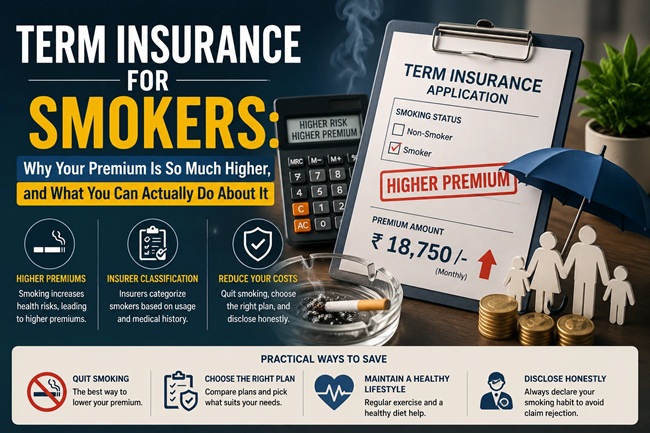
Term Insurance for Smokers: Why Your Premium Is So Much Higher, and What You Can Actually Do About It

If you smoke, even occasionally, and you have ever run a term insurance quote online, you already know the sting. You enter your age, income, and coverage amount, get a friendly little premium number, and then you tick the box that says “do you use tobacco” and watch that number jump. For a lot of people this is the moment they either quietly close the tab or start Googling whether insurers are just overcharging smokers for no real reason.
They are not. But the reasoning behind it, and more importantly what you can actually do to bring that number down, is something most guides either skip entirely or bury under generic advice like “quit smoking, live healthy.” Let’s actually dig into it properly.
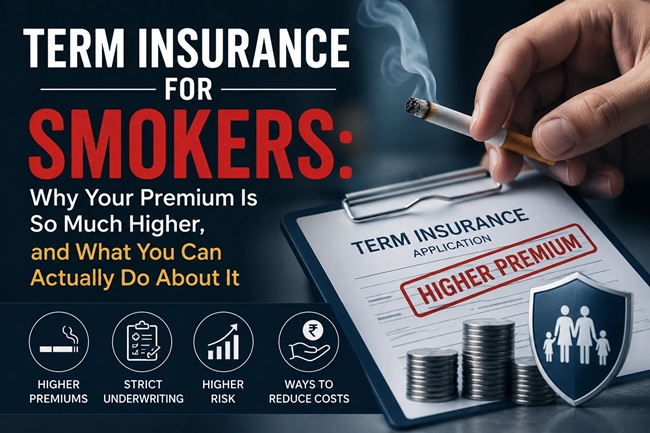
Why Term Insurance For Smokers is High in The First Place
Term insurance is priced almost entirely on one question: how likely is the insurer to have to pay out, and how soon. Smoking and tobacco use are directly linked to a higher risk of heart disease, several forms of cancer, and lung conditions, all of which shorten life expectancy on average. Insurers use decades of actuarial data, meaning statistical death-rate data across large groups of people, to price this risk. A smoker, statistically, is more likely to trigger a claim earlier than a non-smoker of the same age, so the insurer charges more to balance that risk across their entire pool of policyholders.
This is not a moral judgment or a penalty. It is closer to how a car insurer charges more for a sports car than a hatchback. The insurer is not upset at you for smoking, it is simply pricing the statistical likelihood of a payout.
How Much More Do Smokers Actually Pay
This is where most guides get vague, so let’s be specific. Based on current data from Indian insurers, smokers typically pay anywhere between 40 percent and 100 percent more than a non-smoker of the same age, gender, and coverage amount. In some cases, particularly for older applicants or larger sum assured amounts, the gap can stretch even further.
To put real numbers on it, a healthy 25 year old male non-smoker might get one crore rupees of term cover, valid until age 60, for somewhere around 587 rupees a month. A smoker of the same age and profile applying for the identical cover has been quoted closer to 990 rupees a month for that same policy. That is nearly a 70 percent jump for identical coverage, purely based on tobacco use.
The gap tends to widen further as you get older, since age and smoking-related health risk compound each other. This is one of the most important things to understand: waiting to buy term insurance does not just cost you the delay, it costs you the delay plus a widening smoker penalty on top of it.
Who Actually Counts As A Smoker
This surprises a lot of people. You do not need to smoke a pack a day to be classified as a smoker by an insurer. Most Indian insurers define a smoker or tobacco user as anyone who has consumed any tobacco or nicotine product, including cigarettes, bidis, cigars, chewing tobacco like gutkha or khaini, hookah, nicotine gums or patches, or e-cigarettes and vapes, within a certain look-back period before applying. That look-back period is typically the past 12 months, though some insurers extend it to 24 months.
This means someone who smoked occasionally at social gatherings, or who quit eight months ago, will very likely still be classified and priced as a smoker. Occasional use is not treated differently from daily use in most underwriting models, though within the smoker category itself, insurers do sometimes split applicants into tiers, commonly called preferred smoker, standard smoker, and higher risk categories, based on overall health markers like blood pressure, BMI, and any related medical conditions.
You May Also Like To Read:
How Insurers Actually Verify This
You might wonder whether you could simply mark yourself as a non-smoker and save the money. This is a genuinely bad idea, and here is exactly why it does not work the way people hope.
Most term insurance applications above a certain coverage amount require a medical examination, and that exam typically includes a test for cotinine, which is a chemical byproduct your body produces when it processes nicotine. Cotinine stays detectable in urine for several days up to a few weeks depending on how much and how recently you smoked, and can show up in blood and saliva tests as well. Insurers also cross-check applications against your medical history and prescription records where available.
If a discrepancy is caught during underwriting, the insurer will simply reclassify you as a smoker and adjust your premium, or in some cases deny the application. The bigger risk shows up later. If false non-disclosure is discovered after a claim is filed, meaning after the policyholder has passed away and the family is trying to receive the payout, insurers can legally reject the claim entirely on grounds of misrepresentation. This is one of the most common real-world reasons genuine claims get denied, and it is entirely avoidable by simply disclosing your smoking status honestly at the time of purchase.
What You Can Actually Do About The Higher Premium
This is the part most articles skip past with a vague “just quit smoking” line. Here is what actually moves the number, in order of how much control you realistically have over it.
Buy your policy as early as possible. Since premiums rise with age regardless of smoking status, and the smoker gap widens with age too, locking in a rate at 28 costs meaningfully less than waiting until 38, even before factoring in tobacco use. If you are a smoker today, this is arguably the single biggest lever you have, because the premium you lock in generally stays fixed for the entire policy term.
Compare quotes across multiple insurers before buying. This is the most underused strategy, and it works because smoker underwriting is far less standardized across companies than non-smoker underwriting. Two insurers looking at an identical health and smoking profile can price it very differently, sometimes by 30 to 40 percent, because each company weighs smoking risk using its own actuarial models. Getting quotes from at least three to five insurers before committing can meaningfully change your final premium.
Actually quit, and stay quit long enough to matter. Most Indian insurers will reclassify an existing or new policyholder as a non-smoker only after a sustained tobacco-free period, commonly 12 months, though some insurers require up to 24 months, along with a fresh medical test confirming it. This is not an overnight fix, but for someone in their late twenties or thirties looking at several more decades of paying premiums, going through this process once can lower costs for the entire remaining term.
Be completely honest on your application. It genuinely is not worth misrepresenting your smoking status to save on premium, given that it puts your family’s entire payout at risk later. If anything, full disclosure combined with shopping around across insurers tends to get you a far better real-world outcome than hiding it and hoping the underwriting process misses it.
Consider your coverage structure carefully. Since the percentage gap between smoker and non-smoker rates tends to be fairly consistent regardless of coverage size, some financial planners suggest smokers should not under-buy coverage just to manage the premium. A lower sum assured to save money defeats the actual purpose of the policy, which is to adequately protect your family’s financial future.
Follow us on Instagram and Youtube and don’t miss the regular updates.
A Quick Word On Health Insurance Too
While this article focuses on term life insurance, it is worth knowing that health insurance premiums follow a similar logic for smokers, generally running 30 to 40 percent higher, and here too, a sustained quit period, typically around two years for health insurance, can eventually help bring costs down.
The Bottom Line
Smokers are not being unfairly targeted, they are being priced according to real, data-backed risk. But the good news is that this pricing is not permanent or fixed. Buying early, comparing insurers instead of accepting the first quote, being fully honest during underwriting, and genuinely quitting long enough to qualify for reclassification are all real, practical ways to bring your premium down over time, rather than simply accepting the higher number as unavoidable.
Frequently Asked Questions About Term Insurance for Smokers
How much more do smokers pay for term insurance in India?
Smokers typically pay between 40 percent and 100 percent more than non-smokers for identical coverage, with the exact gap depending on age, coverage amount, and the specific insurer’s underwriting policy.
Does occasional smoking count, or only daily smokers?
Most insurers classify anyone who has used any tobacco or nicotine product within the past 12 to 24 months as a smoker, regardless of frequency. Even occasional or social smoking typically results in smoker pricing.
Do vapes and e-cigarettes count as smoking for insurance purposes?
Yes. Nearly all insurers treat e-cigarettes, vapes, and nicotine pouches the same as traditional cigarettes for underwriting purposes, since they still involve nicotine consumption.
Can I lie about being a smoker to get a lower premium?
This is strongly discouraged. Insurers verify tobacco use through medical exams, cotinine testing, and medical records. If discovered later, particularly at the time of a claim, it can lead to the entire claim being rejected, leaving your family without the payout the policy was meant to provide.
How long do I need to quit smoking before my premium goes down?
Most insurers require a minimum of 12 months of being completely tobacco-free, verified through a fresh medical test, before reclassifying you as a non-smoker. Some insurers require up to 24 months.
Will my existing policy premium automatically drop if I quit smoking?
No, it is not automatic. You typically need to proactively contact your insurer, undergo fresh underwriting or a medical test, and request reclassification once you meet their tobacco-free period requirement.
Should I wait until I quit smoking to buy term insurance?
Generally, no. Since premiums also rise with age, waiting years to quit before buying often costs more overall than buying now at smoker rates and later switching to non-smoker rates once eligible. Buying protection early is usually more important than waiting for a lower rate.
Do all insurers charge the same extra amount for smokers?
No. Smoker premium loading varies significantly between insurers, since each company uses its own risk models. This is exactly why comparing quotes from multiple insurers before buying is one of the most effective ways to reduce cost.
Disclaimer
This article is intended for general educational purposes only and does not constitute financial, insurance, or medical advice. Premium figures, percentages, and reclassification timelines mentioned here are based on publicly available information and industry-reported ranges as of 2026, and actual terms vary by insurer, individual health profile, coverage amount, and policy conditions. Insurance products, underwriting rules, and pricing change over time and differ between providers. Readers should independently verify current terms directly with insurers or a licensed insurance advisor, and consult a qualified financial advisor before making any insurance or financial decisions. This article does not endorse any specific insurance company or product.

Shuchi founded Finance Checks after spending 16+ years working in corporate, managing operations and distribution. She managed her own finances, learned and read regularly and helped people make sense of their savings, loans, insurance, and investments.
She started this site to offer the kind of clear, honest financial guidance she wished was more available when she was learning to manage her own money. Every article is researched personally, checked against official sources such as the Reserve Bank of India, SEBI, or the Income Tax Department, and revisited whenever regulations or figures change. She is upfront about how the site earns money through ads and select affiliate partnerships, and she does not let either influence what she actually recommends to readers.