

Term Insurance vs Whole Life Insurance: Which Actually Protects Your Family

Rajat’s insurance agent uncle had one consistent piece of advice every family gathering: buy a policy that “gives your money back.” So when Rajat turned 28 and finally got serious about life insurance, he leaned toward a whole life plan that promised coverage till age 99 along with some cash value building up over time. It felt like the responsible, complete choice. It was only years later, comparing notes with a colleague who’d bought a pure term plan for a fraction of the premium and invested the difference himself, that Rajat realized “getting money back” had quietly cost him a lot more protection than he actually had.
This mix-up is extremely common, and it usually comes down to one core misunderstanding: term insurance and whole life insurance aren’t really two versions of the same product. They’re solving two different problems, and conflating them is how a lot of Indian families end up underinsured while paying premiums that feel substantial.
What Term Insurance Actually Is
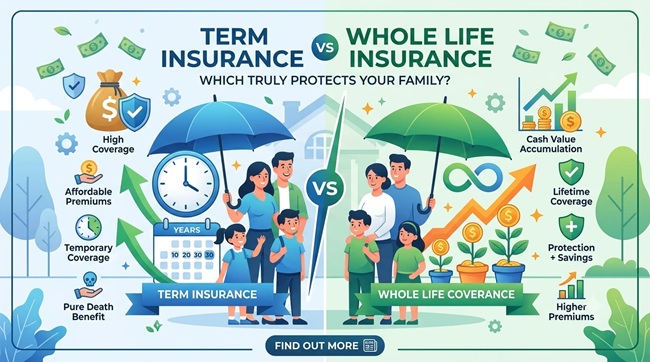
Term insurance is pure protection. You pay a premium, and if you pass away during the policy term, your nominee receives the full sum assured. If you outlive the term, there’s typically no payout at all, unless you’ve specifically chosen a return-of-premium variant, which comes at a meaningfully higher cost. There’s no savings component, no cash value, no investment element bundled in. You’re purely paying for the risk cover, which is exactly why it’s so much cheaper than other forms of life insurance for the same sum assured.
To put real numbers on this, a healthy 30-year-old non-smoking male can typically get a 1 crore rupee term cover, running until around age 60, for somewhere between 8,000 and 15,000 rupees a year, depending on the insurer, policy term, and specific health profile. That works out to roughly 700 to 1,250 rupees a month for a full crore of protection, an amount most working professionals can comfortably fit into a monthly budget.
What Whole Life Insurance Actually Is
Whole life insurance, sometimes marketed as coverage till age 99 or 100, bundles life-long protection with a savings or investment component. A portion of your premium goes toward the death benefit, and a portion builds cash value over time, which you can sometimes borrow against, or which contributes to a maturity payout if you’re still alive when the policy matures at the specified age.
Because whole life insurance is doing two jobs at once, insuring you and building a cash value, the premiums are considerably higher than a term plan offering the same sum assured. Exact multiples vary significantly by insurer and specific plan structure, but as a general pattern, whole life and endowment-style plans consistently cost several times more than a comparable term plan for the same death benefit, precisely because a meaningful chunk of every premium is going toward the savings component rather than pure risk cover.
The Core Tradeoff: Coverage Amount vs Coverage Feel
This is really the heart of the comparison. For the same monthly budget, term insurance lets you buy a dramatically larger sum assured than whole life insurance does, simply because none of your premium is being diverted into a savings bucket. If your actual goal is making sure your family can replace your income, pay off a home loan, and maintain their lifestyle if something happens to you, a large term cover does that job more efficiently, rupee for rupee, than a whole life policy with a smaller death benefit for the same premium.
Whole life insurance can feel more appealing because it doesn’t feel like “wasted” money if you survive the term, you’re not just paying for protection you might never use. But this feeling often comes at the cost of being meaningfully underinsured, since most families end up choosing a smaller sum assured to keep the whole life premium affordable, precisely when a bigger safety net matters most.
Where Whole Life Insurance Genuinely Makes Sense
To be fair, whole life insurance isn’t without a real use case. If your goal shifts from pure income protection toward estate planning or leaving a guaranteed legacy for your children or grandchildren regardless of when you pass away, even at age 85 or 90, a whole life policy’s lifelong coverage window does something a term plan, which usually ends around age 60 to 70, simply can’t. It can also appeal to more conservative savers who want a guaranteed, low-risk component attached to their insurance, rather than separately managing a term plan and a separate investment.
The honest tradeoff here is cost efficiency versus convenience and legacy planning. If your priority is maximizing protection per rupee spent during your working years, term wins clearly. If your priority is guaranteed lifelong coverage bundled with a savings element, and you’re comfortable paying considerably more for it, whole life has a legitimate place.
What Financial Planners Commonly Recommend Instead
A widely recommended approach, often called “buy term and invest the rest,” is to purchase a large term insurance policy for pure protection and separately invest the premium difference, compared to what a whole life policy would have cost, into mutual funds or other market-linked instruments. Over a long horizon, this combination frequently outperforms a whole life policy’s cash value growth, while also giving you a larger death benefit during your working years when your family’s financial dependence on your income is highest.
This isn’t a universal rule for every situation, but it’s worth running the actual numbers, comparing a term plan’s cost plus a separate SIP against a whole life policy’s premium and projected cash value, before assuming the “all-in-one” option is automatically the better deal.
Term vs Whole Life at a Glance
| Factor | Term Insurance | Whole Life Insurance |
|---|---|---|
| Coverage duration | Fixed term, typically till age 60-70 | Lifelong, often till age 99 or 100 |
| Premium for same sum assured | Significantly lower | Significantly higher |
| Savings or cash value component | None | Yes, builds over time |
| Payout if you outlive the policy | Usually none, unless return-of-premium variant | Maturity benefit or cash value payout |
| Best suited for | Income replacement during working years | Legacy planning, guaranteed lifelong cover |
| Cost efficiency per rupee of cover | High | Lower |
| GST on premium | 0%, exempt since September 22, 2025 (individual policies) | 0%, exempt since September 22, 2025 (individual policies) |
The Tax Side of Both
Both term and whole life insurance premiums qualify for a deduction under Section 80C, up to 1.5 lakh rupees per financial year combined with your other 80C investments, and the death benefit paid to your nominee is tax-exempt under Section 10(10D) in both cases, subject to policy conditions.
An important recent change worth knowing: individual life insurance premiums, including term, whole life, endowment, and ULIP policies, have been exempt from GST since September 22, 2025, following the government’s GST 2.0 reforms. Before this, premiums attracted 18 percent GST, so this exemption has made both types of policies meaningfully cheaper than they were previously. It’s worth noting this exemption applies specifically to individual policies, group insurance policies, typically the kind offered through an employer, still attract the standard 18 percent GST.
About This Guide
This article uses commonly cited term insurance premium ranges for a healthy 30-year-old non-smoking male with 1 crore rupee cover, and general industry patterns for whole life insurance pricing relative to term plans, current as of 2026. Exact premiums for both policy types vary significantly by insurer, age, health profile, sum assured, and policy structure, so please get personalised quotes from multiple insurers before making a decision. This article also reflects the GST exemption on individual life insurance premiums effective from September 22, 2025.
Common Mistakes People Make Choosing Between These
Choosing a smaller sum assured just to make a whole life policy fit the budget is probably the most damaging mistake, since it directly undermines the core purpose of the insurance, adequate protection for your family, in exchange for a savings feature you may not actually need attached to your life cover.
Another common mistake is assuming term insurance is “wasted money” if you survive the policy term. This framing misses the point of insurance entirely. You don’t regret not needing your car insurance after a year of safe driving. Term insurance works the same way, you’re paying for protection against a risk, not for a guaranteed return.
People also frequently underestimate how much of their whole life premium is going toward the savings component versus the actual insurance cost, without comparing what that same amount could earn if invested separately through a disciplined SIP alongside a much cheaper term plan.
Finally, some buyers delay purchasing either type of policy while deciding between them, not realizing that premiums, especially for term insurance, rise meaningfully with age. The cost of waiting a few extra years to decide often exceeds any benefit gained from further deliberation.
My Take
If your primary goal is protecting your family’s financial future during your working years, and for most people with dependents, a home loan, or young children, that is the goal, term insurance does that job more efficiently than whole life insurance, almost every time. The “get your money back” appeal of whole life insurance is emotionally understandable, but it usually means buying less actual protection for the same budget. If legacy planning or guaranteed lifelong coverage genuinely matters to you beyond your working years, whole life has a place, but I’d treat it as a deliberate, separate decision from your core income-protection need, not a replacement for adequate term cover.
Frequently Asked Questions
1. What is the main difference between term insurance and whole life insurance? Term insurance provides pure death benefit protection for a fixed period with no savings component, while whole life insurance provides coverage for your entire life, often till age 99 or 100, along with a cash value or savings element, at a significantly higher premium.
2. Which is cheaper, term insurance or whole life insurance? Term insurance is significantly cheaper for the same sum assured, since none of the premium goes toward a savings or investment component, unlike whole life insurance.
3. How much does a 1 crore term insurance policy cost in India? For a healthy 30-year-old non-smoking male, a 1 crore rupee term cover until around age 60 typically costs between 8,000 and 15,000 rupees per year, though this varies by insurer, health profile, and policy term.
4. Does term insurance pay out if I survive the policy term? Generally, no, unless you’ve specifically chosen a return-of-premium variant, which costs considerably more than a standard term plan.
5. Is GST applicable on life insurance premiums in India? No, individual life insurance premiums, including term, whole life, endowment, and ULIP policies, have been exempt from GST since September 22, 2025. Group insurance policies, typically offered through employers, still attract 18 percent GST.
6. Can I claim tax benefits on both term and whole life insurance premiums? Yes, both qualify for deduction under Section 80C, up to 1.5 lakh rupees per financial year combined with other eligible investments, and the death benefit is tax-exempt under Section 10(10D) in both cases, subject to policy conditions.
7. Is “buy term and invest the rest” actually a good strategy? For many people, yes, since it typically provides larger protection during working years combined with the potential for higher long-term growth through separate investments, compared to a whole life policy’s bundled cash value. It requires the discipline to actually invest the premium difference consistently.
8. Who should consider whole life insurance over term insurance? Those primarily focused on legacy planning, guaranteed lifelong coverage beyond typical working years, or who prefer a bundled, low-risk savings component attached to their insurance, and who are comfortable paying a significantly higher premium for it.
9. Does whole life insurance build cash value I can access? Yes, many whole life policies build a cash value over time that can sometimes be borrowed against or contributes to a maturity payout, depending on the specific policy structure.
10. How much life insurance cover do I actually need? A common guideline suggests coverage of roughly 10 to 15 times your annual income, though the right amount depends on your outstanding liabilities, dependents, and future financial goals, and is worth calculating specifically for your situation rather than relying on a flat multiple alone.
Disclaimer
This article is for informational and educational purposes only and does not constitute financial or insurance advice. Premium figures cited are illustrative and based on commonly reported ranges for specific age and health profiles; actual premiums vary by insurer, individual health, lifestyle, and policy terms. Tax benefits are subject to conditions under the Income Tax Act and may change with future amendments. Please compare quotes from multiple insurers and consult a qualified financial advisor before purchasing a life insurance policy.

Shuchi founded Finance Checks after spending 16+ years working in corporate, managing operations and distribution. She managed her own finances, learned and read regularly and helped people make sense of their savings, loans, insurance, and investments.
She started this site to offer the kind of clear, honest financial guidance she wished was more available when she was learning to manage her own money. Every article is researched personally, checked against official sources such as the Reserve Bank of India, SEBI, or the Income Tax Department, and revisited whenever regulations or figures change. She is upfront about how the site earns money through ads and select affiliate partnerships, and she does not let either influence what she actually recommends to readers.



[…] Term Insurance vs Whole Life Insurance: Which Actually Protects Your Family […]
[…] Term Insurance vs Whole Life Insurance: Which Actually Protects Your Family […]