
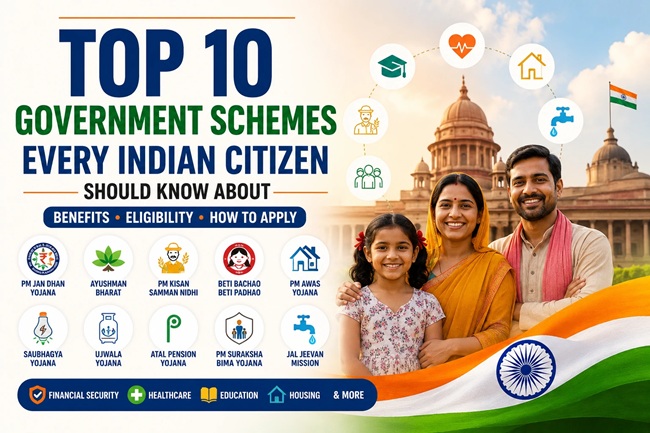
Top 10 Government Schemes Every Indian Citizen Should Know About

Suresh runs a small hardware shop and had never really thought about life insurance, it felt like something for people who could afford a “proper” policy with a relationship manager and a thick brochure. When a bank employee mentioned he could get 2 lakh rupees of life cover for 436 rupees a year, just by linking it to his existing savings account, he assumed there had to be a catch. There wasn’t. He’d simply never heard of Pradhan Mantri Jeevan Jyoti Bima Yojana, a government scheme that’s been sitting there the entire time.
This is the pattern with most government schemes in India. They’re genuinely useful, often absurdly affordable, and almost entirely underused, not because people don’t qualify, but because nobody told them these existed. Here are ten schemes that matter to nearly every Indian household, what they actually offer, and how to sign up.
Different Government Schemes For Indian Citizens Are:
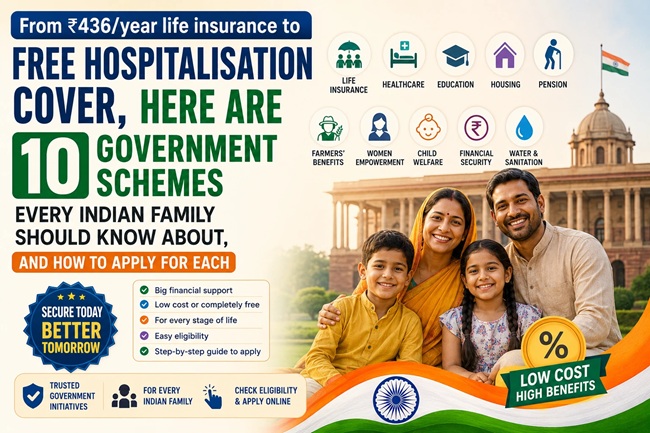
1. Pradhan Mantri Jan Dhan Yojana (PMJDY): The Foundation for Everything Else
Launched in 2014, PMJDY is the world’s largest financial inclusion initiative, giving every Indian household access to a zero-balance savings account, no minimum balance required. It comes with a free RuPay debit card that includes built-in accidental insurance cover, and it’s the account that makes Direct Benefit Transfers and enrollment in several other schemes on this list possible in the first place. Over 53 crore accounts have been opened under this scheme, with combined deposits exceeding 2.3 lakh crore rupees. If you or a family member doesn’t have a bank account yet, this is where to start, at any bank branch or authorised Business Correspondent outlet.
2. Pradhan Mantri Jeevan Jyoti Bima Yojana (PMJJBY): Life Insurance for 436 Rupees a Year
This is the scheme Suresh discovered. For an annual premium of 436 rupees, auto-debited from your bank account, you get 2 lakh rupees of life insurance cover, payable to your nominee if you pass away for any reason during the policy year. It’s available to anyone between 18 and 50 years old with a bank account willing to opt in and authorise auto-debit. At this price, it’s arguably the most cost-effective term life cover available in the country, though the sum assured is modest and shouldn’t be your only life insurance if you have significant financial dependents.
3. Pradhan Mantri Suraksha Bima Yojana (PMSBY): Accident Cover for 20 Rupees a Year
PMSBY is PMJJBY’s companion scheme, covering accidental death and permanent disability specifically, rather than death from any cause. The premium is just 20 rupees a year, and it provides 2 lakh rupees of cover for accidental death or total permanent disability, with a reduced amount for partial permanent disability. Financial advisors commonly recommend taking both PMJJBY and PMSBY together, since between them, the combined annual cost is under 500 rupees for a meaningful insurance safety net covering both natural and accidental causes.
4. Atal Pension Yojana (APY): A Guaranteed Pension for the Unorganised Sector
If you don’t have an employer-provided pension, which describes most of India’s unorganised workforce, from domestic help to gig workers to small shop owners, APY offers a genuinely useful solution. You contribute a small amount regularly between ages 18 and 40, and from age 60 onward, you receive a guaranteed monthly pension ranging from 1,000 to 5,000 rupees, depending on your contribution level and the age you joined. Over 6.5 crore people have enrolled so far. It’s regulated by the PFRDA and administered through most banks and post offices.
5. Ayushman Bharat (PM-JAY): Free Hospitalisation Cover Up to 5 Lakh Rupees
PM-JAY is a health insurance scheme providing coverage of up to 5 lakh rupees per family per year for secondary and tertiary hospitalisation, aimed primarily at economically vulnerable families identified through the Socio-Economic Caste Census, along with senior citizens aged 70 and above regardless of income. It covers over 10 crore families, making it one of the largest publicly funded health insurance programmes in the world. Coverage includes a wide range of medical and surgical procedures, and treatment is typically cashless at empanelled hospitals across the country.
6. PM Kisan Samman Nidhi (PM-KISAN): Direct Cash Support for Farmers
For farming families with cultivable land, PM-KISAN provides 6,000 rupees a year in direct income support, paid in three equal installments of 2,000 rupees every four months, credited straight to the farmer’s bank account. It’s meant to help with basic agricultural input costs and household needs, and enrollment is done through the local agriculture department or the official PM-KISAN portal, with land records and Aadhaar-linked bank details required for verification.
7. Pradhan Mantri Awas Yojana (PMAY): Housing Support for Those Who Need It Most
PMAY offers financial assistance toward building or purchasing a home, with support ranging from roughly 1.2 to 2.5 lakh rupees depending on whether you’re applying under the rural (PMAY-G) or urban (PMAY-U) component, with an expanded urban scheme, PMAY-U 2.0, having widened eligibility since September 2024. It’s specifically targeted at economically weaker sections and lower-income groups who don’t currently own a pucca house. Several states also run their own top-up housing schemes alongside PMAY, so it’s worth checking your specific state’s additional benefits when applying.
8. Pradhan Mantri Mudra Yojana (PMMY): Collateral-Free Loans for Small Businesses
If you’re running or starting a small, non-corporate business, PMMY offers loans without requiring collateral, structured across categories based on the loan amount: Shishu for loans up to 50,000 rupees, Kishor for 50,000 rupees to 5 lakh rupees, Tarun for 5 lakh to 10 lakh rupees, and a newer Tarun Plus category, added in the 2024 Union Budget, extending up to 20 lakh rupees for businesses with a strong repayment track record. These loans are disbursed by banks, NBFCs, and microfinance institutions, and are aimed squarely at small vendors, shopkeepers, and micro-entrepreneurs who typically struggle to access traditional business credit.
9. National Pension System (NPS): Voluntary, Market-Linked Retirement Savings
Unlike APY, which offers a fixed guaranteed pension, NPS is a voluntary, market-linked retirement scheme open to any Indian citizen, offering the potential for higher long-term growth through a mix of equity and debt investment options, regulated by the PFRDA. The scheme currently manages a corpus of over 13 lakh crore rupees across its subscribers. Contributions to NPS also come with tax benefits under Section 80CCD, including an additional deduction beyond the standard 80C limit, making it a genuinely useful addition to a retirement plan for anyone comfortable with market-linked returns.
10. Sukanya Samriddhi Yojana (SSY): A Dedicated Savings Scheme for Daughters
Specifically for families with a girl child under 10, Sukanya Samriddhi Yojana (SSY) offers one of the highest guaranteed, government-backed interest rates among small savings schemes, along with full tax exemption on contributions, interest, and maturity proceeds. Accounts can be opened at any bank or post office with a minimum deposit, and the scheme is specifically designed to help parents build a dedicated corpus for a daughter’s education or marriage expenses over the long term. We’ve covered this scheme in more depth separately, since it deserves a closer look on its own.
These 10 Schemes at a Glance
| Scheme | What It Offers | Who It’s For | Cost/Contribution |
|---|---|---|---|
| PMJDY | Zero-balance bank account with accident cover | Anyone without a bank account | Free |
| PMJJBY | ₹2 lakh life insurance | Ages 18-50 with a bank account | ₹436/year |
| PMSBY | ₹2 lakh accidental death/disability cover | Ages 18-70 with a bank account | ₹20/year |
| APY | Guaranteed pension of ₹1,000-5,000/month from age 60 | Unorganised sector workers, ages 18-40 to join | Small regular contribution |
| PM-JAY | Up to ₹5 lakh/year hospitalisation cover | SECC-identified families, seniors 70+ | Free |
| PM-KISAN | ₹6,000/year direct cash support | Farming families with cultivable land | Free |
| PMAY | ₹1.2-2.5 lakh housing assistance | Economically weaker/lower-income households | Free (subsidy) |
| PMMY (Mudra) | Collateral-free loans up to ₹20 lakh | Small business owners and micro-entrepreneurs | Standard loan interest applies |
| NPS | Market-linked retirement savings with tax benefits | Any Indian citizen | Voluntary contribution |
| SSY | High guaranteed interest, tax-free savings for daughters | Families with a girl child under 10 | Min. ₹250/year |
About This Guide
This article reflects government scheme details, benefit amounts, and eligibility criteria as publicly available in 2026. Scheme parameters, benefit amounts, and eligibility thresholds are periodically revised by the government, so please verify current details on the respective official scheme portals, or with your bank or nearest Common Service Centre, before applying.
Common Mistakes People Make With Government Schemes
Assuming a scheme is “not for someone like me” without actually checking the eligibility criteria is probably the most common missed opportunity. Schemes like PMJJBY and PMSBY are open to nearly anyone with a bank account in the right age range, regardless of income level, yet many people assume these are only for low-income households.
Not linking Aadhaar to your bank account and mobile number is another frequent, quietly costly mistake. Several of these schemes rely on Aadhaar-seeded bank accounts for enrollment, premium auto-debit, or benefit transfer, and a mismatch can cause a Direct Benefit Transfer to silently fail without any clear notification.
People also often let scheme enrollment lapse without realising it. PMJJBY and PMSBY, for instance, require annual renewal through continued auto-debit consent, and a single missed premium due to an insufficient account balance can quietly lapse your coverage without you noticing until you actually need it.
Finally, many families stack schemes inefficiently, or miss stacking them at all. There’s no rule against combining PMJDY, PMJJBY, PMSBY, and APY simultaneously for the same person, and doing so, given how affordable most of them are, builds a genuinely meaningful safety net for a very small combined annual cost.
My Take
What strikes me most about this list is how little most of these schemes actually cost relative to what they cover, 456 rupees a year for both PMJJBY and PMSBY combined is less than most people spend on a single dinner out, for 4 lakh rupees of combined insurance protection. The barrier for most families isn’t affordability, it’s awareness. If there’s one thing worth doing after reading this, it’s checking which of these your own family, and specifically your parents or household help, might already be eligible for and simply never signed up for.
Frequently Asked Questions
1. Can I enroll in multiple government schemes at the same time? Yes, there’s no restriction preventing you from enrolling in several of these schemes simultaneously, such as PMJDY, PMJJBY, PMSBY, and APY together, provided you meet each scheme’s individual eligibility criteria.
2. What documents do I need to apply for most government schemes? Most schemes require an Aadhaar card, a bank account with Aadhaar-linked mobile number, and sometimes a PAN card for financial schemes like Mudra loans or NPS. Scheme-specific documents like land records for PM-KISAN or income certificates for PMAY may also be required.
3. Is Ayushman Bharat available to everyone? No, PM-JAY primarily covers families identified through the Socio-Economic Caste Census as economically vulnerable, along with all senior citizens aged 70 and above regardless of income. It’s worth checking your eligibility status on the official portal.
4. How is PMJJBY different from PMSBY? PMJJBY provides life insurance covering death from any cause for an annual premium of 436 rupees. PMSBY specifically covers accidental death and disability for a much lower annual premium of 20 rupees. Many advisors recommend taking both together.
5. Can I lose my APY benefits if I stop contributing? Discontinued contributions can lead to account freezing or eventual closure depending on how long payments are missed, so it’s important to maintain your contributions to keep your guaranteed pension benefit intact.
6. Is NPS better than APY for retirement planning? They serve different purposes. APY offers a fixed, guaranteed pension amount, ideal for those wanting certainty, while NPS offers market-linked returns with growth potential but no fixed guarantee, better suited to those comfortable with some investment risk for potentially higher retirement savings.
7. How do I check if my Aadhaar is linked to my bank account for these schemes? You can check this through your bank’s net banking portal, by visiting your branch, or through the NPCI’s online Aadhaar seeding status checker, since several scheme benefits and premium auto-debits depend on this link being active.
8. Are Mudra loans really available without collateral? Yes, PMMY loans across all categories, Shishu, Kishor, Tarun, and Tarun Plus, are collateral-free, though standard loan eligibility assessment and interest rates still apply based on the lender’s policies.
9. Can non-farmers apply for PM-KISAN? No, PM-KISAN is specifically for farming families with verified cultivable landholding, and eligibility is checked against land records during enrollment.
10. Where can I apply for these government schemes? Most banking and insurance-related schemes like PMJDY, PMJJBY, PMSBY, and APY can be accessed through any bank branch or Business Correspondent outlet, while PM-KISAN, PMAY, and PM-JAY typically require registration through their respective official government portals or a local Common Service Centre.
Disclaimer
This article is for informational and educational purposes only and does not constitute financial or legal advice. Government scheme details, eligibility criteria, and benefit amounts are subject to periodic revision by the respective ministries and authorities. Please verify current information on official government portals or with authorised bank branches before applying for any scheme mentioned here.

Shuchi founded Finance Checks after spending 16+ years working in corporate, managing operations and distribution. She managed her own finances, learned and read regularly and helped people make sense of their savings, loans, insurance, and investments.
She started this site to offer the kind of clear, honest financial guidance she wished was more available when she was learning to manage her own money. Every article is researched personally, checked against official sources such as the Reserve Bank of India, SEBI, or the Income Tax Department, and revisited whenever regulations or figures change. She is upfront about how the site earns money through ads and select affiliate partnerships, and she does not let either influence what she actually recommends to readers.