
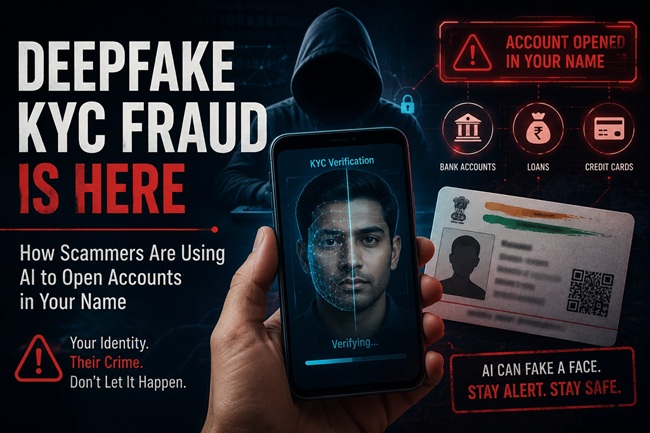
Deepfake KYC Fraud Is Here: How Scammers Are Using AI to Open Accounts in Your Name

For years, video KYC felt like one of banking’s genuine safety upgrades. Instead of just uploading a photo of your Aadhaar card, you’d hop on a live video call, hold your ID up to the camera, maybe turn your head or blink when asked, and a bank representative would visually confirm you were a real, present human being matching your documents. It felt harder to fake than a static photo. For a while, it was.
That assumption is no longer safe. In 2026, Indian financial institutions have started reporting real, seven-figure losses from fraudsters using AI-generated faces to pass live video KYC checks, well enough to open accounts and get loans approved without ever being physically present. One non-banking financial company alone is reported to have lost between 15 and 20 crore rupees this way. This isn’t a theoretical, future risk anymore. It’s already happening, and it’s worth understanding both how exposed you might be and what’s actually being done about it.
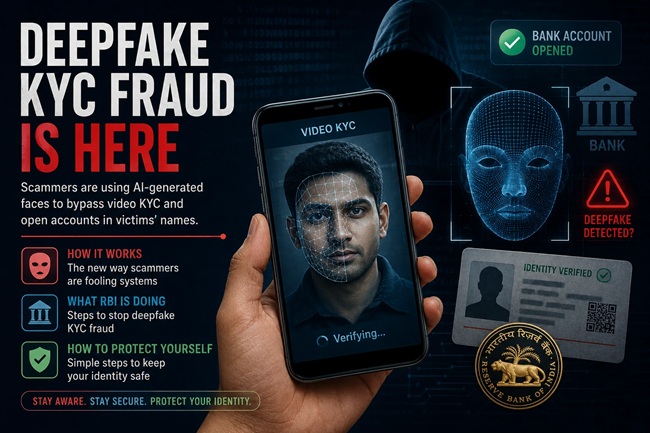
Deepfake KYC Fraud: What’s Actually Happening, in Plain Terms
Deepfake technology uses AI to generate convincing fake video or audio of a person, sometimes by swapping a fraudster’s face with someone else’s in real time during a live video call. Combined with a second technique, feeding a fabricated video feed directly into a device instead of using an actual camera, this can trick a video KYC system into believing it’s looking at a live, genuine person, when it’s actually looking at a synthetic one.
What makes this genuinely dangerous is who it targets. It doesn’t require access to your bank account or your phone. It requires access to your identity documents, an Aadhaar or PAN copy, a photo, some basic personal details, the kind of information that’s unfortunately been exposed in numerous data breaches over the years, or is sometimes carelessly shared with unverified third parties. With that starting material, a fraudster can attempt to open a new bank account, apply for a loan, or pass a KYC check while impersonating you, without you doing anything wrong yourself.
Research from the World Economic Forum’s 2026 report on digital identity verification found that even moderately sophisticated, freely available face-swapping tools, combined with camera injection techniques, could fool identity systems relying on just one verification signal, like a face match alone. And here’s a genuinely sobering statistic: studies on human ability to spot deepfake video put accuracy at around 57 percent, barely better than a coin flip. This isn’t a threat you can reliably catch just by “looking carefully,” which is exactly why it’s a systems and awareness problem, not something individual vigilance alone can fully solve.
Deepfake KYC Fraud: Why This Is Growing So Fast Right Now
Part of what’s changed is cost and accessibility. Earlier deepfake fraud required serious technical skill and expensive computing resources. Industry researchers now describe fraudsters using customized applications built on open-source AI models, run on ordinary, consumer-grade gaming computers, dramatically lowering both the cost and the technical barrier to attempt this kind of fraud. One Group-IB investigation found a single financial institution recorded over 8,000 attempts to bypass its identity checks using AI-generated synthetic faces in just an eight-month window, describing it as targeted, systematic, and iterative, attackers testing which methods work and refining their approach over time, not random, opportunistic attempts.
This is unfolding against a broader backdrop of rising financial fraud in India generally. The RBI’s own annual report shows banking fraud losses jumped 46.4 percent between FY25 and FY26, reaching 48,021 crore rupees, though it’s worth being clear that this broader figure includes many types of fraud beyond deepfake-specific KYC bypass, loan and advances fraud in particular has been a major driver of that overall increase.
Deepfake KYC Fraud: What RBI Is Doing About It
To its credit, the RBI hasn’t been passive on this. Video-based Customer Identification Process, or V-CIP, is governed under the RBI’s KYC Master Direction, and in August 2025, the RBI specifically amended this framework to address exactly this threat. The updated rules make clear that basic liveness checks, the old “blink or turn your head” style prompts, are no longer considered sufficient on their own. Regulated entities, banks, NBFCs, and payment system providers, are now required to actively detect AI-generated, synthetic faces during video KYC, not just confirm that a face is present and moving.
The RBI has also separately and repeatedly warned the public about a related but distinct threat, deepfake videos impersonating RBI officials themselves, used to promote fraudulent investment schemes or fake financial advice. If you ever see a video of an “RBI official” endorsing a specific investment opportunity or scheme, treat it with serious skepticism regardless of how convincing it looks, since the RBI has confirmed such videos have circulated and are fabricated.
Deepfake KYC Fraud: What This Actually Means for You as an Individual
The uncomfortable reality is that this type of fraud largely happens without the victim’s direct involvement, someone can attempt to use your identity without you clicking a suspicious link or making an obvious mistake yourself. That shifts the practical protection strategy from “avoid doing something risky” toward “monitor for signs that something’s already happened.”
Regularly checking your credit report is genuinely one of the most effective tools available to you here. If a loan or credit account is fraudulently opened in your name, it typically shows up on your credit report, sometimes before you’d notice it any other way. Checking this every few months, most credit bureaus in India allow at least one free check annually, can catch a fraudulent account early, before it accumulates significant damage to both your finances and your credit score.
Being deliberate about who you share identity documents with matters more than ever. Using DigiLocker for sharing verified digital copies of documents, rather than emailing scanned copies of your Aadhaar or PAN to unfamiliar parties, reduces how much raw material is floating around that could be repurposed for this kind of fraud. It’s also worth being cautious about which apps and websites you upload identity documents to, sticking to well-established, clearly legitimate platforms rather than a random lender or service you haven’t verified.
Watching for unexpected SMS or email alerts about account openings, loan approvals, or credit inquiries you didn’t initiate is another practical habit. Banks and lenders typically send some form of notification during onboarding, and an unexpected one is worth investigating immediately rather than dismissing as spam.
If You Discover an Account Was Fraudulently Opened in Your Name
Speed matters considerably here, similar to other forms of financial fraud. Contact the bank or lender where the account was opened immediately to report it and request they freeze or investigate the account. File a complaint on the National Cyber Crime Reporting Portal or call the national cybercrime helpline, 1930, to formally report the identity fraud. It’s also worth raising a dispute directly with the credit bureaus, CIBIL, Experian, Equifax, or CRIF High Mark, to have the fraudulent account flagged and prevented from continuing to affect your credit score while the matter is investigated.
About This Guide
This article reflects publicly reported deepfake KYC fraud incidents and RBI regulatory developments in India as of 2026, including the RBI’s August 2025 amendment to its Video-based Customer Identification Process requirements. This is a rapidly evolving threat category, with both fraud techniques and regulatory responses continuing to develop. This article intentionally avoids describing specific technical methods used to create or deploy deepfakes, focusing instead on the risk to consumers and practical protective steps. Please refer to current RBI advisories and your bank’s official communications for the latest guidance.
Deepfake KYC Fraud: Common Mistakes That Increase Your Exposure
- Sharing scanned copies of Aadhaar, PAN, or other identity documents over email or unverified apps, rather than using secure, verified channels like DigiLocker, meaningfully increases how much raw material is available for this kind of impersonation attempt.
- Not checking your credit report regularly is another common gap. Many people only look at their credit score when actively applying for a loan, which means a fraudulently opened account can sit undetected for months, accumulating damage before it’s discovered.
- Assuming that only careless or technically unaware people fall victim to this kind of fraud is a mistake in itself. Since this type of fraud largely doesn’t require any direct action or mistake from the victim, it’s fundamentally different from a scam that relies on tricking you into clicking a link or sharing a PIN.
- Dismissing unexpected account-related notifications as spam without verifying them directly with the bank is another common, costly habit, particularly given how quickly a fraudulently opened account can be used before it’s flagged.
My Take on Deepfake KYC Fraud
What makes this particular threat genuinely unsettling isn’t just the technology, it’s that traditional advice like “don’t click suspicious links” or “never share your OTP” doesn’t fully protect against it, since the fraud can happen using documents and data that may already be out there, without any fresh mistake on your part. That said, I don’t think this is a reason for alarm so much as a reason to add one new habit to your existing financial hygiene: check your credit report periodically, the way you’d check a bank statement, not just when you’re actively borrowing. It’s a small, low-effort habit that happens to be one of the more effective defenses against a threat that’s specifically designed to operate without your knowledge.
Deepfake KYC Fraud: Frequently Asked Questions
1. What is deepfake KYC fraud? It’s a type of fraud where scammers use AI-generated synthetic faces or manipulated video feeds to impersonate someone during a live video KYC verification, attempting to open bank accounts or get loans approved in that person’s name without their involvement.
2. How can someone open a bank account in my name without my phone or OTP? This type of fraud primarily relies on stolen or leaked identity documents, like Aadhaar or PAN copies, combined with AI-generated video, rather than requiring access to your phone, bank account, or OTP.
3. Has RBI done anything about deepfake KYC fraud? Yes, the RBI amended its Video-based Customer Identification Process requirements in August 2025, mandating that regulated financial institutions actively detect AI-generated synthetic faces, rather than relying on basic liveness checks alone.
4. How can I check if someone has fraudulently opened an account in my name? Regularly checking your credit report is one of the most effective ways to catch this, since fraudulently opened credit accounts or loans typically appear there, often before you’d notice through any other channel.
5. Is it safe to share my Aadhaar or PAN copy over email? It’s safer to use verified digital sharing methods like DigiLocker rather than emailing scanned copies to unfamiliar parties, since reducing how widely your identity documents circulate lowers your exposure to this kind of fraud.
6. How common is deepfake fraud in Indian banking right now? While comprehensive nationwide figures specific to deepfake KYC fraud aren’t yet fully established, individual reported cases have involved losses in the tens of crores at specific institutions, and industry researchers have documented thousands of attempted bypass attempts at individual financial institutions within short time windows.
7. Can I tell if a video call is a deepfake just by watching carefully? Not reliably. Studies suggest human accuracy at detecting deepfake video is only around 57 percent, close to random chance, which is why this is considered a systems-level problem rather than something individuals can consistently catch on their own.
8. What should I do if I discover a fraudulent account was opened in my name? Contact the bank or lender immediately, file a complaint on the National Cyber Crime Reporting Portal or call 1930, and raise a dispute with the relevant credit bureau to have the fraudulent account flagged.
9. Are deepfake videos of RBI officials promoting investments real? No. The RBI has publicly confirmed that deepfake videos impersonating its officials to promote investment schemes or financial advice are fake, and has urged the public not to act on them.
10. Does this mean video KYC is no longer safe? Video KYC remains an important verification layer, and regulators and institutions are actively upgrading detection systems in response to this threat. It means relying on any single verification signal alone is no longer sufficient, which is why layered verification and consumer-side monitoring, like checking your credit report, both matter.
Disclaimer
This article is for informational and educational purposes only and does not constitute legal or financial advice. It intentionally does not describe specific technical methods for creating or deploying deepfakes. Fraud statistics and regulatory details reflect publicly reported information as of 2026 and may evolve as this threat and the regulatory response continue to develop. If you suspect identity fraud, contact your bank immediately and report it through the National Cyber Crime Reporting Portal or the 1930 helpline.

Shuchi founded Finance Checks after spending 16+ years working in corporate, managing operations and distribution. She managed her own finances, learned and read regularly and helped people make sense of their savings, loans, insurance, and investments.
She started this site to offer the kind of clear, honest financial guidance she wished was more available when she was learning to manage her own money. Every article is researched personally, checked against official sources such as the Reserve Bank of India, SEBI, or the Income Tax Department, and revisited whenever regulations or figures change. She is upfront about how the site earns money through ads and select affiliate partnerships, and she does not let either influence what she actually recommends to readers.



[…] Deepfake KYC Fraud Is Here: How Scammers Are Using AI to Open Accounts in Your Name […]