
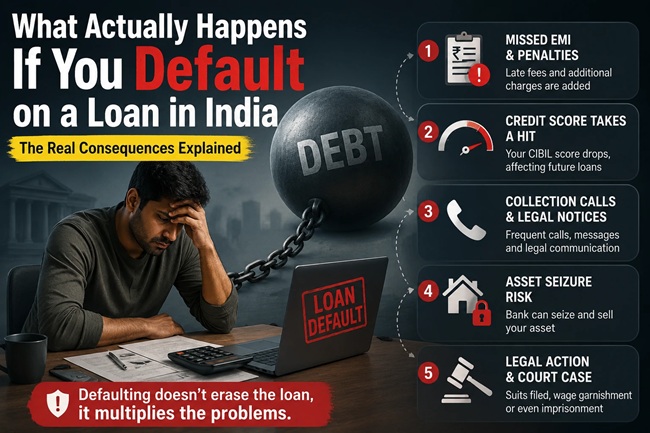

Rohit lost his job in April and missed his personal loan EMI for the first time in his life the following month. His first instinct was panic, fuelled by every horror story he’d heard about recovery agents and property seizures. He avoided calls from unknown numbers for weeks, assuming silence was safer than admitting he couldn’t pay. By the time he actually picked up and spoke to his bank, he’d missed the exact window where he had the most leverage to fix things quietly.
Loan default is one of those topics people either don’t think about at all, or imagine in the worst possible terms once it happens to them. The reality sits somewhere more specific and, frankly, more manageable than either extreme. Here’s exactly what happens, in order, and what rights you actually have at each stage.
Day 1 to 90: This Is Your Best Window, Not a Countdown to Disaster
The period right after you first miss a payment is, somewhat counterintuitively, the stage where you have the most control. Banks are required to send written reminders and, in many cases, will discuss relief options, restructuring your EMI, offering a temporary moratorium, or adjusting your repayment schedule, before your account crosses into more serious territory.
This is genuinely the moment to act, not hide. Reaching out to your lender proactively, in writing, explaining your situation and requesting restructuring, shows good faith and frequently prevents the situation from escalating further. Waiting silently, the way Rohit did, doesn’t buy you safety, it just uses up the window where your options are widest.
Day 90: Your Loan Becomes an NPA
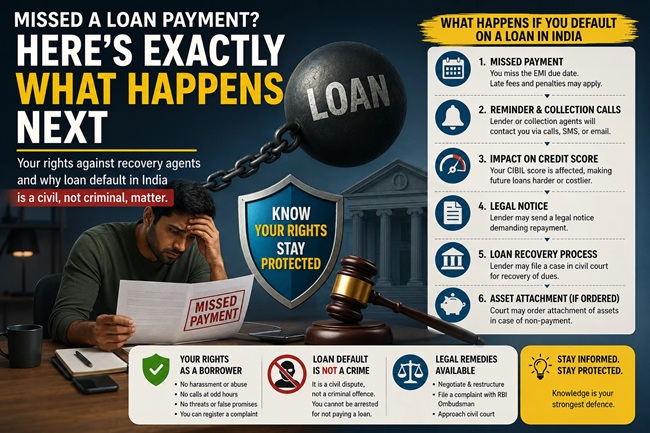
If a loan remains unpaid for 90 consecutive days, it gets formally classified as a Non-Performing Asset, or NPA. This is worth understanding clearly: it’s an internal banking classification, not a court order or a criminal charge. Nothing about your legal status changes at this exact moment, but it does mark the point where your bank’s internal processes shift from reminder mode into active recovery mode, and where your credit score typically takes a serious hit. Borrowers dealing with this stage have reported CIBIL score drops exceeding 100 points within a single reporting cycle, which affects your ability to get credit elsewhere for years afterward, not just your relationship with this one lender.
Day 90 Onward: Recovery Agents Get Involved, But Under Real Rules
Once an account is significantly overdue, the bank may assign an external recovery agent. Under current RBI rules, the bank must give you 30 days’ written notice before doing this, and the agent themselves must carry valid identification along with written authorization from the bank confirming they’re acting on its behalf.
This is also where RBI’s conduct rules for recovery agents matter most, and they’re worth knowing in specific detail, since violations are unfortunately common. Recovery agents are permitted to contact you only between 8 AM and 7 PM. They cannot contact you on Sundays or notified public holidays. They cannot contact your family, friends, employer, or colleagues about your loan, a direct violation of the RBI’s Fair Practices Code. Every certified recovery agent is required to hold an IIBF, Indian Institute of Banking and Finance, certification, and an uncertified agent operating on a bank’s behalf isn’t legally authorised to do so.
The RBI has continued tightening this framework. Draft guidelines set to take effect from July 1, 2026 go further still, explicitly banning verbal or physical harassment and reinforcing the same contact-hour restrictions. This tightening isn’t happening in a vacuum, an RBI-cited survey reported by the Economic Times in February 2026 found that close to 39 percent of borrowers had experienced abusive or threatening recovery calls, and loan and credit card complaints now make up the largest single category of grievances the RBI receives.
If a recovery agent violates any of these rules, contacting you outside permitted hours, reaching out to your family, or using threatening language, you have the right to file a written complaint with the bank first. The bank is expected to address it within 30 days, and cannot escalate further recovery action while that complaint remains pending. Keeping a clear record, screenshots, call recordings, or written notes of any interaction, genuinely matters if you need to escalate this further.
The Critical Distinction: Secured vs Unsecured Loans
This is probably the single most important thing to understand about what can actually happen to you, and it depends entirely on whether your loan is secured or unsecured.
Secured loans, home loans, car loans, gold loans, involve an asset you pledged when you borrowed. If you default, the bank has legal recourse to that specific asset through the SARFAESI Act. But even here, the process is defined and gated, not instant. The bank must first serve a 60-day written notice under Section 13(2) of the Act, during which you have the right to respond with formal objections. Only after this window, and only if those objections don’t resolve the matter, can the bank move toward repossession, and you retain the right to appeal at the Debt Recovery Tribunal before that happens. This is a structured legal process with real checkpoints, not an overnight seizure.
Unsecured loans, personal loans, credit cards, BNPL, and app-based loans, are a fundamentally different category. You pledged no asset when you borrowed, which means the bank has no specific property to point to, and the SARFAESI Act simply doesn’t apply here. Recovery on unsecured debt happens through agent contact, written notices, and, if unresolved, formal legal action, a Debt Recovery Tribunal filing for unsecured amounts above 20 lakh rupees, or a civil suit in regular court for smaller amounts. Importantly, a bank must file such a civil suit within 3 years of the default under the standard limitation period.
Can You Actually Be Arrested for Missing an EMI?
No, and this is worth stating plainly because it’s one of the most common fears people carry into this situation unnecessarily. Loan default in India is a civil matter, not a criminal one. A genuine borrower facing genuine financial hardship cannot be imprisoned simply for missing EMI payments. If anyone threatens you with arrest over a missed personal loan or credit card payment, that threat itself is very likely a violation of RBI’s conduct rules, and it’s worth documenting and reporting.
There are two narrow, specific exceptions where criminal liability can genuinely apply. A bounced post-dated cheque used for loan repayment can trigger criminal proceedings under Section 138 of the Negotiable Instruments Act, a completely separate legal mechanism from ordinary default. And proven wilful default involving deliberate fraud, not genuine hardship, but intentional deception, can carry more serious consequences. These are meaningfully different situations from an ordinary borrower who’s fallen behind due to a job loss, medical emergency, or other genuine financial setback.
The “Wilful Defaulter” Tag: Who It Actually Applies To
A lot of borrowers worry about being labelled a wilful defaulter, but this classification is far narrower than most people assume. The RBI’s Master Directions on Wilful Defaulters, effective October 2024, specifically apply to NPA accounts of 25 lakh rupees and above, and require evidence that the borrower had the capacity to repay but deliberately chose not to, or diverted loan funds for purposes other than what they were sanctioned for. This isn’t the category most personal loan or credit card defaults fall into. Genuine financial hardship is treated fundamentally differently from wilful, deliberate default under RBI’s own framework, and being behind on a personal loan due to job loss doesn’t put you anywhere near this classification.
The Loan Default Process at a Glance
| Timeline | What Happens | Your Rights |
|---|---|---|
| Day 1-90 | Reminders sent, restructuring/moratorium options possible | Best window to negotiate; request restructuring in writing |
| Day 90 | Loan classified as NPA | Internal classification only, not a legal action |
| Day 90+ | Recovery agent may be assigned, with 30 days’ prior written notice | Agent must be certified, contact only 8 AM-7 PM, no contact with family |
| After 180 days (secured) | SARFAESI proceedings may begin, with 60-day notice first | Right to file objections, right to appeal at DRT before repossession |
| After 180 days (unsecured) | DRT filing (above ₹20 lakh) or civil suit | Civil suit must be filed within 3 years of default |
If You’re Currently Struggling With a Loan Payment
The single most useful thing you can do is contact your lender before you fall significantly behind, not after. Request restructuring, a revised repayment schedule, or a temporary moratorium in writing, and keep a copy of that communication. If you’ve already missed payments and are being contacted by a recovery agent, know your specific rights around contact hours and who they’re permitted to reach out to, and document any interaction that crosses those lines.
If a settlement conversation becomes necessary, a One-Time Settlement, where the bank agrees to close the loan for a negotiated amount less than the full outstanding balance, remains a genuine option even after formal notices have been issued, and is generally a far better outcome than letting a matter proceed all the way through legal escalation.
About This Guide
This article reflects RBI guidelines on loan recovery, NPA classification, and recovery agent conduct as they stand in 2026, including draft guidelines set to take effect from July 1, 2026 and RBI’s Master Directions on Wilful Defaulters effective October 2024. Specific timelines and processes can vary by loan type, lender, and individual circumstances. This article does not constitute legal advice; please consult a qualified legal professional for guidance specific to your situation, particularly if you’ve received a formal legal notice.
Common Mistakes People Make When Facing Default
Avoiding contact with the lender out of fear or embarrassment is probably the most costly mistake, and it’s an understandable one. But the early window, before an account crosses into NPA territory, is genuinely your best opportunity to negotiate a manageable outcome, and staying silent simply lets that window close.
Assuming any threat, including arrest, is legitimate without verifying it is another common and costly mistake. Loan default is a civil matter for genuine borrowers, and threats suggesting otherwise are, in most cases, exactly the kind of conduct RBI’s rules explicitly prohibit.
Not keeping records of recovery agent interactions is a gap that becomes a real problem if you later need to file a complaint. A simple habit of noting dates, times, and what was said, or keeping call recordings where legally permitted, makes any escalation considerably more effective.
Finally, assuming a secured loan means immediate asset seizure the moment you default is a common misunderstanding. The SARFAESI process includes a mandatory notice period and a right to object and appeal, a defined legal process with real checkpoints, not an instant, automatic outcome.
My Take
The fear around loan default tends to be worse than the actual process, provided you engage with it rather than avoid it. The system, at least on paper and increasingly in RBI’s enforcement focus, is built around a fairly clear sequence of notices, windows to respond, and rights that specifically protect genuine borrowers from harassment and overreach. The real risk isn’t the process itself, it’s staying silent through the exact stage where you have the most leverage to change how it plays out. If you’re genuinely struggling, the earliest possible conversation with your lender is worth more than months of avoided calls.
Frequently Asked Questions
1. Can I go to jail for missing a loan EMI in India? No, loan default is a civil matter, not a criminal one, and genuine borrowers cannot be imprisoned for missing EMI payments. The narrow exceptions are a bounced post-dated cheque, which can trigger separate criminal proceedings, and proven wilful default involving deliberate fraud.
2. When does a loan get classified as NPA? A loan is classified as a Non-Performing Asset after 90 consecutive days of non-payment. This is an internal banking classification, not a legal or criminal action.
3. Can a bank seize my house immediately if I default on a home loan? No. For secured loans like home loans, the bank must first serve a 60-day written notice under the SARFAESI Act, during which you can file objections, and you retain the right to appeal at the Debt Recovery Tribunal before any repossession takes place.
4. Does SARFAESI apply to personal loans or credit cards? No, SARFAESI only applies to secured loans where an asset was pledged, like home or car loans. Personal loans, credit cards, and similar unsecured debt don’t involve pledged collateral, so this Act doesn’t apply to them.
5. What hours can recovery agents legally contact me? Recovery agents are permitted to contact you only between 8 AM and 7 PM, and are prohibited from contacting you on Sundays or notified public holidays under RBI’s Fair Practices Code.
6. Can recovery agents contact my family or employer about my loan? No, this is a direct violation of RBI’s Fair Practices Code. Recovery agents are not permitted to contact your family, friends, employer, or colleagues about your outstanding loan.
7. What is a wilful defaulter, and does it apply to most loan defaults? A wilful defaulter is someone who had the capacity to repay but deliberately chose not to, or diverted loan funds improperly, and this classification under RBI’s Master Directions specifically applies to NPA accounts of 25 lakh rupees and above. Most ordinary personal loan or credit card defaults due to genuine hardship don’t fall into this category.
8. What should I do if a recovery agent harasses me? Document the interaction, dates, times, and details of what was said or done, and file a written complaint with the bank, which is required to address it within 30 days and cannot escalate further recovery action while your complaint is pending.
9. Is it too late to negotiate once my loan becomes an NPA? No, though the window is better before NPA classification. Even after formal notices are issued, options like a One-Time Settlement or restructuring can still be genuinely available, depending on the lender and circumstances.
10. How long does a bank have to file a civil suit for an unpaid loan? Generally, banks must file a civil suit within 3 years of the default under the standard limitation period, after which pursuing legal recovery through that route becomes considerably harder for the lender.
Disclaimer
This article is for informational and educational purposes only and does not constitute legal or financial advice. Loan recovery rules, timelines, and RBI guidelines are subject to change, including draft guidelines set to take effect from July 1, 2026. If you are facing loan default or aggressive recovery practices, please consult a qualified legal professional and consider filing a formal complaint with your lender or the RBI Ombudsman for guidance specific to your situation.

Shuchi founded Finance Checks after spending 16+ years working in corporate, managing operations and distribution. She managed her own finances, learned and read regularly and helped people make sense of their savings, loans, insurance, and investments.
She started this site to offer the kind of clear, honest financial guidance she wished was more available when she was learning to manage her own money. Every article is researched personally, checked against official sources such as the Reserve Bank of India, SEBI, or the Income Tax Department, and revisited whenever regulations or figures change. She is upfront about how the site earns money through ads and select affiliate partnerships, and she does not let either influence what she actually recommends to readers.



I’ll be revisiting this article whenever I need a refresher.
[…] What Actually Happens If You Default on a Loan in India […]