
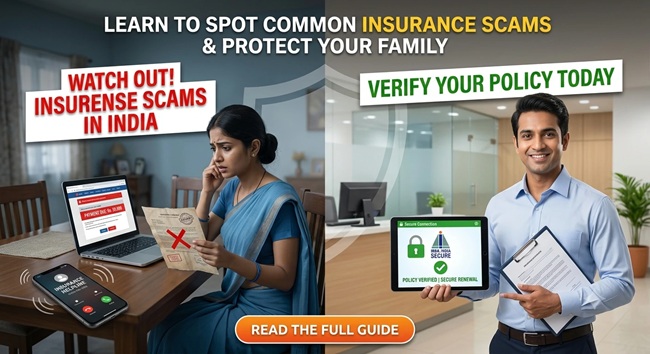
Insurance Scams in India Explained: Real Cases, How They Work, and How to Verify a Genuine Policy

Prakash Uncle bought a comprehensive two-wheeler insurance policy from a young man standing right outside the RTO office in his city, the same spot where dozens of agents set up small tables every renewal season. The man was polite, quick, and offered a price nearly forty percent lower than what the app on Prakash Uncle’s phone had quoted. He paid in cash, received a printed policy document with a real insurer’s logo on it within minutes, and rode off feeling like he had gotten a great deal. Eight months later, his scooter was hit by a car at a signal. When he called the insurer’s claims number to report the accident, the representative told him, after checking their system twice, that no policy existed under his name or vehicle number. The document in his hand, logo and all, had never been registered with the company at all.
Prakash Uncle’s story plays out in some form thousands of times a year across India, in life insurance, health insurance, and motor insurance alike, and the frustrating part is that almost every version of it could have been caught with a single two-minute check before any money changed hands.
Quick Answer about Insurance Scams in India
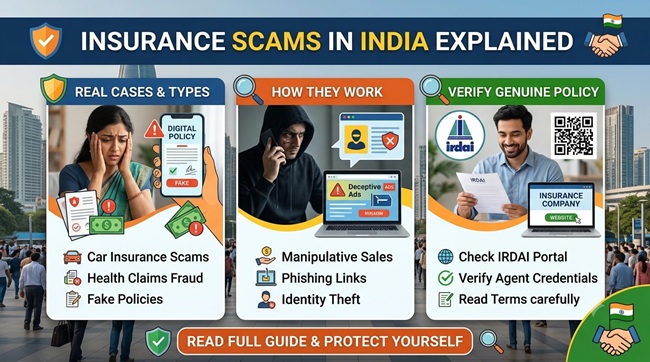
Insurance scams in India generally take one of a few recognisable forms: fake policies sold through unauthorised agents or WhatsApp links using a real insurer’s branding, fraudulent phone calls claiming your existing policy has “lapsed” or is due for “bonus” or “renewal” and pressuring you to transfer money immediately, and forged claim documents used either by policyholders or by criminals impersonating them to extract payouts. The single most reliable way to protect yourself is to never pay for insurance in cash or to a personal bank account, and to independently verify any policy directly through the insurer’s official portal or app, rather than trusting a document, call, or WhatsApp message at face value, however official it looks. If you suspect you’ve been sold a fake policy or targeted by an insurance scam, call the national cybercrime helpline at 1930, and file a formal grievance through IRDAI’s Bima Bharosa portal.
About This Guide
This guide is based on publicly reported insurance fraud cases from Indian police departments and news outlets through 2025 and 2026, along with IRDAI’s official verification tools and grievance redressal framework. FinanceChecks.com is not an insurance company, agent, or IRDAI-affiliated entity, and this article does not constitute insurance or legal advice. Always verify current information directly through IRDAI’s official website or your insurer before making decisions based on this guide.
How Insurance Scams Actually Happen
The fake policy sold by an unauthorised or dishonest agent. This is the most common version, and it takes a few different shapes. Sometimes a roadside agent, often set up right outside an RTO office, collects cash and hands over a printed policy with a real insurer’s logo and what looks like a valid policy number, but the premium is simply pocketed and the policy is never actually registered with the insurer’s system. In other cases, the fraud comes from a genuine, licensed agent who takes the client’s premium in cash and issues fabricated paperwork rather than passing the payment through to the insurer, meaning the cover never actually gets booked at company headquarters despite the agent being a real, identifiable person. The defining signature in both versions is the same: payment made to a personal account or in cash, and a policy that does not appear when checked directly on the insurer’s own portal.
The WhatsApp or Telegram broker selling PDF policies. A growing pattern involves brokers operating entirely through WhatsApp or Telegram, who send a policy document as a PDF after receiving a UPI transfer to a personal account. The PDF is often a convincing, professionally forged replica carrying a real insurer’s logo and formatting, but it was never issued by the company whose branding it borrows.
The fake renewal or bonus call. This version specifically and repeatedly targets people who already own genuine policies. A caller, sometimes using a spoofed number or posing as a representative of a finance company or the insurer itself, tells the victim their existing policy has expired, is at risk of lapsing, or that a “special bonus” is available if they act quickly. The caller creates urgency, asks for an upfront payment to “revive” or “renew” the policy, and afterward sends forged renewal documents over WhatsApp to make everything look legitimate. This tactic has repeatedly and specifically targeted senior citizens.
Identity misuse for fraudulent claims. A different but related version of insurance fraud involves someone else’s identity and documents being used, sometimes without their knowledge, to purchase policies or file claims. In one reported case, a person’s documents were used to buy four separate insurance policies, and a fabricated death declaration, complete with a forged death certificate, was later submitted in an attempt to claim a payout, a scheme that unravelled only when officials tried to verify the death and found the person very much alive.
You May Also Like To Read About:
- Family Floater vs Individual Health Insurance: Which Actually Saves You More
- Why You’re Paying ₹35,000 When Ads Show ₹499/Month: The Real Math Behind Term Insurance Pricing
- Health Insurance Claim Rejected? Here’s What to Do Next
- Term Insurance vs Whole Life Insurance: Which Actually Protects Your Family
- Term Insurance for Smokers: Why Your Premium Is So Much Higher, and What You Can Actually Do About It
- Turning 35? Here Is Why Life Insurance Just Became Non Negotiable For You
Recent Insurance Scams in India Cases That Show How This Plays Out
- In February 2026, Hyderabad police busted a fake insurance racket that had issued over 441 fabricated vehicle insurance certificates carrying the names of well-known insurance companies, a scheme that had reportedly been running since 2020 before it was uncovered, with roughly ₹91 lakh eventually seized. The fraud came to light only when policyholders began filing genuine claims and the insurer discovered there were no matching records on file.
- In Delhi in May 2026, a senior citizen received a WhatsApp call from someone posing as a representative of a finance company, who falsely claimed his insurance policy had expired and that a premium of ₹4 lakh was due for renewal. Believing the caller, he transferred the full amount to a bank account provided over the call, after which forged insurance documents were sent to him over WhatsApp to complete the illusion. Police later arrested four people and recovered ₹2 lakh in cash, along with multiple phones and forged policy documents used in the scheme.
- Mumbai Cyber Police separately uncovered an inter-state gang selling fake online life insurance policies under the names of prominent, real insurance companies, targeting a victim with promises of a large payout, an interest-free loan, and a lifelong pension in exchange for a ₹1.9 lakh deposit. Investigators found the fraud’s reach extended across five states and relied on SIM cards fraudulently obtained using other people’s misused KYC documents.
- And in a case that specifically illustrates the “revive your policy” bonus-call pattern, a group of four scammers repeatedly targeted people aged 50 and older, convincing them to pay premiums to reinstate policies that had supposedly lapsed, with some victims losing lakhs of rupees before the racket was uncovered.
Why Insurance Scams in India Keeps Happening
A few structural factors make insurance an especially attractive target for fraud in India. Genuine agents legitimately do operate informally, at RTO counters, through referrals, and increasingly over WhatsApp, which means the presence of an informal sales channel isn’t itself suspicious, and fraudsters exploit exactly that normalcy. Insurance products are also complex enough that most buyers don’t fully understand what they’re purchasing, which makes it easier for a fraudulent seller to claim benefits, bonuses, or terms that sound plausible but don’t actually exist. Regulatory data also points to a genuine, rising trend rather than a stable background rate: IRDAI’s own Annual Report for the 2024-25 period recorded a 14.3 percent year-on-year rise in grievances tied to unfair business practices, and separate industry fraud-monitoring data has flagged that suspected digital fraud attempts across India’s insurance sector are running well above the global benchmark rate.
How to Verify a Genuine Policy Before You Pay
Never pay in cash or to a personal bank account, ever. This single rule catches the overwhelming majority of insurance fraud at the source. Genuine premium payments go to the insurance company directly, through its official app, website, or a clearly company-linked payment channel, never to an individual’s personal UPI ID or bank account, regardless of how convincing the person collecting it seems.
Check the policy directly on the insurer’s own portal, not just the document you were handed. After any policy purchase, log in to the insurer’s official website or app using your policy number and registered mobile number, and confirm the policy actually appears in your account. A policy that exists only as a PDF or printout, and does not show up when you check independently through the company’s own system, is not a real policy.
For motor insurance specifically, use the IIB V-Seva portal. The Insurance Information Bureau runs a free public lookup at iib.gov.in that shows the actual, currently active insurance cover for any Indian vehicle by registration number, engine number, or chassis number. This is one of the most reliable single checks available, since a fake policy will simply not appear here, regardless of how convincing the paperwork looks. It’s also worth noting that a fake motor policy will not show up when you check your vehicle’s profile on the government’s Parivahan portal either, which is a second independent cross-check.
Verify any agent’s license before dealing with them. Every legitimate insurance agent in India holds an IRDAI-issued license, and you have the right to ask for and verify this credential before doing business with them. IRDAI’s Bima Bharosa platform and the general IRDAI portal allow you to check whether a person is a currently licensed, registered intermediary.
Be suspicious of any price that looks too good to be true. If a quoted premium is significantly lower than every other quote you’ve received for comparable coverage, treat that gap as a warning sign rather than a bargain. Genuine insurers operate within regulated pricing structures, so large, unexplained discounts are one of the more consistent signals of a fraudulent seller.
Be wary of manufactured urgency. Legitimate insurers and agents give you time to review policy documents, compare options, and ask questions before you commit. Any call, message, or in-person pitch that pressures you to pay immediately, “before the offer expires” or “before your cover lapses today,” is using a tactic specifically designed to stop you from verifying the claim before handing over money.
Read the actual policy document for named-insurer branding versus who you’re actually paying. A common inconsistency in fraudulent policies is that the document displays a well-known insurer’s name and logo, but the payment instructions direct you to a completely different, unrelated account name. This mismatch is one of the easiest tells to catch if you simply look for it.
What To Do If You Think You’ve Been Scammed
If you suspect you’ve been sold a fake policy or targeted by a fraudulent renewal call, call the national cybercrime helpline at 1930 as soon as possible, since acting quickly meaningfully improves the odds of the bank freezing the money before it moves further. File a complaint at cybercrime.gov.in, and separately, file a formal grievance through IRDAI’s Bima Bharosa portal, which exists specifically to escalate insurance-related complaints, including fraud, to the regulator. If your bank details were involved in the payment, you can also invoke the RBI’s 2017 customer protection framework with your bank directly, which allows for potential recovery if reported within the specified window and if the receiving account is identifiable. For motor insurance fraud specifically, it’s also worth filing a police FIR, since driving on a fake policy technically leaves you uninsured, which carries its own legal exposure if an accident occurs before the fraud is discovered.
My Take on Insurance Scams in India
What I find most instructive about these cases is how little technical sophistication most of them actually require. A convincing PDF, a real company’s logo copied onto a printout, and a plausible-sounding urgency script are enough to separate people from their money in nearly every case above. That tells me the fix isn’t really about becoming an insurance expert. It’s about building one small, boring habit: whatever document lands in your hand or your WhatsApp, log in to the actual company’s own system and check it yourself before you consider the transaction complete. That single habit would have stopped almost every case described in this article, and it takes less time than the sales pitch that convinced people to skip it in the first place.
Frequently Asked Questions about Insurance Scams in India
1. How can I tell if a motor insurance policy I bought is genuine? Check it directly on the IIB V-Seva portal by entering your vehicle’s registration, engine, or chassis number, and cross-check it on the insurer’s own customer portal using your policy number and registered mobile number. A genuine policy will appear in both places; a fake one will not.
2. Is it safe to buy insurance from an agent outside an RTO office? Not inherently unsafe, but it requires caution. Always pay through an official channel rather than cash or a personal account, ask to see the agent’s IRDAI license, and independently verify the policy on the insurer’s own portal after purchase, regardless of how legitimate the agent seems.
3. I got a call saying my insurance policy has lapsed and needs urgent renewal. Is this likely a scam? It’s a very common scam pattern, particularly targeting senior citizens. Disconnect the call and check your policy status directly through the insurer’s official app, website, or customer care number rather than acting on anything said during the call itself.
4. What should I do if I’ve already paid for a policy that turns out to be fake? Call the national cybercrime helpline at 1930 immediately, file a complaint at cybercrime.gov.in, and file a formal grievance through IRDAI’s Bima Bharosa portal. If banking details were involved, you can also invoke the RBI’s 2017 customer protection framework with your bank.
5. How do I check if an insurance agent is actually licensed? Every legitimate agent holds an IRDAI-issued license. You can verify this through IRDAI’s Bima Bharosa platform or the main IRDAI portal, and you have every right to ask an agent for their license details before doing business with them.
6. Why do fraudsters specifically target senior citizens with insurance scams? Similar to other financial frauds, this reflects a combination of trust in authority-sounding callers, potential unfamiliarity with digital verification tools, and often larger accessible savings, making older policyholders both easier to pressure and more financially rewarding to target.
7. Can a fake insurance policy still show up on government portals like Parivahan? No. Fake motor insurance policies are not booked in any centralised system and will not appear on the Parivahan portal or the IIB V-Seva lookup, which is precisely why checking there is one of the most reliable verification steps available.
8. Is it risky to pay insurance premiums in cash? Yes, generally. Cash payments are harder to trace, offer no strong proof of payment in a dispute, and are the primary payment method used in most reported fake-policy schemes. Paying through the insurer’s official digital channel is significantly safer.
9. What’s the difference between a fake policy and a genuine policy from a dishonest agent? In both cases, you end up without real coverage, but the mechanism differs: a fake policy was never associated with any real insurer at all, while a dishonest-agent case involves a real, licensed agent who pockets the premium and never actually books the cover with the company. Either way, verifying directly on the insurer’s own portal catches both.
10. What is Bima Bharosa and when should I use it? Bima Bharosa is IRDAI’s official online grievance redressal platform, allowing policyholders to file and track complaints against insurers or intermediaries, including cases of suspected fraud. If a complaint remains unresolved with the insurer directly for a period, it can be escalated through this platform and, if needed, further to the insurance ombudsman.
Disclaimer
This article is intended for general informational and educational purposes only and is based on publicly reported cases and IRDAI’s official guidance as of August 2026. FinanceChecks.com is not an insurance company, licensed agent, or IRDAI-affiliated entity, and this article does not constitute insurance, legal, or financial advice. If you suspect you have been the victim of an insurance scam, contact the national cybercrime helpline at 1930 or visit cybercrime.gov.in and IRDAI’s Bima Bharosa portal for official guidance specific to your situation.

Shuchi founded Finance Checks after spending 16+ years working in corporate, managing operations and distribution. She managed her own finances, learned and read regularly and helped people make sense of their savings, loans, insurance, and investments.
She started this site to offer the kind of clear, honest financial guidance she wished was more available when she was learning to manage her own money. Every article is researched personally, checked against official sources such as the Reserve Bank of India, SEBI, or the Income Tax Department, and revisited whenever regulations or figures change. She is upfront about how the site earns money through ads and select affiliate partnerships, and she does not let either influence what she actually recommends to readers.