
Flipkart Minutes Gets Standalone App: Flipkart Takes Quick-Commerce Fight to Blinkit, Zepto and Instamart

Flipkart is making a bigger push into India’s quick-commerce market.
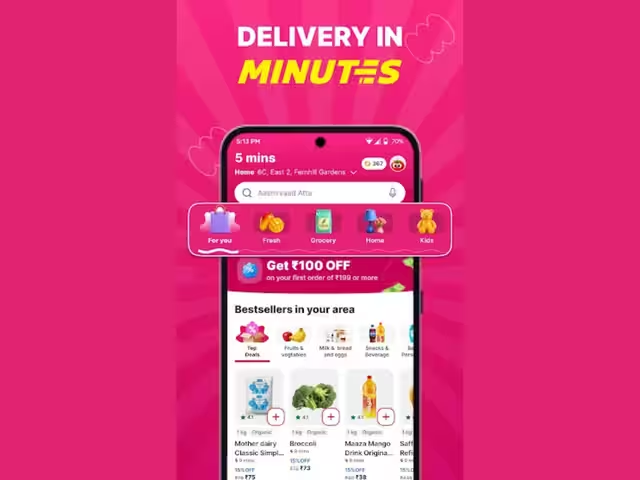
The Walmart-backed e-commerce company is testing a standalone app for its quick-commerce business, Flipkart Minutes, taking the service beyond its earlier position as a feature within the main Flipkart ecosystem.
The standalone Minutes app is currently being offered to a limited group of users in Bengaluru. According to reports, Flipkart is preparing for a wider rollout ahead of its Big Billion Days festive sale in October 2026.
The move could mark an important shift in India’s increasingly competitive quick-commerce market, where Blinkit, Zepto and Swiggy Instamart have already built large standalone businesses.

Why Is Flipkart Giving Minutes Its Own App?
Flipkart Minutes was launched in August 2024 as Flipkart’s quick-commerce offering.
Initially, customers could access Minutes through the main Flipkart app. Giving it a dedicated app could make the service more focused and easier for customers who use quick commerce frequently.
The strategy also reflects how quickly the business has grown.
In June 2026, Flipkart said Minutes had reached 1,000 micro-fulfilment centres across more than 130 cities and 8,000-plus PIN codes, less than two years after launch. The company said orders had increased five times from the previous year.
A standalone application could help Flipkart position Minutes as a dedicated quick-commerce destination rather than simply another service inside its broader e-commerce platform.
Flipkart Minutes Has Already Built a Large Network
Quick commerce depends heavily on local fulfilment infrastructure.
Unlike traditional e-commerce, where an order can travel from a large warehouse to a customer over a day or more, quick-commerce platforms rely on smaller fulfilment centres located close to customers.
Flipkart has been rapidly building this network.
The company says Minutes now has more than 1,000 micro-fulfilment centres across 130-plus cities and 8,000-plus PIN codes. It has also expanded into Tier 2 and Tier 3 markets, where Flipkart says the business has scaled 42 times compared with the previous year.
This expansion is particularly important because India’s quick-commerce market is no longer limited to major metropolitan areas.
What Can Customers Buy on Flipkart Minutes?
Minutes initially focused heavily on everyday essentials and faster delivery.
However, the service has expanded into a much wider selection of categories.
Flipkart has said its quick-commerce platform now covers more than 250 categories. These include groceries and everyday essentials as well as beauty, electronics, wellness and lifestyle products.
This broader assortment is strategically important.
The more categories a customer can purchase through Minutes, the greater the opportunity for frequent usage.
For Flipkart, the objective is not necessarily just to compete for grocery orders. Its existing strength in electronics and other e-commerce categories gives Minutes an opportunity to differentiate itself from platforms that historically built their businesses around groceries and daily essentials.
You May Also Like to Read About:
Flipkart Minutes vs Blinkit, Zepto and Instamart
The standalone app comes at a time when competition in India’s quick-commerce sector is intensifying.
Blinkit, Zepto and Swiggy Instamart have already established strong customer habits around rapid delivery.
Flipkart’s advantage is different.
It already has a large e-commerce customer base and years of transaction data. Minutes can potentially use that existing customer relationship to encourage shoppers to make more frequent purchases.
Recent UBS channel checks reported by Financial Express indicate that 40% to 45% of Flipkart customers in markets where Minutes operates also use Minutes. The same report said Minutes’ average order value, excluding mobile phones, was around ₹500 to ₹530, broadly close to Blinkit and Instamart.
However, Flipkart still has ground to cover in operational efficiency compared with the leading players.
The Electronics Advantage
One of the interesting aspects of Flipkart Minutes is its presence in categories beyond traditional quick-commerce products.
Flipkart has a long-standing strength in smartphones and electronics.
That strength can potentially help Minutes generate larger baskets than a service focused primarily on groceries.
Financial Express, citing UBS channel checks, reported that the inclusion of mobile-phone purchases pushes Minutes’ overall order value ahead of Blinkit, although the comparison changes when mobile purchases are excluded.
This could become an important differentiator as quick commerce expands beyond groceries.
Consumers increasingly expect rapid delivery for products such as personal care items, electronics accessories, beauty products and other immediate-use purchases.
How Big Is Flipkart Minutes Today?
Flipkart’s own June 2026 update put the Minutes network at 1,000 micro-fulfilment centres across 130-plus cities and more than 8,000 PIN codes.
More recent industry reporting suggests the network has continued expanding.
TechCrunch reported in August that Minutes had reached approximately 1,020 to 1,050 micro-fulfilment centres and was adding roughly 100 facilities a month. The report said Flipkart was targeting around 1,500 centres by the end of 2026.
This would put Flipkart among the more aggressive quick-commerce expansion stories in India.
But store count alone does not determine whether a quick-commerce business is successful.
Orders per fulfilment centre, average order value, delivery costs, customer retention and contribution margins are equally important.
Why the Standalone App Matters Before Big Billion Days
The timing of the new app is particularly interesting.
Flipkart’s Big Billion Days sale is one of India’s biggest online shopping events, generating significant traffic and purchasing activity.
A standalone Minutes app could give Flipkart an opportunity to establish a separate customer habit before the festive shopping period.
Business Standard reported that the standalone Minutes app was being tested with select users and that a wider rollout was expected ahead of the Big Billion Days sale.
If the rollout happens as expected, the festive season could become an important test of how quickly Flipkart can move customers from its traditional e-commerce platform into frequent quick-commerce usage.
Flipkart Is Not Only Competing With Blinkit and Zepto
The quick-commerce competition is becoming broader.
Amazon has launched Amazon Now, while Reliance-backed JioMart is also expanding its quick-commerce operations.
Recent industry data reported by Financial Express suggests that Flipkart Minutes is currently scaling faster than Amazon Now, with Minutes operating more than 1,000 stores compared with approximately 500 to 600 for Amazon Now.
The established leaders, however, remain considerably larger.
The same report cited approximately 2,443 Blinkit dark stores and 1,171 Instamart stores at the end of the respective reporting periods, illustrating the scale of the challenge facing newer entrants.
What Does This Mean for Indian Consumers?
For consumers, increased competition could mean more choice.
Quick-commerce companies are expanding beyond groceries into electronics, beauty, personal care, toys, lifestyle products and other categories.
Competition may also encourage platforms to improve delivery speed, assortment and pricing.
However, quick commerce is an expensive business to scale.
Every additional fulfilment centre requires investment in property, technology, inventory, employees and delivery infrastructure.
Therefore, the long-term winners will need more than rapid expansion. They will need strong repeat usage and healthy unit economics.
What Happens Next for Flipkart Minutes?
The next major milestone will be the wider launch of the standalone Minutes app.
If the rollout expands nationally, Flipkart will have a dedicated platform for its quick-commerce ambitions rather than relying entirely on traffic from the main Flipkart app.
The company has already built significant infrastructure and expanded beyond major metros.
Now it needs to turn that infrastructure into sustainable customer demand.
The bigger question is whether Flipkart can use its enormous existing customer base to close the gap with Blinkit, Zepto and Instamart.
The standalone app suggests the company believes it can.
Frequently Asked Questions
What is Flipkart Minutes?
Flipkart Minutes is Flipkart’s quick-commerce service offering rapid delivery of groceries, everyday essentials, electronics and other products.
Does Flipkart Minutes have its own app?
Flipkart is currently testing a standalone Minutes app with select users in Bengaluru. A broader rollout is expected ahead of the Big Billion Days sale in October 2026.
When was Flipkart Minutes launched?
Flipkart launched Minutes in August 2024.
How many Flipkart Minutes fulfilment centres are there?
Flipkart said in June 2026 that Minutes had crossed 1,000 micro-fulfilment centres across more than 130 cities and 8,000-plus PIN codes.
Who are Flipkart Minutes’ main competitors?
Its major competitors include Blinkit, Zepto and Swiggy Instamart. Amazon Now and JioMart are also competing in India’s quick-commerce market.
What can you buy on Flipkart Minutes?
Minutes has expanded beyond groceries and everyday essentials into categories including electronics, beauty, wellness and lifestyle products. Flipkart says the platform now covers more than 250 categories.
The Bigger Picture
Flipkart giving Minutes its own app is more than a simple app launch.
It signals that quick commerce has become important enough for one of India’s largest e-commerce companies to build a dedicated customer proposition around it.
Flipkart already has the customer base, logistics experience and fulfilment infrastructure. Its challenge now is to turn those advantages into frequent quick-commerce usage.
With more than 1,000 fulfilment centres, expansion across smaller cities and a standalone app being tested ahead of the festive season, Flipkart Minutes is clearly preparing for a much bigger fight.
The real question is no longer whether Flipkart wants to compete in quick commerce.
It is how close Minutes can get to India’s established quick-commerce leaders.

Shuchi founded Finance Checks after spending 16+ years working in corporate, managing operations and distribution. She managed her own finances, learned and read regularly and helped people make sense of their savings, loans, insurance, and investments.
She started this site to offer the kind of clear, honest financial guidance she wished was more available when she was learning to manage her own money. Every article is researched personally, checked against official sources such as the Reserve Bank of India, SEBI, or the Income Tax Department, and revisited whenever regulations or figures change. She is upfront about how the site earns money through ads and select affiliate partnerships, and she does not let either influence what she actually recommends to readers.