

Best Credit Cards in India to Convert Reward Points into Airline Miles, Hotel Stays and Dining Benefits in 2026

Looking for the best credit card in India that lets you turn reward points into airline miles, hotel stays or dining benefits? Here’s how HDFC Infinia, HDFC Diners Club Black, Axis Atlas and American Express Platinum compare — and which type of card makes sense for different spending patterns.
Most people choose a credit card by looking at the number of reward points it offers.
That can be a mistake.
A card giving 10,000 reward points is not necessarily better than one giving 5,000 points. What matters is what those points are actually worth when you redeem them.
For someone who travels regularly, the real attraction of a premium rewards credit card is not cashback. It is the ability to convert everyday spending into something tangible — an airline ticket, a hotel stay, an upgrade, airport lounge access, or even a good dinner at a premium restaurant.
In India, a few premium credit cards stand out because they offer a combination of reward points, airline or hotel transfer options, travel redemptions and dining privileges.
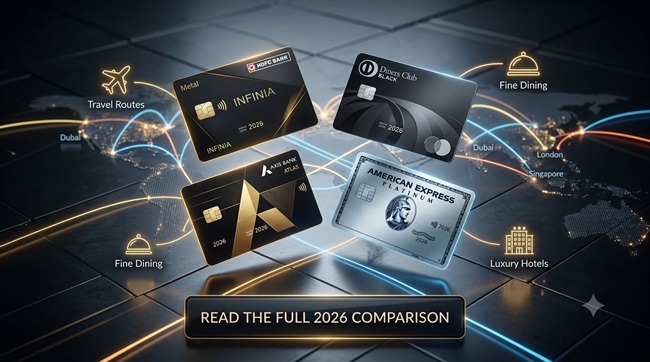
Among them, HDFC Infinia Metal, HDFC Diners Club Black Metal, Axis Atlas and American Express Platinum Charge deserve serious consideration, although they suit very different users.
This guide looks at these cards from one perspective:
How much useful travel and lifestyle value can you realistically get from the money you spend?
Quick answer: If you want one premium card that combines flights, hotels and dining, HDFC Infinia Metal is one of the strongest all-round choices in India. If your primary objective is transferring points into airline miles, a card such as Axis Atlas can be particularly attractive where available. If luxury hotel and dining benefits matter as much as rewards, American Express Platinum Charge operates in a different category altogether.
Best Credit Cards for Airline Miles, Hotel Stays and Dining in India
| Credit Card | Best suited for | Airline/Travel | Hotel benefits | Dining |
|---|---|---|---|---|
| HDFC Infinia Metal | All-round premium rewards | Excellent | Excellent | Excellent |
| HDFC Diners Club Black Metal | Travel + rewards + dining | Excellent | Excellent | Excellent |
| Axis Atlas | Airline miles-focused users | Excellent | More limited after programme changes | Moderate |
| American Express Platinum Charge | Luxury travel & lifestyle | Excellent | Exceptional | Exceptional |
The important point is that these cards should not be treated as interchangeable.
A person who wants free or discounted international flights has a different requirement from someone who wants a weekend hotel stay or restaurant discounts.
1. HDFC Infinia Metal Credit Card
Best for: Flights + hotel stays + premium dining + flexible reward redemption
If you want one card that can cover most premium travel requirements, HDFC Infinia Metal is arguably the most balanced option.
The card is available by invitation and currently carries a joining and renewal fee of ₹12,500 plus applicable taxes. HDFC Bank states that cardholders earn 5 Reward Points for every ₹150 spent on eligible retail transactions. The renewal fee can be waived when the cardholder spends ₹10 lakh or more in the preceding 12 months.
The interesting part is not simply the earn rate.
It is the redemption flexibility.
HDFC currently states:
- 1 Reward Point = ₹1 for flights and hotel bookings
- Up to 1 airline mile per Reward Point for eligible airline-mile conversions
- Up to ₹0.50 per point for products and vouchers
- Up to ₹0.30 per point for statement cashback
- Reward points can also earn accelerated rewards through SmartBuy
- Flight, hotel and airmile redemptions are subject to monthly limits
That last point is important.
Why Infinia works well for travellers
Suppose you accumulate 50,000 reward points. You don’t necessarily have to use them for cashback.
Depending on the redemption option and applicable programme rules, those points can potentially be used for:
50,000 points → ₹50,000 of flight/hotel booking value or potentially transferred into eligible airline miles.
This is fundamentally different from a conventional cashback card.
The value becomes even more interesting for people who use HDFC’s SmartBuy ecosystem, where HDFC advertises accelerated reward earning on eligible travel and shopping transactions.
Hotel and dining benefits
Infinia is not just a miles card.
The current card benefits include complimentary Club Marriott membership for the first year, participating ITC hotel benefits, a 3-night-and-pay-for-2 offer at participating ITC hotels and a 1+1 buffet benefit at participating ITC hotels. Club Marriott also offers dining and stay discounts at participating properties.
That makes the card particularly interesting for someone who wants to convert credit-card spending into family vacations, hotel stays and restaurant experiences, rather than only airline tickets.
Who should consider Infinia?
Infinia makes the most sense for someone who:
- Has substantial annual credit-card spending
- Travels several times a year
- Wants hotel and airline flexibility
- Can make meaningful use of SmartBuy
- Values airport lounge access
- Wants premium dining benefits
- Can justify a ₹12,500 + GST annual fee
- Can potentially meet the ₹10 lakh annual spend requirement for renewal-fee waiver
HDFC also currently lists unlimited domestic and international airport lounge access as a benefit for Infinia cardholders.
One important warning
Do not take Infinia simply because it is considered a premium card.
If you spend only ₹1–2 lakh a year and rarely travel, the annual fee and premium positioning may not make financial sense.
2. HDFC Diners Club Black Metal
Best for: High spenders who want travel, hotel and dining rewards
HDFC Diners Club Black Metal is another serious contender for people who want to build a travel-rewards ecosystem.
HDFC currently lists a ₹10,000 + applicable taxes annual fee and offers 5 Reward Points for every ₹150 spent, along with accelerated rewards on eligible SmartBuy transactions.
The card also has a strong lifestyle proposition.
Depending on the prevailing programme terms, benefits can include:
- Airport lounge access
- Hotel and flight booking benefits
- Club Marriott-related benefits
- Dining privileges
- Golf benefits
- SmartBuy accelerated rewards
HDFC currently advertises up to 10X reward points on eligible hotel and flight bookings through SmartBuy.
Why it deserves consideration
For a high-spending customer, the real advantage is the combination of:
ordinary spending + accelerated travel spending + premium lifestyle benefits.
This makes Diners Club Black Metal particularly attractive for someone who spends heavily on travel and dining.
However, there is one practical consideration:
Diners Club acceptance
Diners Club acceptance has improved significantly, but Visa and Mastercard remain more universally accepted in India and overseas.
Therefore, someone travelling frequently should not necessarily depend on a single payment network.
For some users, the best strategy is to have a premium rewards card alongside a widely accepted backup card.
3. Axis Atlas Credit Card
Best for: People who specifically want airline miles
Axis Atlas is an interesting card because it was designed more around the concept of travel miles than conventional reward points.
The card earns EDGE Miles, which can be used for travel redemptions and, subject to the applicable programme terms, transferred to airline and hotel loyalty programmes. Axis Bank maintains a dedicated miles-transfer programme covering airline and hotel partners.
This is important because the value of a travel card often depends more on the transfer ratio and partner programme than on the headline number of points.
For example, 10,000 bank reward units that convert into 10,000 airline miles may be considerably less attractive than 10,000 units that can convert into a larger airline-mile balance.
Current 2026 market comparisons continue to rate Atlas highly for airline-mile transfers, particularly for users targeting programmes such as Singapore KrisFlyer, Air India Maharaja Club and Flying Blue. However, transfer partners and ratios have changed during 2026, so cardholders should always verify the current transfer table before moving points.
Why Atlas is different
Atlas is particularly interesting if your objective is:
Credit-card spending → EDGE Miles → airline loyalty programme → award flight
rather than:
Credit-card spending → cashback
That distinction matters.
A frequent traveller who knows how to use airline award charts can potentially extract much more value from miles than someone who simply redeems everything for vouchers.
But don’t buy miles blindly
Airline miles are not automatically valuable.
If you transfer 50,000 points into an airline programme and then use them for a poor-value redemption, the theoretical value of the points means very little.
Before transferring:
- Check the flight you want.
- Check the number of miles required.
- Check taxes and fees.
- Check award-seat availability.
- Compare the cash fare.
- Calculate the value per mile.
- Transfer only after confirming availability.
This is one of the biggest differences between a beginner and an experienced travel-rewards user.
You May Also Like To Read About:
4. American Express Platinum Charge Card
Best for: Luxury hotels, premium dining, travel experiences and high-income users
The American Express Platinum Charge Card sits in a different segment.
The current annual fee in India is ₹66,000 plus applicable taxes, and American Express currently states that new card applications in India are temporarily paused while it makes technology-platform updates for domestic card issuing operations.
So this isn’t a straightforward recommendation for someone looking for a conventional rewards credit card.
It is a premium lifestyle card.
The attraction comes from the overall package.
American Express currently advertises:
- Global lounge access
- Fine Hotels + Resorts benefits
- Hotel status benefits
- Premium hotel programmes
- Travel-related privileges
- Dining benefits
- Membership Rewards
- Premium concierge services
The Platinum Card currently offers access to the Fine Hotels + Resorts programme, where eligible bookings can include benefits such as breakfast for two, potential room upgrades, 4 p.m. checkout and a property-specific experience credit. American Express currently lists more than 1,300 participating properties.
For dining, American Express advertises access to EazyDiner benefits, including discounts at participating premium restaurants in India.
The big question: Is ₹66,000 worth paying?
For an average credit-card user, probably not.
For someone who frequently uses:
- Luxury hotels
- Airport lounges
- Premium restaurants
- Hotel status
- Concierge services
- Travel programmes
the calculation can be completely different.
The Platinum Charge Card should therefore be evaluated on total annual benefits, not merely reward points.
Which Credit Card Is Best for Converting Reward Points Into Airline Miles?
If airline miles are your number-one priority, don’t look at the card’s reward-point number alone.
Look at four things:
1. Conversion ratio
How many airline miles do you receive for your bank reward points?
2. Airline partners
A card is far more useful if it works with the airline programmes you actually use.
3. Transfer caps
Some programmes limit how many points can be transferred within a calendar year or membership period.
4. Redemption value
A mile is useful only if you can redeem it for something valuable.
For an India-based frequent flyer, programmes such as Singapore KrisFlyer, Air India Maharaja Club and Flying Blue can be particularly relevant depending on the routes you travel.
Which Credit Card Is Best for Hotel Stays?
This depends on the hotel ecosystem you prefer.
If you regularly stay at participating Marriott properties, the hotel benefits attached to cards such as HDFC Infinia can be useful.
Infinia currently provides Club Marriott membership for the first year and associated hotel and dining benefits.
American Express Platinum takes a different approach, offering access to luxury hotel programmes and status benefits rather than simply giving you a fixed rupee value per reward point.
Therefore:
For regular premium hotel stays: Infinia
For luxury hotel experiences and status: Amex Platinum
For airline-focused travel rewards: Atlas, where currently available and suitable
Which Credit Card Is Best for Dinner and Lunch Outings?
This is where many credit-card comparisons become misleading.
A card can offer a high reward rate but still provide less dining value than a card offering direct restaurant discounts.
There are two separate benefits:
Reward-based dining
You earn points when you pay the restaurant bill.
Direct dining discount
You receive an immediate discount on the restaurant bill.
The second can sometimes be more valuable.
For example, a 20% restaurant discount on a ₹5,000 dinner saves ₹1,000 immediately.
You don’t have to wait months to accumulate points.
HDFC Infinia currently offers Club Marriott and ITC-related dining benefits, including a 1+1 buffet benefit at participating ITC hotels.
American Express Platinum currently advertises EazyDiner benefits with discounts at participating restaurants.
Therefore, someone who eats out frequently should evaluate both reward earning and direct dining discounts.
Reward Points vs Airline Miles: Which Is Better?
This is one of the most important questions. There is no universal answer.
Consider this example.
You have: 30,000 credit-card reward points.
Option A:
Redeem them for ₹9,000 cashback.
Option B:
Use them for ₹30,000 worth of eligible travel booking.
Option C:
Transfer them into an airline programme and use them for a flight that would otherwise cost ₹40,000.
Option C may be the best outcome.
But it requires more effort and availability.
This is why experienced credit-card users generally don’t ask:
“How many points does this card give?”
They ask:
“How much value can I get from every ₹100 I spend?”
How to Calculate the Real Value of a Credit Card
A simple formula can help.
Effective reward value
Effective Reward Value = Value Received ÷ Amount Spent × 100
Suppose you spend ₹5 lakh in a year and receive travel benefits worth ₹20,000.
Your effective return is:
₹20,000 ÷ ₹5,00,000 × 100 = 4%
Now suppose another card gives you ₹25,000 worth of cashback and benefits on the same spending.
Its effective return is:
5%
That card may actually be better, even if its headline reward-point rate looks less impressive.
Should You Use Reward Points for Cashback?
Usually, premium travel cards are most interesting when you don’t treat them like cashback cards.
HDFC’s current Infinia terms illustrate this clearly. The bank lists flight and hotel redemption at ₹1 per reward point, while statement cashback is valued at up to ₹0.30 per point. That is a substantial difference.
So if you have a card where:
1 point = ₹1 for travel
but:
1 point = ₹0.30 for cashback
using it for cashback can destroy a significant portion of the potential value.
Always check the redemption table before pressing the redeem button.
A Better Strategy: Build a Travel Rewards Ecosystem
For someone who spends ₹5–15 lakh or more annually on credit cards, one card may not always be enough.
A sensible strategy can be:
Card 1: Premium reward card
Use it for your largest eligible spending categories.
Card 2: Airline/hotel transfer card
Use it when the transfer ratio or partner programme is particularly attractive.
Card 3: Cashback card
Use it where the premium card provides poor rewards.
Card 4: Zero/low-forex card
Use it for international spending if your premium rewards card has an expensive foreign-currency markup.
This can produce better overall returns than putting every transaction on a single card.
But there is a catch.
Do not collect credit cards simply to collect points.
Every additional card creates another statement, another due date and another opportunity to overspend.
The Most Important Rule: Never Pay Interest to Earn Rewards
This deserves emphasis.
If you earn ₹15,000 worth of reward points but pay ₹20,000 in credit-card interest, you have not earned a reward.
You have paid for it.
Credit-card rewards make sense only when you:
- Pay the total amount due on time
- Avoid revolving credit
- Avoid unnecessary EMI conversions
- Understand annual fees
- Understand reward exclusions
- Use points for high-value redemptions
- Avoid spending extra merely to hit milestones
The reward should be a by-product of spending you were going to do anyway.
Our Verdict: Which Card Should You Choose?
If you want the best all-round premium travel rewards card
HDFC Infinia Metal, It offers a strong combination of reward earning, travel redemption, airline-mile conversion, hotel benefits, dining privileges and lounge access. HDFC currently lists 5 reward points per ₹150 spent and up to 10X reward points through eligible SmartBuy transactions.
If airline miles are your biggest priority
Axis Atlas, subject to current availability and the prevailing transfer-partner terms.
The card’s appeal is its travel-mile structure rather than conventional cashback. However, transfer partners and ratios can change, so verify the current programme before transferring points.
If you want travel + dining + premium lifestyle benefits
HDFC Diners Club Black Metal, It combines reward earning with travel, hotel and dining-related benefits and can be particularly attractive to high spenders who use the HDFC ecosystem extensively.
If you want luxury hotels and premium dining
American Express Platinum Charge
This is a lifestyle product rather than a normal rewards card. Its ₹66,000 annual fee means the benefits have to be actively used to justify the cost. American Express currently has a temporary pause on new applications in India.
Best Credit Card Based on Your Goal
| Your primary goal | Card to consider |
|---|---|
| Airline miles | Axis Atlas, subject to current availability |
| Flights + hotels | HDFC Infinia |
| Hotel + dining | HDFC Infinia |
| Premium travel ecosystem | HDFC Infinia |
| Travel + dining + SmartBuy | HDFC Diners Club Black |
| Luxury hotel experiences | Amex Platinum |
| Premium restaurant benefits | Amex Platinum |
| One-card solution | HDFC Infinia |
| Maximum flexibility | HDFC Infinia / suitable multi-partner card |
| High-end lifestyle benefits | Amex Platinum |
Frequently Asked Questions
Which is the best credit card in India for airline miles?
There is no single best card for every traveller. A card such as Axis Atlas can be attractive for airline-mile transfers, while HDFC Infinia provides broader travel redemption flexibility and airline-mile conversion. The correct choice depends on the airline programme, transfer ratio and your annual spending.
Which credit card is best for converting reward points into airline miles?
Look for a card with a strong airline transfer ratio, useful airline partners and reasonable transfer limits. Do not select a card merely because it offers a large number of reward points.
Can HDFC Infinia reward points be converted into air miles?
Yes. HDFC currently states that Infinia reward points can be converted into airline miles, with up to one airmile per reward point depending on the applicable programme and terms.
Can HDFC Infinia reward points be used for hotel bookings?
Yes. HDFC currently values eligible flight and hotel redemption at ₹1 per reward point, subject to the applicable redemption limits and terms.
Which credit card is best for hotel stays in India?
HDFC Infinia is one of the strongest options for people who want a combination of reward redemption and hotel benefits. American Express Platinum can be more suitable for consumers who specifically value luxury hotel programmes, status and premium hotel benefits.
Which credit card is best for dining in India?
It depends on whether you want reward points or an immediate dining discount. HDFC Infinia has Club Marriott and ITC dining benefits, while American Express Platinum currently provides premium dining privileges including EazyDiner-related benefits.
Is it better to use credit-card points for flights or hotels?
There is no fixed answer. Compare the cash price with the points required. If a ₹30,000 flight requires 15,000 points, you are getting ₹2 per point. If a ₹30,000 hotel requires 30,000 points, you are getting only ₹1 per point.
How do I calculate the value of airline miles?
Use:
Value per mile = (Cash price of ticket − taxes/fees payable with miles) ÷ Number of miles required
The higher the result, the better the redemption.
Should I transfer all my credit-card points to airline miles?
No.
Transfer points only after you have identified a redemption. Airline and hotel programmes can change their award charts, transfer ratios and availability.
Keeping points in a flexible bank rewards programme can sometimes be safer until you know exactly how you intend to use them.
Are airline miles better than cashback?
Not necessarily.
Cashback is simple and predictable. Airline miles can provide significantly higher value, but they require planning, availability and knowledge of loyalty programmes.
For someone who rarely travels, cashback may actually be better.
Is a premium credit card worth the annual fee?
It depends on how much value you actually use.
Calculate:
Annual value of rewards + travel benefits + dining benefits + lounge benefits + vouchers − annual fee
If the result is positive and you are not changing your spending behaviour just to earn rewards, the card may be worth keeping.
Is HDFC Infinia better than HDFC Diners Club Black?
For many high-spending users, both are excellent premium cards. Infinia has particularly strong travel redemption and premium benefits, while Diners Club Black can be attractive for people who make extensive use of HDFC SmartBuy and its lifestyle ecosystem.
The better card depends on your spending pattern and the benefits you actually use.
Is American Express Platinum worth ₹66,000?
For an average cardholder, it is difficult to justify such a fee purely through reward points.
For a frequent traveller who uses luxury hotels, airport lounges, dining benefits, hotel status and premium travel services, the economics can be very different.
The card should be evaluated as a premium lifestyle membership, not simply as a rewards card.
Can I get the American Express Platinum Charge Card in India?
As of September 2026, American Express states that it is temporarily pausing acceptance of new Platinum Card applications in India while it makes planned technology-platform updates for domestic card issuing operations. Existing terms and benefits may continue to be subject to their respective conditions.
Do credit-card reward points expire?
The answer depends on the card issuer and reward programme. Always check the specific card’s current reward programme terms rather than assuming all points have the same validity period.
Should I have more than one credit card?
Possibly, but only if you can manage them responsibly.
A two- or three-card setup can make sense when the cards serve different purposes — for example, one for travel rewards, one for cashback and another for international spending.
There is little benefit in having five cards that all offer essentially the same rewards.
Does spending more on a credit card always mean earning more rewards?
No.
Banks often exclude categories such as rent, fuel, wallet loading, government payments, utilities, insurance or other transactions from accelerated rewards, depending on the card and current programme rules.
Always read the latest reward exclusions before calculating your expected return.
Final Takeaway
The best credit card is not the one with the biggest reward-point number.
It is the card that converts your existing spending into the benefits you actually use.
If your objective is to turn everyday expenses into airline miles, hotel stays and premium dining experiences, HDFC Infinia is one of the strongest all-round options currently available to eligible customers.
If you are primarily interested in airline-mile transfers, a dedicated miles-oriented card such as Axis Atlas can be more compelling when its current transfer terms and availability suit you.
If luxury hotels and premium experiences matter more than pure reward optimisation, American Express Platinum operates at a different level — but its high annual fee means you need to use its benefits extensively.
And there is one rule that should override everything else:
Never spend ₹100 unnecessarily just to earn ₹2–₹5 worth of rewards.
A credit card reward is valuable only when it comes from spending you would have made anyway and when you pay the bill in full and on time.
Disclaimer
This article is intended for general educational and informational purposes only and should not be treated as personalised financial advice, investment advice or a recommendation to apply for any particular credit card.
Credit-card fees, reward rates, transfer ratios, airline and hotel partners, redemption values, eligibility criteria, exclusions, lounge access rules, annual-fee waiver conditions and other benefits can change at the issuer’s discretion.
Reward-point values mentioned in this article are based on the applicable redemption structures available at the time of writing and should not be interpreted as guaranteed monetary returns.
Before applying for or renewing a credit card, readers should verify the latest terms, fees, exclusions, eligibility requirements and reward-programme conditions directly with the card issuer.
Airline miles and hotel points may have limited availability, blackout dates, taxes, surcharges and programme-specific restrictions. A theoretical transfer value does not guarantee that a particular flight or hotel booking will be available.
Credit cards should be used responsibly. Paying only the minimum amount due can result in substantial interest costs and can outweigh the value of rewards earned.
FinanceChecks does not guarantee approval for any credit card and does not represent that any card will be suitable for every individual. Readers should assess their own spending pattern, repayment capacity, annual fees and financial objectives before making a credit-card decision.
Information checked for this article: September 2026.

Shuchi founded Finance Checks after spending 16+ years working in corporate, managing operations and distribution. She managed her own finances, learned and read regularly and helped people make sense of their savings, loans, insurance, and investments.
She started this site to offer the kind of clear, honest financial guidance she wished was more available when she was learning to manage her own money. Every article is researched personally, checked against official sources such as the Reserve Bank of India, SEBI, or the Income Tax Department, and revisited whenever regulations or figures change. She is upfront about how the site earns money through ads and select affiliate partnerships, and she does not let either influence what she actually recommends to readers.