
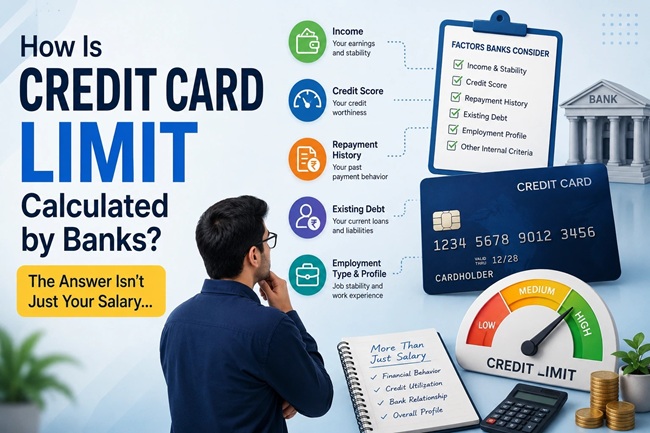
How Is Credit Card Limit Calculated by Banks? The Answer Isn’t Just Your Salary

A colleague of mine applied for a credit card last year expecting a limit of around two lakh rupees, based purely on his salary. He got sanctioned for sixty thousand. Same bank his friend used, similar income bracket, and yet a number nearly a third of what he’d mentally budgeted for. He called the bank, got a vague answer about “internal assessment,” and gave up trying to understand it.
Most people assume credit card limit calculation comes down to one number: how much you earn. It doesn’t. That “internal assessment” banks talk about is actually a fairly specific formula-driven process that weighs your salary alongside several other factors, and once you understand how it works, you can actually influence it — sometimes getting it raised within months, instead of waiting years and hoping.
This post breaks down exactly how banks calculate your credit card limit, why your salary is just the starting point and not the whole answer, and what you can realistically do to get a higher one.

What Exactly Is a Credit Card Limit?
Your credit limit is the maximum amount you’re allowed to spend on your credit card at any given time, set by the bank when they issue the card. It’s not your salary, it’s not your savings, and it’s not related to how much money you actually have sitting in your bank account. It’s purely a ceiling on borrowed money that the bank is willing to extend to you, based on how likely they think you are to pay it back.
There’s an important distinction worth knowing here too: your total credit limit is different from your available credit limit. If your card has a limit of ₹1 lakh and you’ve already spent ₹40,000 this billing cycle, your available limit drops to ₹60,000 until you either pay down the balance or the billing cycle resets. This trips up a lot of first-time cardholders who assume the number on their card statement is always what they have to spend.
How Banks Actually Decide Your Credit Card Limit
This is the part most people never get a straight answer on. Banks don’t look at one number, they run your profile through several factors together, and the final limit is essentially a risk-weighted output of all of them combined.
- Your income is the starting point, but not the whole story. Banks typically use your monthly or annual income to set a baseline range for what limit makes sense, often somewhere between one to three times your monthly salary for a standard card, though this varies significantly by bank and card type. But income alone rarely explains the final number, which is exactly why two people with similar salaries can get very different limits.
- Your credit score carries serious weight. A CIBIL score above 750 signals to the bank that you’ve handled credit responsibly in the past, and lenders are considerably more comfortable extending a higher limit to someone in that range. A lower score, even with a healthy income, often results in a more conservative limit because the bank is pricing in higher perceived risk.
- Your existing debt obligations matter more than people expect. Banks look at your overall debt-to-income ratio, meaning how much of your monthly income is already committed to EMIs, other credit card dues, or loan repayments. If a large chunk of your income is already spoken for, the bank will offer a lower limit, since they’re calculating how much room you realistically have to take on new repayment obligations.
- Your credit history and repayment behavior across other accounts play in too. If you’ve held a credit card or loan before, the bank checks how consistently you paid on time, whether you ever defaulted or paid only the minimum due repeatedly, and how long you’ve maintained those accounts. A longer, cleaner track record tends to unlock higher limits over time.
- The type of card you’re applying for sets its own ceiling. Entry-level or lifetime-free cards typically come with lower default limits, while premium or super-premium cards are designed around higher-income, higher-credit-score applicants and start with meaningfully larger limits baked into the product itself.
- Your relationship with the bank can quietly tip the scales. If you already hold a savings account, fixed deposit, or existing loan with the same bank, they often have more visibility into your financial behavior and may factor that existing relationship into a more favorable limit, sometimes even offering a secured credit card against your FD with a limit tied directly to the deposit amount.
Why Two People With the Same Salary Get Different Limits
This is the question that trips up almost everyone, including my colleague from the story above. The honest answer is that salary is just one input among several, and the other factors — credit score, existing debt, credit history length, even the specific bank’s internal risk model — can pull the final number in very different directions even when income is identical.
A person earning ₹80,000 a month with a clean credit history and no other loans might get offered a higher limit than someone earning ₹95,000 a month who’s already juggling two personal loan EMIs and a mediocre credit score. The bank isn’t just asking “can this person afford it,” it’s asking “how much of this person’s income is truly free to service new credit,” and those two questions produce very different answers.
You May Also Like To Read About:
Can You Get Your Credit Card Limit Increased?
Yes, and this is genuinely within your control more than most people realize. Banks periodically review existing cardholders and offer limit increases automatically to those who’ve shown consistent, responsible usage, but you don’t always have to wait for that review cycle.
Paying your bill in full every month, rather than carrying forward a balance or paying only the minimum due, builds the kind of track record banks look for. Keeping your credit utilization low, generally under 30 percent of your available limit, signals that you’re not overly dependent on borrowed money. You can also proactively request a limit increase through your bank’s app or customer care after six to twelve months of consistent, on-time payments, especially if your income has increased since you first got the card.
Do be aware that some limit-increase requests involve a hard inquiry on your credit report, which can cause a small, temporary dip in your credit score, so it’s worth checking with your specific bank whether their review process is a soft or hard pull before requesting one.
A Quick Comparison of What Moves the Needle
| Factor | Impact on Credit Limit |
|---|---|
| Monthly/Annual Income | Sets the baseline range |
| CIBIL Score (750+) | Strong positive impact |
| Existing EMIs/Loans | Reduces available limit |
| Repayment History | High impact over time |
| Card Type (entry vs premium) | Sets minimum/maximum range |
| Existing Bank Relationship | Moderate positive impact |
| Credit Utilization Ratio | Influences future increases |
Should You Actually Want a Higher Credit Card Limit?
It’s worth pausing here, because a higher limit isn’t automatically a win. A larger limit does lower your credit utilization ratio if your spending stays the same, which can help your credit score. But it also means more room to overspend if you’re not tracking your usage carefully, and for some people, a lower limit actually acts as a useful guardrail against impulse spending. The right limit isn’t the highest one you can get, it’s one that matches how disciplined you actually are with repayment.
Get the regular Financial Tips and Updates, Follow us on Instagram and Youtube
Frequently Asked Questions About Credit Card Limit
What is a good credit card limit for a first credit card? There’s no fixed “good” number, since it depends entirely on your income and credit profile, but first-time cardholders in India commonly start anywhere between ₹20,000 to ₹1 lakh depending on the bank, card type, and income documentation provided.
Does a higher credit card limit mean I have to spend more? No. A credit limit is simply the maximum you’re allowed to spend, not a target. You can hold a ₹5 lakh limit and only use ₹10,000 of it every month if that fits your actual spending needs.
Will requesting a credit card limit increase hurt my credit score? It depends on the bank. Some increases happen through a soft inquiry, which doesn’t affect your score, while others involve a hard inquiry that can cause a small, temporary dip. It’s worth confirming with your bank before requesting one.
Does my credit card limit reset every month? Your available credit limit resets as you pay down your outstanding balance, but your total sanctioned limit stays the same unless the bank specifically increases or decreases it.
Can a bank reduce my credit card limit without telling me? Banks generally notify cardholders before reducing a limit, though this can happen if your repayment behavior changes, your credit score drops significantly, or during periods of broader risk tightening across the industry. It’s worth reading any communication from your bank carefully rather than ignoring it.
Does my credit card limit affect my CIBIL score directly? Not directly, but it affects your credit utilization ratio, which is a meaningful factor in how your score is calculated. A higher limit with the same spending lowers your utilization ratio, which can have a positive effect on your score over time.
How often do banks review credit card limits for existing customers? This varies by bank, but many review accounts for potential limit increases every six to twelve months based on updated income information, repayment history, and overall account behavior.
About This Guide
This guide is part of FinanceChecks‘ ongoing series on credit cards and loans in India, written to help readers understand the decisions banks make behind the scenes so they can manage their credit more confidently. It draws on standard lending and credit bureau practices followed by Indian banks, and is updated periodically to stay current.
Disclaimer
The information in this article is for educational purposes only and should not be considered personalized financial advice. Credit limit decisions vary by bank, card type, and individual applicant profile. Please refer to your specific bank’s terms and conditions and consult a financial advisor for guidance tailored to your situation.

Shuchi founded Finance Checks after spending 16+ years working in corporate, managing operations and distribution. She managed her own finances, learned and read regularly and helped people make sense of their savings, loans, insurance, and investments.
She started this site to offer the kind of clear, honest financial guidance she wished was more available when she was learning to manage her own money. Every article is researched personally, checked against official sources such as the Reserve Bank of India, SEBI, or the Income Tax Department, and revisited whenever regulations or figures change. She is upfront about how the site earns money through ads and select affiliate partnerships, and she does not let either influence what she actually recommends to readers.



[…] How Is Credit Card Limit Calculated by Banks? The Answer Isn’t Just Your Salary […]
[…] How Is Credit Card Limit Calculated by Banks? The Answer Isn’t Just Your Salary […]