

Bank Lost Your Property Documents? Here’s the Legal Process to Get Justice

A Bengaluru homeowner spent 20 years paying off a home loan of ₹1.86 crore. When he finally went to collect his original sale deed after full repayment, the bank couldn’t find it. Not delayed — lost. What followed became one of the most closely watched consumer disputes in Indian banking: the case eventually reached the National Consumer Disputes Redressal Commission (NCDRC), which held the bank liable and ordered a payout running into lakhs for the loss and the mental distress it caused.
If you’re reading this because you’re in some version of that situation right now, the first thing to know is: you’re not without recourse. India actually has a specific regulatory framework for exactly this scenario, put in place by the Reserve Bank of India in 2023 — most borrowers have simply never had to learn it until they needed it. Here’s exactly what the law says, what the bank is required to do, and what steps you should take.
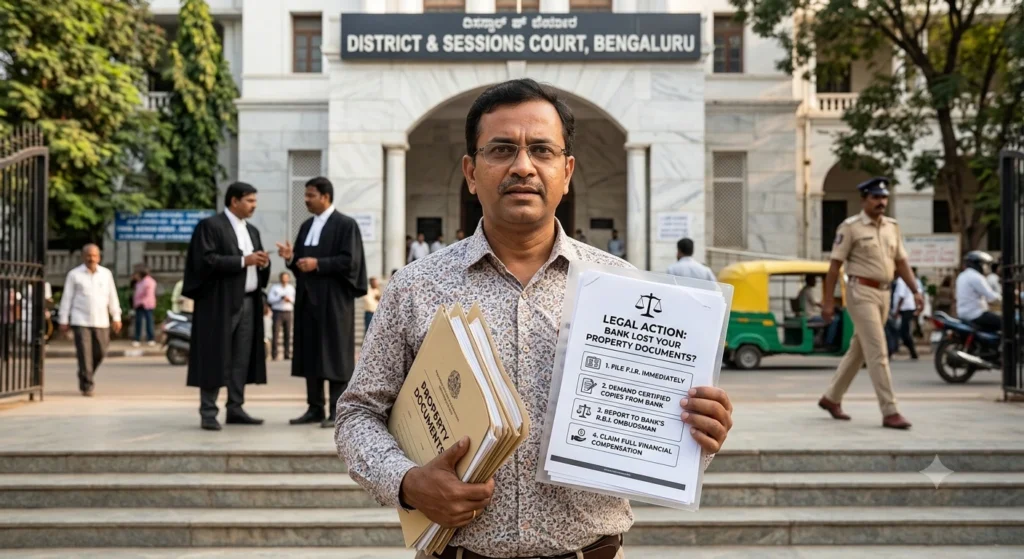
Why This Happens More Often Than You’d Expect
When you take a home loan or a loan against property, the bank keeps your original title documents — sale deed, mother deed, encumbrance certificates, and related papers — as security for the loan, usually stored in a physical vault or sent to a central document-storage facility. Documents move between branches, get sent to third-party storage vendors, or sit in poorly indexed archives for years, sometimes decades, before a loan is finally closed. Misplacement, water damage, misfiling, or loss in transit (including, in some reported cases, loss by courier companies handling inter-branch transfers) are the most common causes. It’s rare, but when a loan runs 15–20 years, the odds of something going wrong along the way are higher than most borrowers assume.
What the RBI Actually Requires Banks to Do
On September 13, 2023, the RBI issued specific directions — applicable to banks, NBFCs (including housing finance companies), asset reconstruction companies, and co-operative banks — governing exactly how original property documents must be handled after a loan is repaid or settled. These directions took effect for all loan closures falling on or after December 1, 2023, and they’re binding, not merely advisory guidance.
The core requirements:
- 30-day release window. The lender must release all original movable/immovable property documents within 30 days of full repayment or settlement of the loan.
- ₹5,000-per-day compensation for delay. If the release is delayed beyond 30 days for reasons attributable to the lender, the lender must pay the borrower ₹5,000 for every day of delay.
- Specific provision for lost or damaged documents. If the original documents are lost or damaged, in part or in full, the lender must assist the borrower in obtaining duplicate or certified copies of the documents, at the lender’s own cost.
- Extended timeline for lost documents. Lenders get an additional 30 days (60 days total from full repayment) to complete this process before the daily compensation penalty starts being calculated.
- This compensation doesn’t cap your other legal rights. The RBI directions explicitly state that this compensation is “without prejudice” to the borrower’s right to seek any other compensation available under applicable law — meaning the ₹5,000/day isn’t a ceiling, it’s a floor.
- Clear process for legal heirs. If the borrower has passed away, the lender must have a defined, published process for returning documents to legal heirs.
This framework exists because, prior to 2023, RBI found that regulated lenders followed wildly inconsistent practices around returning property documents, leading to a steady stream of borrower complaints and disputes.
What Actually Happens When Documents Are Lost: The Real Legal Process
Step 1: The bank must assist you in reconstructing the documents
The first legal obligation on the bank isn’t to pay you — it’s to actively help you get your title re-established. This usually involves:
- Obtaining certified copies of the original sale deed from the Sub-Registrar’s office where the property was originally registered (registered documents are recorded there permanently, so a certified copy can usually be issued even if the original is lost).
- Publishing a public notice in newspapers declaring the original document lost, inviting objections — a standard legal step before a duplicate can be treated as valid for future transactions.
- Filing a police complaint / FIR for the lost documents, which is often required both for the public notice process and to formally establish that the loss wasn’t the borrower’s fault.
- Obtaining a non-encumbrance certificate confirming there are no other claims or liens on the property, and in some cases getting an indemnity bond executed.
- Getting a certified copy of the registered mortgage/loan document and, where applicable, revenue records (like a copy of the property’s record of rights) to support the reconstructed title chain.
Critically — this entire process is supposed to happen at the bank’s cost and initiative, not yours. Many borrowers don’t realize this and end up paying out of pocket for a process the lender was legally obligated to fund and coordinate.
Step 2: Compensation for delay starts accruing automatically
Once the 60-day window (30 days standard + 30 days extension for lost documents) passes without resolution, the ₹5,000-per-day compensation clock starts running, and continues until documents are actually restored or an alternative resolution is reached. Over a few months, this can add up to a genuinely significant sum — several lakhs of rupees isn’t unusual in drawn-out cases.
Step 3: If the bank doesn’t cooperate — escalation and legal remedies
If the bank is unresponsive, slow-walking the process, or disputing its liability, borrowers have several formal channels, roughly in order of escalation:
- Written complaint to the bank’s internal grievance redressal officer, citing the RBI’s September 2023 directions specifically, and requesting a written timeline.
- RBI Banking Ombudsman / Integrated Ombudsman Scheme complaint, if the bank doesn’t resolve the issue within 30 days of your complaint, or resolves it unsatisfactorily. This is a free, regulator-run grievance mechanism specifically meant for exactly this kind of dispute.
- Consumer court (District, State, or National Consumer Disputes Redressal Commission), filed as a “deficiency of service” case under the Consumer Protection Act. This is the route that produced the two major precedents discussed below, and it’s where borrowers can claim compensation well beyond the RBI’s ₹5,000/day figure — including damages for mental agony, litigation costs, and in serious cases, a demand that the bank compensate at the current market value of the property if the title genuinely cannot be restored.
- Civil suit, in more complex cases involving disputed ownership, multiple parties, or where the property’s market value and the bank’s proposed compensation are far apart.
What Real Cases Have Actually Decided
Two cases give a clear sense of how seriously consumer forums are now treating this issue:
- In the widely reported dispute involving a Bengaluru homeowner and ICICI Bank, the NCDRC found the bank liable for a serious deficiency of service after original title documents were lost, and ordered a substantial compensation payout along with litigation costs — though it’s worth noting the bank subsequently challenged the order before the Supreme Court, which stayed the payout portion in December 2023 while the matter remains under review. This shows that even strong consumer forum rulings can face appeal, so outcomes aren’t always final at the first stage.
- In a 2026 order from the Kanchipuram District Consumer Disputes Redressal Commission, the State Bank of India was held liable for failing to return a borrower’s original property documents despite full loan repayment. The Commission directed SBI to either trace and return the original documents or compensate the borrower at the property’s current market value, in addition to the RBI-mandated ₹5,000/day delay compensation, interest, and litigation costs.
The pattern across both cases: consumer forums are willing to go well beyond the RBI’s baseline ₹5,000/day figure when the loss causes genuine, demonstrable harm — and “just get certified duplicates” is not treated by courts as an automatic, risk-free fix, since a reconstructed title can still create friction when the property is eventually sold or refinanced.
What to Do If This Happens to You: A Practical Checklist
- Get everything in writing. Ask the bank to confirm in writing (email is fine) that the original documents cannot be located, along with the date you requested them.
- Cite the RBI circular by name in your written communication — referencing the September 13, 2023 RBI directions on release of property documents signals to the bank that you know your rights, and often speeds up internal escalation on their end.
- Track every day of delay. Keep a simple log from the date of full repayment; this becomes your evidence for the ₹5,000/day compensation claim.
- Don’t sign anything waiving your rights in exchange for the bank simply providing duplicate documents — you’re entitled to both the reconstructed documents and the compensation for the delay, not one or the other.
- File a Banking Ombudsman complaint if there’s no resolution within 30 days of your written complaint — it costs nothing and is designed for exactly this.
- Consult a property lawyer before accepting a settlement, especially if the property’s market value is high, since a lawyer can advise on whether pursuing a consumer court claim makes more sense than a negotiated settlement with the bank.
- Keep copies of everything — your original loan documents, sale deed copies if you have them, registration receipts, and all correspondence — since your own personal copies significantly speed up the reconstruction process.
About This Information
This article is based on the Reserve Bank of India’s official directions dated September 13, 2023 on “Responsible Lending Conduct – Release of Movable/Immovable Property Documents,” issued under the Banking Regulation Act, 1949 and the RBI Act, 1934, along with publicly reported consumer forum rulings, including NCDRC and District Consumer Disputes Redressal Commission orders. Legal outcomes vary by individual case facts, and ongoing litigation (such as the Supreme Court review mentioned above) can change how these rules are applied over time.
Frequently Asked Questions
1. Is a bank legally required to compensate me if it loses my property documents?
Yes. Under RBI’s September 2023 directions, if the delay in resolving lost property documents is attributable to the bank, it must pay ₹5,000 for every day of delay beyond the permitted timeline (60 days from full loan repayment for lost-document cases), in addition to assisting you in obtaining duplicate or certified copies at its own cost.
2. How long does a bank have to return my property documents after I repay my loan in full?
Under normal circumstances, 30 days from the date of full repayment or loan settlement. If the original documents are lost or damaged, the bank gets an additional 30 days (60 days total) to assist in reconstructing them before the daily compensation penalty begins accruing.
3. Can I get more than ₹5,000 per day in compensation?
Yes. The RBI’s ₹5,000/day figure is explicitly described as being “without prejudice” to a borrower’s other legal rights, meaning it’s a floor, not a ceiling. Consumer courts have awarded significantly higher compensation in cases involving genuine hardship, mental agony, and deficiency of service — as seen in reported cases against major Indian banks.
4. What should I do first if I find out my bank has lost my property documents?
Request written confirmation from the bank of the loss, cite the RBI’s September 2023 directions in your communication, and ask for a clear timeline for reconstructing the documents. Start tracking the date of delay immediately, since this becomes the basis for any compensation claim.
5. Can the bank just give me photocopies instead of restoring proper legal documents?
No — plain photocopies don’t carry the same legal standing as certified copies. The bank is required to help you obtain properly certified duplicate documents (typically certified copies of the registered sale deed from the Sub-Registrar’s office, along with associated legal steps like a public notice and, where needed, an indemnity bond), not just informal photocopies.
6. Does losing the original sale deed affect my ability to sell the property later?
It can create friction, since buyers, their lawyers, and their banks (if the buyer needs a loan) will scrutinize a reconstructed title chain more carefully than an original, unbroken one. This is why consumer forums have taken document loss seriously as a genuine harm, not just an inconvenience, and why some rulings have ordered banks to compensate at the property’s market value rather than just facilitating duplicates.
7. What is the RBI Banking Ombudsman, and how do I file a complaint there?
The RBI’s Integrated Ombudsman Scheme is a free, regulator-run grievance redressal mechanism for complaints against banks and other regulated entities. You can typically file a complaint if the bank hasn’t resolved your written complaint within 30 days, or has resolved it unsatisfactorily, through the RBI’s official complaint management portal (cms.rbi.org.in).
8. Should I go to consumer court, or is the Banking Ombudsman enough?
For straightforward delay cases, the Banking Ombudsman is often sufficient and faster. For cases involving significant financial loss, high property value, or where you’re seeking compensation well beyond the RBI’s standard delay penalty, a consumer court (District, State, or National Consumer Disputes Redressal Commission) is generally the more appropriate route, since it has the power to award broader damages.
9. Do these RBI rules apply to all loans, or just home loans?
They apply broadly to any loan where movable or immovable property documents were pledged as security — this includes home loans, loans against property, and similar secured personal loans — across banks, NBFCs (including housing finance companies), asset reconstruction companies, local area banks, and co-operative banks regulated by the RBI.
10. What happens if the borrower has passed away and the documents are lost?
The RBI’s directions specifically require regulated lenders to have a clearly defined, publicly displayed procedure for returning original property documents to legal heirs in the event of the borrower’s death, and the same obligations around lost or damaged documents apply in that process as well.
11. Can I claim compensation for mental stress, not just financial loss?
Yes, in consumer court proceedings specifically — consumer forums in India have awarded compensation for “mental agony” and deficiency of service in cases involving lost property documents, over and above the RBI’s standard daily delay compensation, when the facts support genuine hardship caused by the bank’s failure.
12. Is there a time limit for filing a complaint about lost property documents?
Generally, consumer complaints in India must be filed within two years of the cause of action arising (in this context, typically from when the delay or loss became apparent, or when the bank’s response became unsatisfactory), though this can vary by case — it’s advisable to act promptly and consult a lawyer if significant time has already passed.
Disclaimer: This article is for general informational and educational purposes only and does not constitute legal or financial advice. Regulatory requirements, compensation amounts, and legal outcomes can vary based on individual case facts, the specific lender and loan involved, and ongoing developments in case law (including matters currently under appeal before higher courts). Readers dealing with an actual case of lost property documents should consult a qualified lawyer and formally engage with their bank’s grievance redressal process and, if needed, the RBI Banking Ombudsman, for guidance specific to their situation.

Shuchi founded Finance Checks after spending 16+ years working in corporate, managing operations and distribution. She managed her own finances, learned and read regularly and helped people make sense of their savings, loans, insurance, and investments.
She started this site to offer the kind of clear, honest financial guidance she wished was more available when she was learning to manage her own money. Every article is researched personally, checked against official sources such as the Reserve Bank of India, SEBI, or the Income Tax Department, and revisited whenever regulations or figures change. She is upfront about how the site earns money through ads and select affiliate partnerships, and she does not let either influence what she actually recommends to readers.