
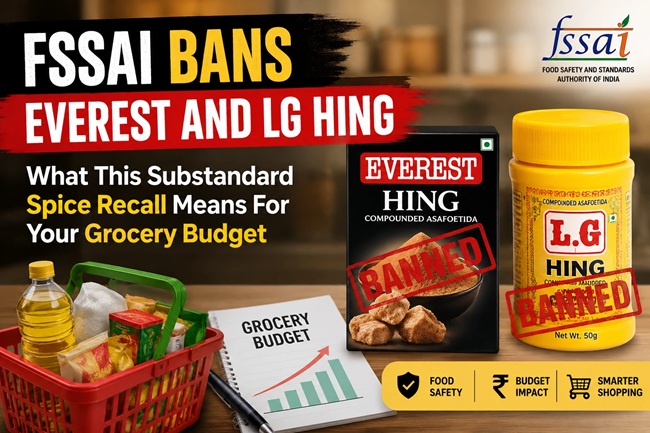
FSSAI Bans Everest and LG Hing: What This Substandard Spice Recall Means For Your Grocery Budget

Rekha had just restocked her kitchen for the month. Two jars of hing sat on her spice rack, one from a brand she had trusted for fifteen years, bought without a second thought because “sabko yahi lagta hai, sabse bada brand hai.” She was scrolling through her phone on Saturday evening, checking her UPI statement to see how much she had spent on groceries that week, when a news alert stopped her. FSSAI had just banned the sale of compounded hing made by Everest and Laljee Godhoo, the brand sitting right there in her kitchen. Her first thought was not about the spice at all. It was about every rupee she had spent trusting a label without ever checking what it actually meant.
That instinct, the one that made Rekha pause and think about her spending rather than just her cooking, is exactly why this story belongs on a personal finance blog and not just in the news pages. Every packaged product you buy is a small financial decision. When the product turns out to be substandard, that decision costs you more than money. It costs you the ability to trust a label again without checking it.
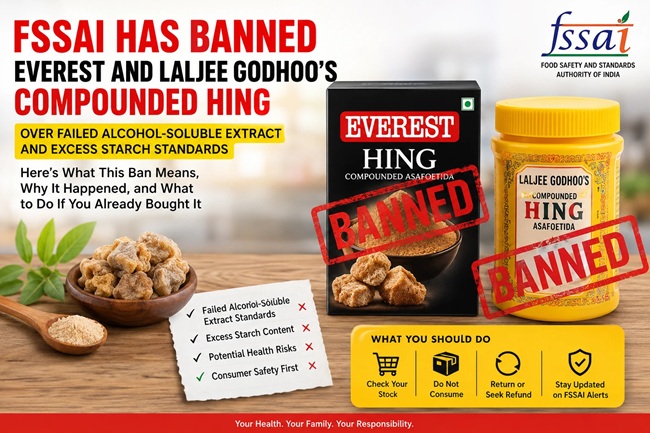
Quick Answer
FSSAI, India’s food safety regulator, issued prohibition orders on Saturday against Everest Food Products Private Limited and Laljee Godhoo and Company, banning the sale of their compounded hing (asafoetida) products with immediate effect. Everest’s samples failed on alcohol-soluble extract, a purity marker that should be at least 5 percent but was found at 0 percent in one sample and as low as 3.29 percent and 4.4 percent in others. Laljee Godhoo’s hing was found to contain excess starch, a filler that by rule should not exceed 1 percent of the product’s weight. Both companies have been asked to submit corrective action plans and have been advised to recall the affected batches voluntarily. If you have either brand’s hing at home, you are not required by law to throw it out immediately, but from a consumer protection and value-for-money standpoint, it makes sense to hold off on repurchasing until the companies confirm compliance.
About This Guide
This guide is based on the official statement issued by the Food Safety and Standards Authority of India (FSSAI) on August 29, 2026, and has been cross-checked against reports from Business Standard, The Week, and IANS. FinanceChecks.com covers this story through a consumer protection and household finance lens, because regulatory actions like this one directly affect how Indian families should evaluate the products they routinely spend money on. We are not affiliated with FSSAI, Everest Food Products, or Laljee Godhoo and Company, and nothing in this article should be read as a certification of any brand’s current safety status. Always refer to FSSAI’s official channels for the latest updates on this matter.
What Exactly Did FSSAI Find
Hing, or asafoetida, almost never reaches Indian kitchens in its pure resin form. It is far too pungent and expensive to use undiluted, so manufacturers blend a small amount of raw asafoetida resin with edible gum, rice flour, or wheat flour to create what is sold as “compounded hing.” This blending is legal and standard practice across the industry. The FSS (Food Products and Food Additives) Regulations, 2011 lay down exactly how much of the real ingredient has to be present for the compounded version to still count as genuine hing rather than flavoured starch sold at a premium.
Two markers decide whether a batch of compounded hing passes or fails. The first is alcohol-soluble extract, which measures how much actual asafoetida resin is present, since resin dissolves in alcohol while fillers largely do not. The prescribed minimum is 5 percent. The second is starch content, which should not cross 1 percent by weight, since starch is meant to be a minor binding agent, not a bulk filler.
In Everest’s case, one sample of compounded asafoetida returned an alcohol-soluble extract of exactly 0 percent, meaning the lab could not detect the resin that is supposed to give hing its flavour and aroma in the first place. Two other variants, sold as Yellow Hing Powder and Black Hing Powder, came in at 3.29 percent and 4.4 percent, both below the required 5 percent floor. FSSAI’s statement noted that routine surveillance samples had shown the same non-compliance pattern, and that earlier reviews of some of Everest’s other products, including Chicken Masala, Garam Masala, and Egg Curry Powder, had already flagged labelling issues.
Laljee Godhoo’s hing, sold under the LG brand, failed on a different parameter. FSSAI found the raw hing varieties used in manufacturing to contain excess starch, pushing the final compounded product beyond the 1 percent limit and into what the regulator classified as adulteration. The company’s compounded hing, in both powder and lump form, was found sub-standard and misbranded.
How This Investigation Started
According to FSSAI, the entire exercise began with a single consumer complaint about the quality of one brand’s hing. Rather than stopping there, the regulator widened its surveillance to cover the major hing brands available in the market. Legal samples were then drawn from the companies’ centrally licensed manufacturing units in Mumbai, and the Gujarat State FDA carried out an inspection of Everest’s state-licensed unit as part of the same exercise. This is worth noting because it shows the system working the way it is designed to. One person’s complaint, properly escalated, led to a nationwide check on a product almost every Indian household buys.
What Happens Next For Everest and Laljee Godhoo
Both companies have been issued Prohibition of Sale orders under the Food Safety and Standards Act, 2006, and are barred from selling the affected hing products with immediate effect until further orders. FSSAI has asked both firms to submit a detailed corrective action plan explaining how they intend to fix the formulation and bring future batches within the prescribed limits. Both have also been advised to initiate a voluntary recall of the substandard stock already sitting on store shelves and in warehouses. FSSAI has warned that failure to comply could invite further regulatory action. Neither company had issued a public response at the time this article was written.
This is not the first time FSSAI has widened a food safety exercise from one complaint into a broader crackdown. Earlier this year, the regulator’s chief executive spoke about the need for stricter monitoring of high-risk food commodities, and this hing action fits into that larger pattern of tighter enforcement across packaged spices, dairy analogues, and branded masalas.
Why This Matters For Your Household Budget, Not Just Your Kitchen
It is tempting to treat this as a food safety story that has nothing to do with money. That would be a mistake. Every time you buy a branded product at a premium over a generic or loose alternative, you are paying for a promise, the promise that the brand name guarantees a certain standard so you do not have to verify it yourself. When that promise breaks, the financial logic behind paying the premium breaks with it.
Think about what you were actually buying when you picked up a jar of premium hing over a cheaper, unbranded one. You were not just buying asafoetida. You were buying the assurance that you would not have to think about whether the product does what it claims. A jar with 0 percent alcohol-soluble extract is functionally flour with a strong smell added to it, sold at a price that assumed you were getting the real thing. That gap between what you paid for and what you received is a silent tax on trust, and it adds up across dozens of packaged products in an average Indian kitchen over a year.
This is also a useful moment to build a habit that pays off well beyond hing. Before restocking any packaged food item, especially spices, ghee, and dairy analogues where adulteration is common, it takes less than a minute to search “FSSAI recall [product name]” or check the FSSAI website’s food alert section. That minute is a better use of your time than the hours it would take to earn back the money spent on a product that turns out to be substandard.
What You Should Actually Do If You Have Everest or LG Hing At Home
If you already have Everest or Laljee Godhoo hing in your pantry, FSSAI’s order is a prohibition on future sale, not a legal requirement for you to dispose of stock you already own. That said, since the affected samples failed on the very parameter that defines whether the product is genuine asafoetida or mostly filler, there is limited practical value in continuing to use it, since it likely will not deliver the flavour you are paying for. From a pure value-for-money standpoint, it makes more sense to hold off on repurchasing either brand’s compounded hing until the companies confirm their corrective action has been accepted by FSSAI, and to keep the receipt or packaging in case a formal recall or refund process is announced.
My Take
What strikes me most about this case is not the hing itself but how ordinary the failure is. This was not a rare contamination scare or a one-off manufacturing error. It was a well-known, long-established brand failing a basic purity test that has existed in Indian food regulation for over a decade, and it happened at scale across multiple product variants. That tells me the gap between what we assume a trusted brand guarantees and what it actually delivers can be wider than most of us think.
For a personal finance blog, the lesson I keep coming back to is that consumer protection and financial literacy are the same skill wearing different clothes. Reading a mutual fund’s expense ratio before investing and checking a spice jar’s FSSAI compliance before buying come from the same instinct, verify before you trust, because premiums are only worth paying when the thing you are paying for actually exists. I would encourage anyone reading this to treat both habits as part of the same discipline rather than separate concerns.
Frequently Asked Questions
1. What products exactly has FSSAI banned? FSSAI has prohibited the sale of compounded asafoetida, commonly known as hing powder, manufactured by Everest Food Products Private Limited, including its Yellow Hing Powder and Black Hing Powder variants, and compounded hing in both powder and lump form manufactured by Laljee Godhoo and Company under the LG brand.
2. Why was Everest’s hing banned specifically? Everest’s compounded asafoetida samples failed on alcohol-soluble extract, a purity indicator that must be at least 5 percent under the FSS (Food Products and Food Additives) Regulations, 2011. One sample tested at 0 percent, and others at 3.29 percent and 4.4 percent, all below the prescribed minimum.
3. Why was Laljee Godhoo’s hing banned? LG’s compounded hing and the raw hing used to manufacture it were found to contain excess starch, a filler that is legally capped at 1 percent by weight in genuine compounded asafoetida.
4. Is it illegal for me to keep using the hing I already bought? No. FSSAI’s order prohibits the companies from selling these products going forward. It does not require consumers to discard stock they already own, though continuing to use it means you likely will not get the flavour or quality you paid for.
5. Can I get a refund for the hing I already purchased? FSSAI has advised both companies to initiate a voluntary recall, which sometimes includes a refund or exchange process. Keep your receipt and packaging, and watch for official recall communication from the retailer or company where you purchased the product.
6. Does this mean all Everest or LG products are unsafe? No. This action is specific to compounded hing (asafoetida) products from both companies. FSSAI’s order does not extend to their other spice or masala products, though the regulator did note earlier labelling-related non-compliances in some of Everest’s other items.
7. How did FSSAI find out about this? The investigation began with a single consumer complaint about one brand’s hing quality. FSSAI then widened its surveillance to cover major hing brands in the market and collected legal samples from the companies’ licensed manufacturing units.
8. What is compounded hing and why is it different from pure asafoetida? Pure asafoetida resin is too strong and expensive to use directly in cooking, so manufacturers blend a small quantity of it with edible gum or flour to create compounded hing, which is what almost all branded hing sold in India actually is. This blending is legal as long as it meets the prescribed minimum resin content and maximum filler limits.
9. What should I check before buying spices or packaged food going forward? Look for the FSSAI license number on the packaging, check the manufacturing and expiry dates, and if you have any doubt about a specific brand, a quick search for “FSSAI recall” along with the product name takes only a minute and can save you from buying a substandard product.
10. Will this affect the price of hing in the market? It is too early to say. If a large volume of stock is recalled and manufacturers need to reformulate, there could be short-term supply tightness for these two brands specifically, though other compliant brands and loose hing sold through spice markets are unlikely to see any direct impact.
Disclaimer
This article is intended for general informational and educational purposes only and is based on publicly available reports of an FSSAI regulatory action as of August 29, 2026. It does not constitute legal, medical, or consumer advocacy advice, and FinanceChecks.com is not affiliated with FSSAI, Everest Food Products Private Limited, or Laljee Godhoo and Company. Regulatory situations can change quickly; readers should verify the latest status directly through FSSAI’s official website or press releases before making purchasing or disposal decisions.

Shuchi founded Finance Checks after spending 16+ years working in corporate, managing operations and distribution. She managed her own finances, learned and read regularly and helped people make sense of their savings, loans, insurance, and investments.
She started this site to offer the kind of clear, honest financial guidance she wished was more available when she was learning to manage her own money. Every article is researched personally, checked against official sources such as the Reserve Bank of India, SEBI, or the Income Tax Department, and revisited whenever regulations or figures change. She is upfront about how the site earns money through ads and select affiliate partnerships, and she does not let either influence what she actually recommends to readers.