
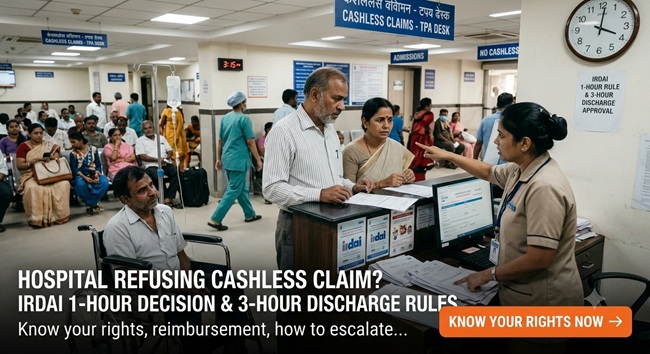
Cashless Claim Denied at the Hospital? Your Rights, the One-Hour Rule and What to Do Next

By the FinanceChecks.com Editorial Team | Published October 12, 2026 | Last reviewed October 12, 2026 | 10-minute read
It is the worst possible moment to discover a problem with your insurance. A family member has been admitted, the paperwork is moving, and then someone at the hospital desk says the insurer has not approved the cashless request, so please pay a deposit. You hold a health policy that you have paid for, sometimes for years, and you are being asked to find lakhs of rupees in the middle of an emergency.
India’s insurance regulator has anticipated exactly this situation. Since 2024, insurers have faced hard clocks on cashless requests, including the “one-hour rule” that most people have heard of and few know how to use. This guide explains what the rule actually says, what it does not promise, why cashless gets denied, and the step-by-step actions that protect both your health and your money.

Quick Answer
Under the IRDAI Master Circular on Health Insurance Business of May 29, 2024, an insurer must decide a cashless authorisation request within one hour of receiving it from the hospital, and must give final authorisation within three hours of the hospital’s discharge request. If the insurer overruns the three hours, the extra hospital charges caused by the delay are to be borne by the insurer, and the policyholder should not be made to wait for discharge. The rule sets a deadline for a decision, not a guarantee of approval, so a cashless request can still be denied or only partly approved. If cashless is denied, you can pay the bill and file a reimbursement claim, which the insurer is expected to settle within 30 days of receiving the last necessary document, with interest at 2% above the bank rate for any delay. If you disagree with a rejection, you can escalate to the insurer’s grievance officer, IRDAI’s complaint portal and the Insurance Ombudsman.
About This Guide
This guide was compiled by the FinanceChecks.com editorial team using IRDAI’s Master Circular on Health Insurance Business (May 29, 2024), government data on cashless authorisation timelines shared in Parliament in December 2025, and published explainers on IRDAI’s health insurance rules. Regulations and circulars can be updated and interpretations differ, so we describe the rules at the level of what they require and recommend checking the current text on the IRDAI website and your own policy wording. This is general information, not legal advice.
The Rule in Plain English
There are two separate clocks, and people often mix them up.
| Stage | What happens | The deadline |
|---|---|---|
| Pre-authorisation | The hospital sends the insurer or its TPA (the third-party administrator that handles claims) a request for cashless treatment | The insurer must decide within one hour of receiving the request |
| Final authorisation | At discharge, the hospital sends the final bill for approval | The insurer must give final authorisation within three hours of the hospital’s discharge request |
| Delay beyond three hours | The insurer misses the discharge deadline | The extra amount the hospital charges because of the delay is borne by the insurer, not you |
The circular also says a policyholder should not be made to wait for discharge, and that if a patient dies during treatment, the insurer must process the settlement request immediately and facilitate the release of the body from the hospital. The rule applies to health insurers and standalone health insurers selling indemnity cover.
You May Also Like To Read About:
- Top Reasons Health Insurance Claims Get Rejected in India
- What Happens If You Miss an Insurance Premium Payment? Grace Period, Lapse and Revival Explained
- Claim Settlement Ratio Is the Most Misleading Number in Indian Insurance, Here’s What to Check Instead
- What Happens to Insurance if Both the Insured Person and Nominee Die in the Same Accident?
- Insurance Scams in India Explained: Real Cases, How They Work, and How to Verify a Genuine Policy
What the One-Hour Rule Does Not Do
It is important to be realistic, because the rule is often described as if it forces an approval.
It is a deadline for a decision, not a promise of approval. The insurer can approve, approve part of the cost, ask for more information or reject. What it cannot do is leave you waiting indefinitely.
The clock starts when the insurer receives a complete request. If the hospital is slow to send documents, or the request is incomplete, the one-hour period does not start in the way you might hope. This is why it helps to ask the hospital desk to confirm exactly when the request was sent.
It does not remove the hospital’s own rules. A hospital can have its own deposit or billing practices, and items your policy does not cover, such as certain consumables, can still be billed to you.
It does not apply in the same way outside the network. Cashless is normally tied to network hospitals, although the Master Circular pushes insurers towards wider cashless access, and some insurers allow cashless at non-network hospitals on conditions, so ask your insurer what applies to you.
How Often Does the Clock Actually Work?
Government data tabled in Parliament in December 2025 suggests the system is working most of the time but not always. Between August 1, 2024 and May 31, 2025, about 87% of pre-authorisation requests were decided within one hour, and about 97% of final authorisations were granted within three hours. That means roughly one in eight pre-authorisations and one in thirty final authorisations missed the deadline, which is why knowing your rights matters.
Why Cashless Gets Denied
A denial rarely means the claim itself is invalid, and the reason determines your next move.
| Reason | What is going on | What you can do |
|---|---|---|
| Hospital not in the network | Cashless is generally offered at network hospitals | Ask your insurer whether non-network cashless is available, or pay and claim reimbursement |
| Incomplete pre-authorisation form | The doctor’s notes, diagnosis or estimate are missing | Ask the hospital to resubmit with the missing details and note the time |
| Waiting period or pre-existing condition | The insurer thinks the condition falls within a waiting period | Ask for the written reason, check the 60-month moratorium, and pay and claim if needed |
| Alleged non-disclosure | The insurer says a condition was not declared at purchase | Ask for the specific basis in writing and escalate |
| Treatment not covered | The procedure is an exclusion, or the sum insured has run out | Check the policy wording and the remaining sum insured |
| Room rent limit | You chose a room above your limit, which triggers proportionate deductions | Ask for the itemised deductions and see our guide to claim rejection reasons |
| A dispute between hospital and insurer | Some hospitals suspend cashless for certain insurers over rates | Ask which insurers are currently accepted and consider reimbursement |
What to Do at the Counter: The First Hour
| Step | What to do |
|---|---|
| 1. Do not delay treatment | In an emergency, let treatment start first and sort the paperwork in parallel |
| 2. Ask for the status in writing | Ask the hospital desk for the time the request was sent and whether it was approved, partly approved or denied |
| 3. Call your insurer’s 24×7 helpline | Quote your policy number and ask the claim status, the reason for any denial and whether the request is complete |
| 4. Ask for the denial reason in writing | A written reason from the insurer or TPA is the basis for any later complaint |
| 5. Get missing documents sent | If the issue is a missing document, have the hospital resend it and note the new time |
| 6. Decide on the fallback | If cashless is not coming, tell the hospital you will pay and claim reimbursement, and ask for itemised bills |
| 7. Keep every original | Bills, receipts, discharge summary, investigation reports, prescriptions and the denial letter |
If You Pay: Your Reimbursement Rights
Paying the bill does not end your claim. A denial of cashless is not a rejection of the claim, and you can still file for reimbursement.
Intimate the insurer quickly. Most policies ask you to inform them within 24 to 48 hours of an emergency admission, so check your wording. Then submit the claim form with the original bills, discharge summary, reports and ID within the time your policy allows, and keep a courier or email record. Insurers are expected to settle within 30 days of receiving the last necessary document, or within about 45 days where an investigation is needed, and a delay should carry interest at 2% above the bank rate. Ask for a written acknowledgement and a claim number.
When the Insurer Misses the Clock
If the insurer takes more than an hour to decide or more than three hours at discharge, write it down. Note the time the hospital submitted the request, the time of any response and the discharge request time, and ask the hospital to give you these in writing. If the delay pushes you into extra charges, such as another day of room rent, these are meant to be borne by the insurer under the circular. Raise this in writing with the insurer and ask for the extra amount to be paid or reimbursed.
The Escalation Ladder
| Step | Where | What to expect |
|---|---|---|
| 1 | The insurer’s grievance redressal officer | Insurers are expected to acknowledge a complaint within a few days and respond within about 14 days |
| 2 | IRDAI’s complaint portal, Bima Bharosa, or its toll-free grievance line | A regulator-supervised complaint that the insurer must answer |
| 3 | The Insurance Ombudsman | A free forum for claims up to ₹30 lakh, normally used after the insurer rejects or does not reply within about 30 days, with a time limit of about one year |
| 4 | Consumer commission | A court-like route for deficiency in service, with compensation possible |
The timelines above are the commonly stated ones, so confirm current details on the IRDAI and Ombudsman websites before relying on them for a deadline.
A Complaint That Gets Results
A short, factual complaint works better than a long emotional one. State your name and policy number, the hospital and admission date, the time the cashless request was submitted, the time and nature of the insurer’s response, the reason given for the denial, the amount you were asked to pay and the specific rule you rely on, such as the one-hour and three-hour timelines in the Master Circular. Attach the supporting documents and ask for a specific outcome, such as approval of the claim, reimbursement of the extra charges or interest for the delay.
Common Mistakes People Make
The most damaging mistake is accepting a verbal denial and leaving it there, when a written reason is the foundation of everything that follows. Another is paying the deposit and forgetting to keep itemised bills, which can weaken the reimbursement claim. People also assume that a cashless denial means the insurer has rejected the claim, when it often just means the cashless route is not available. Some wait to intimate the insurer, which can create avoidable disputes, and some do not note the times, which makes the one-hour and three-hour rules hard to enforce. Many also forget the 60-month moratorium, after which most claims cannot be contested on grounds of non-disclosure or pre-existing disease except in proven fraud cases.
My Take
The one-hour rule is best understood as a pressure valve, not a guarantee. It makes delay expensive for the insurer and gives you a clear timetable to hold them to, and the government data shows it works for most families. But the people who benefit are the ones who can show times and documents when the clock is missed.
If you take one habit from this guide, make it this: at the hospital counter, ask for the time the request was sent and for any denial in writing. Those two pieces of paper turn an argument into a complaint with evidence, and they are what the insurer, the regulator and the Ombudsman will ask for.
Frequently Asked Questions
1. What is the one-hour rule for cashless claims? Under IRDAI’s 2024 Master Circular, an insurer must decide a cashless authorisation request within one hour of receiving it from the hospital.
2. What is the three-hour rule? The insurer must give final authorisation within three hours of the hospital’s discharge request. If it takes longer, the extra hospital charges caused by the delay are to be borne by the insurer.
3. Does the one-hour rule guarantee my cashless claim will be approved? No. It is a deadline for a decision. The insurer can approve, partly approve, ask for more information or reject, but it must decide within the time.
4. What if cashless is denied? You can pay the bill and file a reimbursement claim. A cashless denial is not the same as claim rejection.
5. How long does reimbursement take? Insurers are expected to settle within 30 days of receiving the last necessary document, or about 45 days where an investigation is needed, with interest at 2% above the bank rate for delay.
6. Can I get cashless at a non-network hospital? It depends on your insurer. Cashless is normally tied to network hospitals, but some insurers offer it elsewhere on conditions, so ask your insurer directly.
7. Who bears the extra charges if the insurer delays discharge approval? Under the circular, the extra amount the hospital charges due to a delay beyond three hours is borne by the insurer.
8. What should I ask for at the hospital if cashless is denied? The time the request was sent, the insurer’s decision and the reason in writing, and itemised bills if you will pay.
9. Where can I complain if the insurer is wrong? Start with the insurer’s grievance officer, then IRDAI’s Bima Bharosa portal or grievance line, then the Insurance Ombudsman, and then the consumer commission if needed.
10. Does the Insurance Ombudsman charge a fee? No. It is a free forum, normally for claims up to ₹30 lakh, usually used after the insurer rejects the complaint or does not reply in time.
How We Verified This Information
This guide was researched using IRDAI’s Master Circular on Health Insurance Business dated May 29, 2024 as described in several published explainers, and Parliament data from December 2025 on authorisation timelines as reported by Upstox. Details on reimbursement timelines, grievance steps and the Ombudsman come from secondary summaries and may have been updated, so we flagged the commonly stated figures and recommend confirming them on the IRDAI and Ombudsman websites.
Disclaimer
This article is for general informational purposes only and does not constitute legal or insurance advice. Policy terms, IRDAI circulars and complaint procedures differ by insurer and can change. Readers facing an actual dispute should refer to their policy wording, contact their insurer and, where needed, a qualified professional. FinanceChecks.com is not an insurance company or a licensed insurance advisor.
Last reviewed and fact-checked on October 12, 2026 by the FinanceChecks.com Editorial Team.

Shuchi founded Finance Checks after spending 16+ years working in corporate, managing operations and distribution. She managed her own finances, learned and read regularly and helped people make sense of their savings, loans, insurance, and investments.
She started this site to offer the kind of clear, honest financial guidance she wished was more available when she was learning to manage her own money. Every article is researched personally, checked against official sources such as the Reserve Bank of India, SEBI, or the Income Tax Department, and revisited whenever regulations or figures change. She is upfront about how the site earns money through ads and select affiliate partnerships, and she does not let either influence what she actually recommends to readers.