
Sent Money to the Wrong UPI ID? Here’s What Actually Happens Next (The Real Recovery Process)

Last updated: July 2026
About This Guide: Written by the Financechecks.com Editorial Team, Personal Finance Researchers. This article has been researched using RBI circulars, NPCI’s official dispute resolution guidelines, and the RBI Integrated Ombudsman Scheme, and is reviewed for accuracy as regulations are updated.
It’s a very specific kind of panic. You hit send, watch the little green checkmark appear, and then notice — a split second too late — that the name on the confirmation screen isn’t the one you expected. Maybe autofill picked the wrong saved contact. Maybe you typed one digit of a UPI ID wrong. Either way, ₹15,000 (or worse, ₹1,50,000) has just left your account and gone to a complete stranger.
India processes well over 1,000 crore UPI transactions every month. Even a tiny fraction of a percent going to the wrong recipient adds up to hundreds of thousands of misdirected payments happening every single day. If this has happened to you, you’re not careless, and you’re not alone — but what you do in the next few hours genuinely determines whether you get that money back.
Here’s the real process, not the WhatsApp-forward version.
First, the Myth You Need to Let Go Of
The single biggest misunderstanding about wrong UPI transfers is this: once a payment has successfully gone through and the money has actually credited into a valid recipient’s account, your bank cannot reverse it on its own, and NPCI cannot force the reversal either. UPI is designed to move money instantly and irreversibly, the same way handing someone cash works — once it’s in their hand, getting it back depends on their cooperation, not a button someone can press on your behalf.
This is different from a transaction that fails or times out due to a technical glitch. If money is deducted from your account but doesn’t actually reach anyone due to a system error, RBI rules require the recipient’s bank to reverse that amount automatically, typically by the next working day. That specific scenario resolves itself. A wrong UPI ID, where the transaction genuinely succeeds and lands in someone else’s real account, does not.
Understanding this distinction upfront changes how you should think about the whole process — you’re not waiting for an automatic fix. You’re actively working through a defined escalation chain, and speed is the single biggest factor in whether it works.
Why Speed Matters More Than Almost Anything Else Here
Complaints raised within the first 24 to 48 hours have meaningfully better recovery odds than those raised days later, for a simple reason: the recipient hasn’t had time to spend the money yet, and your bank still has a fresh, verifiable transaction trail to act on. The longer you wait, the more likely the funds have already moved out of that account.
The moment you notice the mistake, before doing anything else, take a screenshot of the transaction success screen. You’ll need the UTR (UPI Transaction Reference Number) — a 12-digit number every UPI transaction generates — along with the exact amount, date, time, and the wrong UPI ID or account the money went to. Every step from here on will ask you for these details.
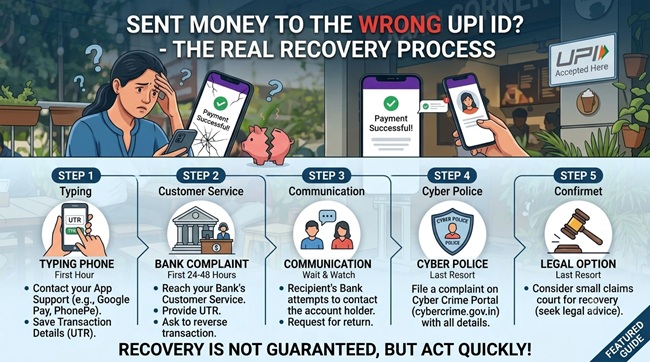
The Actual Recovery Process, Step by Step
Step 1: Raise a dispute directly in your UPI app. Whether you use Google Pay, PhonePe, Paytm, or your bank’s own app, locate the specific transaction and use the “Raise Dispute” or “Report an Issue” option, selecting a category like “Wrong receiver” or “Money sent to wrong UPI ID.” Do this as soon as you notice the error — most apps allow this within a few days of the transaction, but sooner is always better.
Step 2: Contact your bank directly, in writing. In parallel with the in-app dispute, contact your bank’s customer care or visit a branch, and formally report the incorrect transfer, quoting your UTR number. Ask specifically that they invoke what’s commonly referred to as the RBI 48-hour rule — under RBI’s guidelines, once a bank receives a wrong-credit complaint, it’s required to proactively contact the recipient’s bank to inform the unintended recipient that funds were received in error. Banks don’t always do this automatically unless you specifically request it, so putting your ask in writing and getting a complaint reference number matters.
Step 3: Let your bank coordinate with the recipient’s bank. Once your complaint is registered, your bank raises a reversal request with the beneficiary’s bank. The recipient’s bank is expected to reach out to the account holder and ask them to authorise a return of the funds. If the recipient agrees and cooperates, refunds typically land back in your account within 24 to 72 hours of that agreement.
Step 4: Escalate to NPCI if your bank doesn’t resolve it. If there’s no resolution through your bank within roughly 7 to 15 working days, or if you’re unsatisfied with the response, escalate the complaint through the NPCI’s official dispute resolution portal. You can also call NPCI’s dedicated toll-free helpline at 1800-120-1740, or write to upihelp@npci.org.in, quoting your UTR and complaint details. NPCI doesn’t hold or move your money directly — it’s the payment infrastructure body, not a bank — but it can formally investigate and direct both banks involved to act.
Step 5: Approach the RBI Banking Ombudsman if it’s still unresolved after 30 days. If your bank hasn’t resolved the matter within 30 days of your original complaint, or you’re dissatisfied with the outcome, you can file a complaint with the RBI’s Integrated Ombudsman Scheme, free of cost, through the RBI’s Complaint Management System at cms.rbi.org.in. This is a formal grievance redressal mechanism specifically designed for situations exactly like this.
The Recovery Timeline at a Glance
| Stage | Where to Go | Typical Timeframe |
|---|---|---|
| Report the transaction | Your UPI app + your bank (in writing) | Immediately, ideally within 24-48 hours |
| Bank-to-bank reversal request | Your bank contacts recipient’s bank | 7-15 working days |
| Escalation if unresolved | NPCI dispute portal / helpline | 15-30 working days |
| Final escalation | RBI Banking Ombudsman (cms.rbi.org.in) | After 30 days of no resolution |
These are typical ranges based on standard grievance redressal timelines, not guaranteed deadlines — actual resolution time can vary depending on how quickly each bank responds and whether the recipient cooperates.
What If the Recipient Simply Refuses to Return the Money?
This is the scenario everyone dreads, and it’s worth understanding your actual legal standing here, not just the informal process. Neither your bank nor NPCI has the power to compel someone to return money that landed correctly in their valid account — their role is limited to facilitating contact and formally requesting a return. If the recipient refuses, this becomes a legal matter rather than a purely banking one.
Under the Indian Contract Act, 1872, a recipient who knowingly retains money that was clearly sent to them by mistake is generally considered to have been unjustly enriched, and is legally obligated to return it. Deliberately refusing to return funds you know weren’t meant for you can also be treated as a matter for law enforcement, since it can amount to dishonest retention of property.
If you’ve exhausted the bank and NPCI channels and the recipient still won’t cooperate, you have two further options:
- File a complaint with India’s National Cyber Crime Reporting Portal or call the 1930 helpline, particularly if you suspect the money was diverted deliberately or there’s any element of fraud involved, rather than a genuine accidental transfer on both sides
- Pursue the matter legally, through a civil recovery claim, if the amount involved justifies the time and cost of that route
For most genuine accidental transfers, it rarely reaches this point — most recipients, once formally contacted by their own bank, do return money that clearly wasn’t meant for them. But it’s worth knowing this escalation path exists if cooperation doesn’t come.
How to Avoid This Happening in the First Place
- Always check the recipient’s name confirmation screen before entering your UPI PIN. Every UPI app displays the registered name tied to the UPI ID or account you’re paying, right before you confirm — this single habit catches the vast majority of wrong-recipient mistakes before the money actually leaves
- Double-check autofilled or saved contacts, especially if a friend or vendor has changed their UPI handle recently
- Be extra careful with amounts that don’t match your usual pattern. A larger-than-usual payment is exactly the moment to slow down and re-verify, not rush through
- Save the correct UPI ID as a verified contact in your app once confirmed, rather than manually re-typing it every time
Common Mistakes People Make After a Wrong Transfer
- Waiting too long to report it. Every extra hour reduces the odds the recipient still has the funds available to return
- Only complaining through the app and not also contacting the bank directly in writing. A written complaint with a reference number creates a paper trail that matters if you need to escalate later
- Assuming NPCI or the bank can just reverse it instantly. As covered above, this isn’t how a successfully completed UPI transaction works — recovery depends on process and cooperation, not a simple undo button
- Trusting unofficial “recovery agent” numbers found on social media. Only use your bank’s official customer care, NPCI’s official helpline, or the RBI’s official ombudsman portal — scammers specifically target people anxious about a wrong transfer with fake “recovery service” offers
- Not escalating when the bank goes quiet. If you don’t hear back within the expected timeframe at any stage, proactively follow up and escalate rather than assuming no news means it’s being handled
Frequently Asked Questions
1. Can I get my money back if I sent it to the wrong UPI ID? Yes, recovery is genuinely possible, but it isn’t automatic or instant. It depends on reporting the transaction quickly, your bank successfully contacting the recipient, and the recipient agreeing to return the funds.
2. Does NPCI automatically reverse a wrong UPI transfer within 24 hours? No, this is a common misconception. NPCI facilitates and investigates disputes between banks but does not automatically reverse successfully completed transactions. Only transactions that failed or timed out due to a technical error are reversed automatically, typically by the next working day.
3. What is the RBI 48-hour rule for wrong UPI transfers? Under RBI guidelines, once a bank receives a complaint about a wrongly credited transfer, it’s required to proactively contact the recipient’s bank to inform the unintended recipient that funds were received in error, generally within 48 hours of the complaint being raised.
4. What information do I need to report a wrong UPI transfer? You’ll need the UTR (UPI Transaction Reference Number), the exact amount, the date and time of the transaction, and the wrong UPI ID or account number the money was sent to. A screenshot of the transaction success screen is the easiest way to have all of this ready.
5. How long does it take to recover money sent to the wrong UPI ID? If the recipient cooperates quickly, funds can be returned within 24 to 72 hours of them agreeing. If it requires escalation through your bank and then NPCI, the process can take anywhere from a few days to 30 days or more, depending on each stage’s response time.
6. What can I do if the recipient refuses to return the money? After escalating through your bank and NPCI, you can file a complaint with India’s National Cyber Crime Reporting Portal or call the 1930 helpline, particularly if fraud is suspected, or pursue a civil recovery claim under the Indian Contract Act, 1872, since knowingly retaining money sent by mistake is generally considered unjust enrichment.
7. Who do I contact if my bank isn’t resolving my complaint? If your bank doesn’t resolve the matter within roughly 30 days, or you’re dissatisfied with the response, you can escalate to the RBI’s Integrated Ombudsman Scheme, free of cost, through the RBI’s Complaint Management System at cms.rbi.org.in.
8. Is there an official NPCI helpline for wrong UPI transactions? Yes, you can call NPCI’s toll-free helpline at 1800-120-1740, or write to upihelp@npci.org.in, quoting your UTR and transaction details.
9. Can a bank reverse a UPI transaction on its own once it’s successfully completed? No. Once a UPI payment successfully credits into a valid recipient’s account, the bank has no unilateral authority to reverse it. Recovery requires the recipient’s cooperation, facilitated through the bank’s and NPCI’s dispute process, or legal escalation if the recipient refuses.
10. How can I avoid sending money to the wrong UPI ID in the future? Always check the recipient’s name displayed on the confirmation screen before entering your UPI PIN, since every UPI app shows the registered account holder’s name tied to the ID you’re paying. Take an extra moment to verify this, especially for larger or unfamiliar payments.
Final Thoughts
A wrong UPI transfer is one of those mistakes that feels catastrophic in the moment but is genuinely recoverable more often than people assume, provided you move quickly and follow the actual process rather than panicking or falling for a fake “instant recovery” service. Report it within your UPI app and your bank in writing within the first day if you possibly can, keep your UTR and complaint reference numbers organised, and escalate methodically through NPCI and, if needed, the RBI Ombudsman rather than giving up after the first quiet week.
The habit that prevents almost all of this, though, costs nothing and takes two extra seconds: actually reading the recipient’s name on the confirmation screen before you enter your UPI PIN. It’s the single most effective thing you can do, and it’s the step nearly everyone who’s been through this wishes they hadn’t skipped.
Disclaimer: This article is for general informational and educational purposes only and should not be treated as legal or financial advice. The processes, timelines, and regulatory provisions mentioned above are based on RBI circulars and NPCI’s publicly available dispute resolution guidelines current as of the stated dates, and are subject to change. Please verify the latest process with your bank, the official NPCI website, or the RBI’s Complaint Management System (cms.rbi.org.in), and consult a qualified legal professional if pursuing formal recovery action.

Shuchi founded Finance Checks after spending 16+ years working in corporate, managing operations and distribution. She managed her own finances, learned and read regularly and helped people make sense of their savings, loans, insurance, and investments.
She started this site to offer the kind of clear, honest financial guidance she wished was more available when she was learning to manage her own money. Every article is researched personally, checked against official sources such as the Reserve Bank of India, SEBI, or the Income Tax Department, and revisited whenever regulations or figures change. She is upfront about how the site earns money through ads and select affiliate partnerships, and she does not let either influence what she actually recommends to readers.



-
-
-
-
-
Show Comments[…] fraud in India isn’t really a technology problem. NPCI’s systems are robust, and UPI itself hasn’t been “hacked” in any meaningful sense. Nearly every rupee lost […]
Terima kasih atas informasinya.
Have you ever considered about adding a little bit more than just your articles?
I mean, what you say is important and all.
But just imagine if you added some great pictures or videos to give your posts more,
“pop”! Your content is excellent but with pics and clips, this
website could undeniably be one of the most beneficial in its niche.
Terrific blog!
Everything is very open with a very clear explanation of the challenges.
It was really informative. Your website is useful. Many thanks
for sharing!
It’s in fact very complicated in this busy life to listen news on TV,
so I simply use world wide web for that reason, and get
the most up-to-date information.