
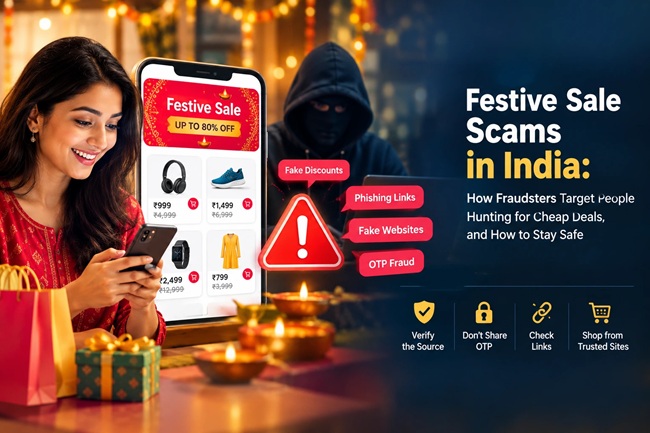
Festive Sale Scams in India: How Fraudsters Target People Hunting for Cheap Deals, and How to Stay Safe

By the FinanceChecks.com Editorial Team | Published October 12, 2026 | Last reviewed October 12, 2026 | 10-minute read
Every October, two things arrive together in India: the biggest online sales of the year and the biggest wave of shopping scams. This week, police in Kerala and Rajasthan have both issued public warnings within a day of each other, as Amazon’s Great Indian Festival and Flipkart’s Big Billion Days run alongside smaller sales on Myntra, Meesho and AJIO. The reason is simple. Millions of people are searching for the lowest price at the same moment, and a scammer only needs to look like the lowest price.
The scams do not usually happen on Amazon or Flipkart. They happen on lookalike sites, in messages that reach you outside the platform, and in phone calls that appear after an order. This guide explains how the common festive scams work, why they are so effective at this time of year, the signs that give them away, and what to do in the first hour if you are caught.
Quick Answer
Scammers exploit festive sales by copying the look of real shopping platforms and offering discounts that are too good to be true. The most common routes are fake shopping websites and apps shared through WhatsApp, SMS and social media ads, lucky-draw and gift messages with links, UPI collect requests disguised as refunds or cashback, fake customer care numbers found through search results, and fake delivery or order-cancellation calls. They work by creating urgency, with messages along the lines of “only two minutes left” or “pay now or the offer expires,” so that you pay before you verify. The safest habits are to type the website address yourself, install apps only from the official app stores, never approve a UPI request to receive money, and get customer care numbers only from the official app or website. If you lose money, call 1930 or report at cybercrime.gov.in immediately, because the first hour matters most.

About This Guide
This guide was compiled by the FinanceChecks.com editorial team using public advisories from the Kerala and Rajasthan police issued on October 9 and 10, 2026, Tamil Nadu cyber crime wing warnings about fake discount websites, earlier CERT-In advisories on festive gift messages, and industry analyses of festive-season fraud patterns. We describe how each scam works at the level of the pattern and the warning signs, and we do not reproduce complete messages that could be reused. Scam tactics change quickly, so treat this as a guide to the underlying habits that protect you.
Why Festive Sales Are Prime Time for Scammers
Several things line up at once, and fraudsters know it.
Your price anchor is already broken. During a sale, every product is advertised at 50 to 80% off, so a “70% off” offer on a lookalike site does not feel unusual. A scam that would look suspicious in March looks normal in October.
Everyone is shopping at the same time. Heavy traffic means people are clicking quickly, comparing many tabs and receiving many genuine messages about orders and deliveries. A fake message blends into the noise.
Urgency is part of the sale itself. Countdown timers and “only a few left” labels are normal on real platforms, so scammers’ pressure tactics look familiar. Rajasthan Police specifically pointed to phrases such as “Buy today,” “Only two minutes left” and “Pay now or the offer expires” as designed to push hasty decisions.
People are spending more and paying digitally. Festive spending, gifting and travel bookings mean larger payments through UPI and cards, which is exactly what fraudsters want to redirect.
The Scam Map at a Glance
| Scam | How it reaches you | What it is after | The giveaway |
|---|---|---|---|
| Fake shopping website | Social media ads, WhatsApp forwards, search ads | Your payment, which never produces a product, and your card details | A web address with a slightly different spelling, prices far below every other seller |
| Fake shopping app | A link or file shared on WhatsApp or a download site | Access to your phone, messages and banking apps | The app does not come from the official Play Store or App Store |
| Lucky draw and gift links | WhatsApp, SMS, email | Personal and bank details, or a “processing fee” | You won something you never entered, and the message asks you to forward it |
| UPI collect request | A payment request dressed up as a refund or cashback | Money out of your account | You are asked to approve or enter your PIN to receive money |
| Fake customer care | A number found through a search result or social post | OTPs, card details, remote access to your phone | The number is not from the official app or website |
| Fake delivery or order cancellation call | A call or message about an order you may or may not have placed | A small payment, then card details, or a link | A request for payment or a link to confirm a delivery |
| Gift card and voucher resale | Discounted vouchers offered by third parties | Payment for codes that do not work | Vouchers sold well below face value through unofficial sellers |
| Fake festive products | Ads for crackers, sweets, jewellery or gifts at deep discounts | Your payment | A brand-new site with no reviews outside its own page |
| Fake travel deals | Festive holiday and ticket offers | Advance payments for bookings that do not exist | Payment requested to a personal account |
How the Main Scams Work
Fake websites. A fraudulent site copies the look of a known brand or invents a new one and advertises deep discounts through social media ads or forwarded links. In Tamil Nadu, the cyber crime wing recorded complaints about fake websites selling discounted crackers, with victims drawn in by ads on Instagram, YouTube and Facebook. Kerala Police advised checking the spelling of web addresses carefully because fraudulent sites often use names with small variations, and Rajasthan Police added that a padlock icon or HTTPS does not prove a site is genuine, since scammers can obtain those too.
Fake apps. Lookalike apps with names that echo a sale event circulate through WhatsApp links and unofficial download sites, promising “app-only” deals. Installing one can give a fraudster access to your messages and the apps on your phone, which can include banking apps. This is the same malware route we described in our guides on random international calls and on KYC update scams.
Lucky-draw and gift messages. Messages claim you have won a gift or voucher and ask you to click a link and forward it to friends. CERT-In has warned in the past that such campaigns spread through WhatsApp, Telegram and Instagram, push users to enter personal and bank details, and often use links with unusual domain endings. The forward-it-to-others instruction is part of how they spread.
UPI collect requests. Here you receive a request that looks like a refund or cashback, and approving it, or entering your UPI PIN, sends money out of your account instead of into it. The rule to remember is that you never need to enter a PIN to receive money. Our guide to your rights in UPI fraud explains what protection exists and why speed matters.
Fake customer care. Searching for the helpline of a shopping platform or a bank can bring up sponsored results or social posts with fraudulent numbers. Rajasthan Police specifically advised against trusting customer care numbers found through search engines or social media, and to use the support options inside the official app or website instead. Scammers on these lines typically ask for OTPs, card details or for you to install a screen-sharing app.
Fake delivery and cancellation calls. A call or message says an order is stuck, needs cancelling, or needs a small fee to be delivered, and it directs you to a link or a payment. The pattern is to start from something you may really be waiting for and slip in a payment request.
You May Also Like To Read About:
- SBI Warns of UPI Fraud: How the ‘Jumped Deposit Scam’ Can Drain Your Bank Account
- Your Rights If You Are a Victim of UPI or Online Banking Fraud
- Fraud Isn’t Just Calls and SMS Anymore: How Fake Websites Are Stealing From Indians Right Now
- SMS Fraud Alert: How to Tell a Genuine Bank Message From a Scam
- Deepfake KYC Fraud Is Here: How Scammers Are Using AI to Open Accounts in Your Name
- UPI Fraud: The 7 Scams Costing Indians the Most Money Right Now
The Red-Flag Check: Real vs Fake
| Check | Genuine | Scam |
|---|---|---|
| Where you shop | You open the official app, or type the address yourself | You click a link from WhatsApp, SMS, a social ad or a forward |
| The price | Close to what other trusted platforms show, even in a sale | Far below everyone else, with no clear reason |
| The payment | Through the platform’s own checkout | To a personal UPI ID or bank account, or through a link in a chat |
| Customer care | Reached through the official app or website | A number from a search result or a message |
| Urgency | A real timer on the official site | Messages pressing you to pay within minutes |
| Requests | Never asks for your OTP or UPI PIN | Asks for an OTP, PIN, card details or to install an app |
| The seller | An established seller with a verifiable history | A new site or profile with no history |
A Safe Shopping Routine
A few habits remove most of the risk without taking the fun out of the sale.
First, go to the shop yourself. Open the official app, or type the address into your browser, rather than clicking a sale link someone sent. This single habit defeats most fake-website, phishing and lucky-draw scams. Second, install shopping apps only from the official Play Store or App Store, and never from a file shared in a chat. Third, check any deal that looks extreme against two other trusted sellers before paying. Fourth, pay only through the platform’s own checkout and never to a personal UPI ID or by following a payment link from a chat. Fifth, treat any request for your OTP, UPI PIN or card details as a sign of fraud, whoever is asking. Sixth, get customer care numbers only from inside the official app or website. And seventh, turn on two-factor authentication on your shopping and banking accounts so a stolen password alone is not enough.
If you are buying through a card, ask your bank about a dispute or chargeback if an item never arrives, and keep screenshots of the listing, the order and the payment.
If You Have Already Been Scammed: The First Hour
Speed decides how much can be recovered, so do these in order. Call your bank’s helpline immediately, using the number on the back of your card, to block the card or account and to report the transaction. Call 1930, the national cyber crime helpline, or file a complaint at cybercrime.gov.in, since early reports give authorities a chance to freeze the receiving account. Keep every screenshot, message, link, payment receipt and phone number, and do not delete anything. If you installed an app or shared a screen, disconnect the phone from the internet, avoid banking apps on it and get it checked or reset. Report the fake site, ad or profile to the platform where you saw it. And change the passwords of any account you used.
Common Mistakes People Make
The most common mistake is paying on a site first and checking it later, when the check takes less time than the payment. Another is trusting a padlock icon or a professional-looking design, neither of which proves a site is real. People also search for customer care numbers instead of using the app, and end up calling the scammer. Many approve a UPI request thinking it is a refund. Some install an app from a forwarded file because it promises a bigger discount. And some wait a day before reporting out of embarrassment, which is when recovery chances are best lost.
My Take
What makes festive scams so effective is that they do not need to be clever. They need to be fast. A scam works when the victim has no time to compare, and festive sales are designed, legitimately, to remove that time. That makes slowing down your most valuable defence, and it costs nothing.
If a deal is real, it will still be there after you type the address yourself and compare the price on two other places. If it disappears when you try to verify it, it was not a deal. The platform’s real discounts are already large this season, and there is rarely a reason to chase an offer that arrives in a forwarded message.
Frequently Asked Questions
1. Why do scams increase during festive sales? Because millions of people are hunting for discounts and clicking quickly, a fake offer blends in, and time pressure is part of the normal sale experience.
2. How can I tell if a shopping website is fake? Check the address spelling, compare the price with other trusted sellers, look for reviews outside the site itself, and be wary of sites reached through forwarded links or social ads. A padlock icon does not prove a site is genuine.
3. Is it safe to click sale links sent on WhatsApp? It is safer to open the official app or type the address yourself. Police in several states have advised against shopping through links received on WhatsApp, SMS, Telegram or social media.
4. What is a UPI collect request scam? A fraudster sends a payment request that looks like a refund or cashback. Approving it, or entering your UPI PIN, sends money out of your account. You never need a PIN to receive money.
5. Should I search Google for a platform’s customer care number? No. Search results and social posts can carry fake numbers. Use the support option inside the official app or website.
6. Can installing a fake shopping app hurt me? Yes. A fraudulent app can access your messages and other apps, including banking apps. Install apps only from the official app stores.
7. What should I do if I paid a fake site? Call your bank immediately, report to 1930 or cybercrime.gov.in, keep all evidence, and ask your bank about a dispute if you paid by card.
8. Are discounted gift cards from third parties safe? Usually not. Vouchers sold well below face value through unofficial sellers are a common scam, and the codes may not work.
9. Do real platforms ever ask for my OTP or UPI PIN? No. Genuine platforms and banks do not ask for your OTP or PIN to give you an offer or a refund.
10. Where can I report festive shopping fraud? Call 1930 or file a complaint at cybercrime.gov.in, tell your bank and report the fake site or profile to the platform where you saw it.
How We Verified This Information
This guide was researched using the Kerala Police advisory reported by PTI on October 10, 2026, the Rajasthan Police cyber crime branch advisories of October 9 and 10, 2026, Tamil Nadu cyber crime wing warnings, an earlier CERT-In advisory on festive gift messages, and cybersecurity and industry analyses of festive scams. We describe each scam at the level of the pattern and its warning signs, not as a script, and we recommend confirming helpline details on official sites.
Disclaimer
This article is for general informational purposes only and does not constitute legal or cybersecurity advice. Scam tactics change quickly and this guide describes common patterns, not every variant. Readers who believe they have been defrauded should contact their bank and report the incident to the National Cyber Crime Reporting Portal (cybercrime.gov.in) or call 1930. FinanceChecks.com is not a law enforcement agency and does not provide fraud investigation services.
Last reviewed and fact-checked on October 12, 2026 by the FinanceChecks.com Editorial Team.

Shuchi founded Finance Checks after spending 16+ years working in corporate, managing operations and distribution. She managed her own finances, learned and read regularly and helped people make sense of their savings, loans, insurance, and investments.
She started this site to offer the kind of clear, honest financial guidance she wished was more available when she was learning to manage her own money. Every article is researched personally, checked against official sources such as the Reserve Bank of India, SEBI, or the Income Tax Department, and revisited whenever regulations or figures change. She is upfront about how the site earns money through ads and select affiliate partnerships, and she does not let either influence what she actually recommends to readers.



[…] Online shopping fraud often targets consumers looking for discounts, limited-period offers or products advertised at prices substantially below normal retail rates. […]
[…] Festive Sale Scams in India: How Fraudsters Target People Hunting for Cheap Deals, and How to Stay S… […]