
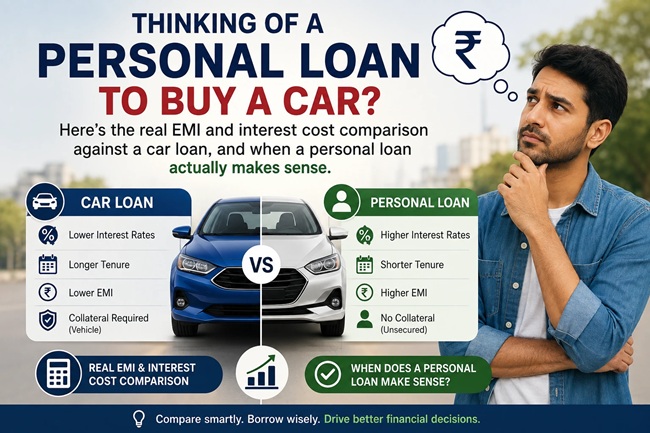

Arjun wanted a used car from a private seller, not a dealership, and his bank’s used car loan scheme wouldn’t finance a vehicle bought that way. His salesperson at another lender suggested a personal loan instead, “same money, no restrictions, you can use it however you want.” It sounded reasonable enough that Arjun almost didn’t bother checking the interest rate difference. He got lucky, a colleague mentioned in passing that personal loans usually cost several percentage points more than car loans, which sent him back to actually run the numbers before signing anything.
That gap turned out to be real, and on an 8 lakh rupee loan, it was the difference between paying around 1.85 lakh rupees in interest and paying well over 3 lakh rupees, for the exact same amount borrowed. Here’s the real cost comparison, and the situations where a personal loan genuinely makes sense anyway, despite costing more.
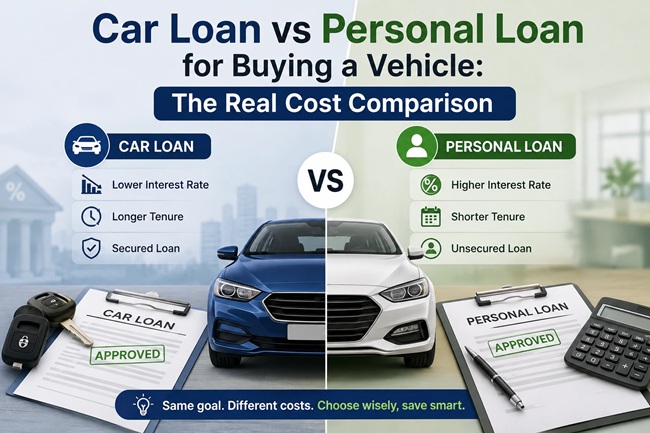
Why Car Loans Are Cheaper: It’s About Collateral, Not the Lender Being Generous
A car loan is a secured loan, the vehicle you’re buying is hypothecated to the bank, meaning the bank has a legal claim on it until you’ve fully repaid the loan. If you default, the bank can repossess the car. This collateral significantly reduces the lender’s risk, which is why car loans consistently come with lower interest rates than personal loans.
A personal loan is unsecured, there’s no asset backing it, which makes it inherently riskier for the lender. That extra risk gets priced directly into a higher interest rate, regardless of how you actually plan to use the money.
The Actual Rate Gap in 2026
As of mid-2026, car loan interest rates in India typically range from around 7.4 to 11 percent per year for new cars, with the most competitive rates going to borrowers with a CIBIL score of 750 or above. Some public sector banks have offered rates as low as 7.4 to 7.6 percent for well-qualified borrowers, while rates can climb to 12 to 14 percent for weaker credit profiles. Used car loans typically carry a somewhat higher rate than new car loans, along with a lower loan-to-value ratio, usually financing 80 to 85 percent of the car’s value rather than up to 100 percent for a new car.
Personal loans, by comparison, typically range from 10.5 to 18 percent per year, depending heavily on your credit score, income, and existing relationship with the lender. Even in the best-case scenario for a personal loan borrower, you’re still likely paying meaningfully more than an average car loan borrower with similar creditworthiness.
What This Actually Costs on a Real Loan Amount
Let’s run the numbers on an 8 lakh rupee loan, roughly what you’d borrow for a mid-range car after a reasonable down payment, comparing a car loan at 8.5 percent against a personal loan at 14 percent, both fairly representative rates for a borrower with a good but not exceptional credit score.
| Loan Type | Rate | Tenure | Monthly EMI | Total Interest Paid |
|---|---|---|---|---|
| Car Loan | 8.5% | 5 years | ₹16,413 | ₹1,84,794 |
| Car Loan | 8.5% | 7 years | ₹12,669 | ₹2,64,212 |
| Personal Loan | 14% | 5 years | ₹18,615 | ₹3,16,876 |
| Personal Loan | 14% | 3 years | ₹27,342 | ₹1,84,316 |
A few things stand out here. Comparing the two 5-year options directly, the personal loan costs roughly 1.32 lakh rupees more in interest alone for identical principal and tenure, purely due to the rate difference. Interestingly, a personal loan repaid aggressively over just 3 years ends up costing almost the same total interest as a car loan stretched over 5 years, which tells you something useful: if you’re considering a personal loan, keeping the tenure as short as your budget allows matters enormously, since the higher rate compounds the cost of every extra year you take to repay it.
Follow us on Instagram and Youtube for more Financial Updates and Knowledge
Where a Personal Loan Actually Makes Sense Despite Costing More
Buying an older used car is probably the most common legitimate reason to choose a personal loan over a car loan. Most car loan schemes, especially from banks, have restrictions on vehicle age, often not financing cars older than 8 to 10 years, and won’t necessarily cover purchases from private sellers rather than dealerships or certified pre-owned outlets. A personal loan has no such restriction, since the lender isn’t tying the loan to a specific asset.
Covering costs beyond the vehicle price itself is another practical reason. A car loan typically finances the vehicle’s on-road price, but if you need extra funds for accessories, extended warranties, or other related expenses beyond what your car loan covers, a personal loan can fill that gap without the paperwork of a second secured loan.
Avoiding hypothecation is a real consideration for some buyers too. With a car loan, the vehicle stays hypothecated to the bank until fully repaid, meaning you’ll need a No Objection Certificate from the bank to sell the car before the loan closes, which adds a step if you’re the kind of buyer who tends to upgrade vehicles every few years. A personal loan gives you full, unencumbered ownership from day one.
Speed and simplicity can also matter in some cases. Personal loan disbursal can sometimes be marginally faster than a car loan, particularly if you already have a pre-approved offer with your bank, since there’s no vehicle-specific documentation or valuation involved.
A Few Practical Tips Worth Knowing Either Way
If you’re going with a car loan, be cautious about financing through the dealership’s in-house financing partner without comparing it against your own bank first. Dealer-arranged financing often carries a rate 0.5 to 1.5 percent higher than what you could secure by approaching a bank or NBFC directly, since dealers typically earn a commission on the loan they arrange.
Regardless of which loan type you choose, a widely used budgeting guideline is keeping your car EMI under 10 to 15 percent of your monthly take-home income. On a take-home salary of 80,000 rupees a month, for instance, that translates to an EMI ceiling of roughly 8,000 to 12,000 rupees, a useful sanity check before committing to a specific loan amount or tenure.
It’s also worth checking if you qualify for any rate concessions. Several banks offer a small interest rate reduction, typically 0.05 to 0.25 percent, for women applicants on car loans, and maintaining a strong relationship with your existing bank can sometimes open the door to a negotiated rate reduction as well.
Car Loan vs Personal Loan at a Glance
| Factor | Car Loan | Personal Loan |
|---|---|---|
| Security | Secured against the vehicle | Unsecured |
| Typical interest rate (2026) | ~7.4% – 11% | ~10.5% – 18% |
| Loan-to-value | Up to 100% for new cars, 80-85% for used | Based on income and eligibility, not asset value |
| Vehicle age restrictions | Usually yes, especially for used cars | Generally none |
| Ownership during loan tenure | Hypothecated to the lender | Fully unencumbered from day one |
| Best suited for | New cars, dealership or certified used car purchases | Older used cars, private sales, or funding beyond the vehicle price |
| Flexibility of end use | Restricted to the vehicle purchase | Can cover accessories, insurance, or other related costs |
About This Guide
This article uses car loan and personal loan interest rate ranges as reported across major Indian banks and lending platforms as of mid-2026. Actual rates depend significantly on your credit score, income, existing banking relationship, and the specific lender’s current offers, so please compare live quotes from multiple banks and NBFCs before deciding. The EMI and interest calculations shown are illustrative examples based on standard loan amortization and don’t include processing fees or other charges, which vary by lender.
Common Mistakes People Make Choosing Between These
Defaulting to whatever financing option the dealership presents first, without comparing it to a bank’s direct offer, is one of the most common and avoidable mistakes, given how consistently dealer-arranged rates run higher than what’s available directly from a bank.
Choosing a personal loan purely for its flexibility, without actually running the interest cost comparison, is another frequent misstep. The flexibility is real and sometimes worth paying for, but it’s worth knowing exactly what that flexibility costs in rupee terms before assuming it’s the better choice.
People also often stretch their loan tenure purely to lower the monthly EMI, without accounting for how much extra total interest a longer tenure adds, especially on a personal loan where the rate is already higher. As the table above shows, tenure length can matter as much as the rate itself in determining your total cost.
Finally, some buyers don’t check their eligibility for rate concessions or negotiate at all, simply accepting the first rate quoted, even when a slightly better relationship with the bank or a specific eligibility category could have shaved a meaningful amount off the total interest paid.
My Take
For most people buying a reasonably new car through a standard dealership or certified pre-owned channel, a car loan is going to be the cheaper, more sensible choice almost every time, the rate gap is simply too large to ignore for the sake of convenience alone. Where a personal loan genuinely earns its higher cost is in the specific situations a car loan doesn’t comfortably cover, an older private-party purchase, extra funds beyond the vehicle price, or wanting to avoid hypothecation entirely. The mistake isn’t choosing a personal loan in those situations, it’s not doing the math first and assuming both options cost roughly the same.
Frequently Asked Questions
1. Is a car loan always cheaper than a personal loan? In most cases, yes, since car loans are secured against the vehicle, which typically results in a lower interest rate than an unsecured personal loan. However, actual rates depend on your credit profile and the specific lender.
2. What is the current car loan interest rate in India? As of 2026, car loan rates typically range from around 7.4% to 11% per year for new cars, with the best rates going to borrowers with a CIBIL score of 750 or above.
3. Can I use a personal loan to buy a car? Yes, personal loans can be used for any purpose, including buying a car, and are especially useful for older used cars or private-party purchases that many car loan schemes don’t cover.
4. Why do dealerships offer higher interest rates than banks for car loans? Dealership-arranged financing typically comes through a partner lender that pays the dealer a commission, which is often reflected in a rate 0.5% to 1.5% higher than what you could get by approaching a bank directly.
5. What is the maximum age of a used car that qualifies for a car loan? This varies by lender, but many banks restrict used car loans to vehicles under 8 to 10 years old, and often require the purchase to be from a dealership or certified pre-owned outlet rather than a private seller.
6. How much car loan EMI can I afford based on my salary? A common guideline suggests keeping your car EMI within 10% to 15% of your monthly take-home income, though your overall existing debt obligations should also factor into this decision.
7. Does a car loan affect my ownership of the vehicle? Yes, the car remains hypothecated to the lender until the loan is fully repaid, meaning you’ll need a No Objection Certificate from the bank to sell the vehicle before that point.
8. Are there interest rate concessions for women on car loans? Yes, several banks offer a rate concession, typically 0.05% to 0.25%, for women applicants on car loans.
9. Should I choose a shorter or longer tenure for my vehicle loan? Generally, the shortest tenure you can comfortably afford results in significantly less total interest paid, especially important for personal loans given their higher base interest rate compared to car loans.
10. Can I get 100% financing for a new car? Some lenders offer up to 100% financing of the on-road price for new cars with strong borrower profiles, though many still require a down payment, and used car loans typically cap financing at 80% to 85% of the vehicle’s value.
Disclaimer
This article is for informational and educational purposes only and does not constitute financial advice. Interest rates for car loans and personal loans vary by lender, borrower profile, and market conditions, and are subject to change. The EMI and interest examples in this article are illustrative calculations based on standard amortization and don’t account for processing fees or other charges. Please compare current rates from multiple lenders and consult a financial advisor before making a borrowing decision.

Shuchi founded Finance Checks after spending 16+ years working in corporate, managing operations and distribution. She managed her own finances, learned and read regularly and helped people make sense of their savings, loans, insurance, and investments.
She started this site to offer the kind of clear, honest financial guidance she wished was more available when she was learning to manage her own money. Every article is researched personally, checked against official sources such as the Reserve Bank of India, SEBI, or the Income Tax Department, and revisited whenever regulations or figures change. She is upfront about how the site earns money through ads and select affiliate partnerships, and she does not let either influence what she actually recommends to readers.