
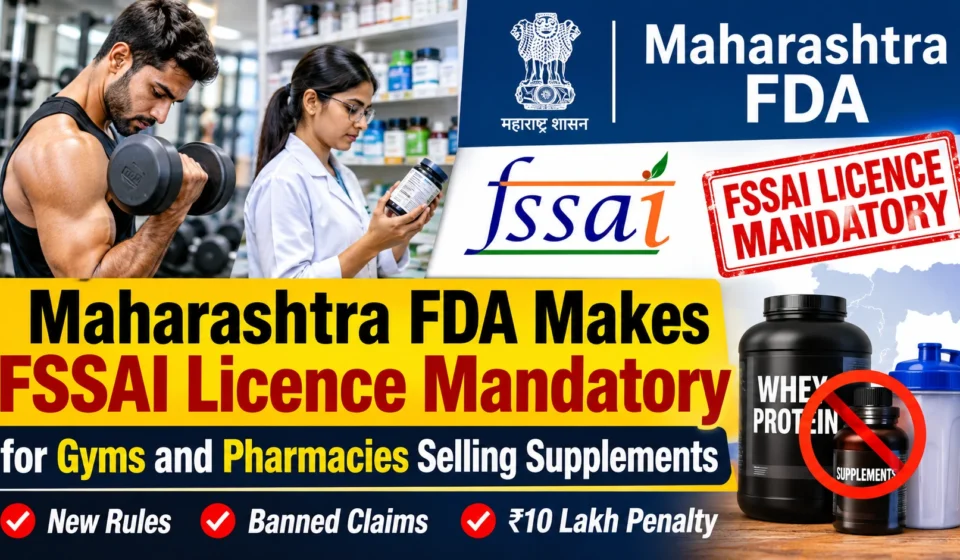
Maharashtra FDA Makes FSSAI Licence Mandatory for Gyms and Pharmacies Selling Supplements: New Rules, Banned Claims and ₹10 Lakh Penalty Explained

Maharashtra FDA’s November 2026 order brings gyms, fitness centres, pharmacies, supplement brands, online sellers and social media influencers under stricter scrutiny. Here’s what businesses and consumers need to know.
The Maharashtra Food and Drug Administration (FDA) has announced a major crackdown on the health supplement and nutraceutical industry, making FSSAI licences or registrations mandatory for gyms, fitness centres, pharmacies and medical stores selling these products.
The statewide order, issued by Maharashtra FDA Commissioner Tukaram Mundhe on November 20, 2026, requires businesses dealing in health supplements to comply with food safety regulations even if they already hold licences under other laws.
The action comes after the FDA seized health supplement stock worth approximately ₹1.38 crore from 17 establishments across Maharashtra during inspections conducted on November 13. Authorities also raised concerns about unauthorised ingredients, misleading product claims and suspected undeclared steroids or pharmaceutical substances.
The new compliance requirements extend beyond manufacturers and retailers. Distributors, importers, e-commerce platforms, hospital suppliers, gymnasiums and even social media influencers promoting health supplements are now under the regulatory scanner.
For India’s rapidly growing fitness and nutrition industry, the order could mean significant changes in how supplements are sold, advertised and recommended.
What Has Maharashtra FDA Ordered?
The Maharashtra FDA has issued a statewide compliance order covering health supplements, nutraceuticals, foods for special dietary use, foods for special medical purposes, prebiotic and probiotic foods and novel foods.
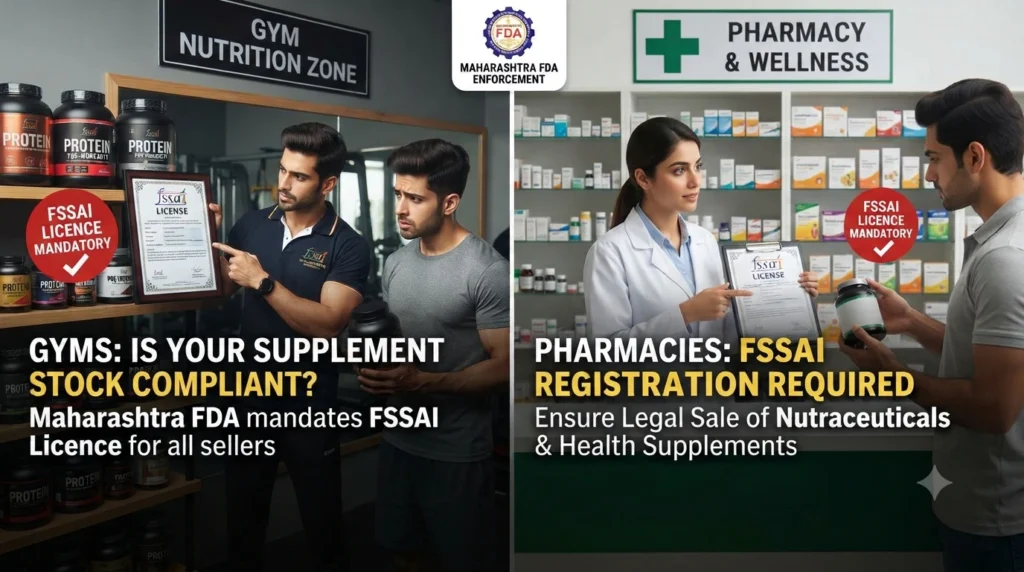
One of the most important requirements is that gyms, fitness centres, pharmacies and medical stores selling these products must obtain the relevant FSSAI food licence or registration.
Having a drug licence, gym registration or any other business permission does not automatically fulfil this requirement.
The order also directs businesses across the supply chain to follow existing FSSAI licensing, product approval, labelling and advertising requirements.
According to reports, the state currently has around 1,100 operative food business licences in the health supplement and nutraceutical categories, including 313 manufacturers, 759 relabellers and 28 repackers.
You May Like To Read About:
- FSSAI Warns Red Bull: How Much Sugar Is in One Can, and How to Check Any Drink Label
- Everest Cumin Powder Found ‘Unsafe’ in FSSAI Test: What Happened, and What You Should Do If You Have It at Home
- Nestle Low Fat Dairy Whitener Sale Banned: Why FSSAI Called It ‘Unsafe, Substandard’
- FSSAI’s Paneer Update: What Can Legally Be Called “Paneer” and What Cannot
1. Gyms and Pharmacies Must Obtain FSSAI Registration or Licence
This is among the biggest changes for businesses selling supplements directly to consumers.
Many gyms and fitness centres sell products such as:
- Whey protein and protein powders
- Creatine and pre-workout supplements
- Amino acid supplements
- Multivitamin and mineral supplements
- Weight-loss and fat-burning products
- Herbal and sports nutrition products
Under the new order, gyms and fitness centres selling products covered by the regulations must obtain the appropriate FSSAI licence or registration.
The same requirement applies to pharmacies and medical stores selling health supplements and nutraceuticals.
Businesses cannot rely solely on an existing drug licence or other business registration.
The relevant FSSAI registration or licence must cover the applicable food business activity and product category.
Importantly, this requirement concerns businesses selling or handling regulated food products. It does not mean that individuals purchasing or consuming protein powder or other supplements need an FSSAI licence.
2. New Labelling Requirements for Health Supplements
The FDA has also tightened scrutiny of product labels to ensure consumers receive accurate information about what they are purchasing.
Health supplement and nutraceutical packaging must carry relevant product information, including:
- Product category and intended use.
- Target age group.
- Nutrient quantities and applicable Recommended Dietary Allowance (RDA) percentages.
- Probiotic strain details, wherever applicable.
- Recommended usage limits.
- Safety precautions and warnings.
- Details of the specific plant parts used in herbal ingredients.
One particularly important requirement is the warning:
“NOT FOR MEDICINAL USE”
This warning must be prominently displayed on applicable health supplement packaging.
The requirement is intended to make it clear that health supplements are food products and should not be mistaken for medicines.
Consumers should also check the recommended daily dosage, ingredient list and applicable warnings before purchasing a supplement.
3. Medical Claims and Doctor-Recommended Promotions Face Restrictions
The Maharashtra FDA has taken a particularly strong position against misleading health claims.
Manufacturers, marketers, sellers and promoters cannot present health supplements as products that treat, cure, mitigate or prevent diseases.
For example, advertisements suggesting that a protein powder cures a medical condition or that a particular supplement prevents a disease could violate the applicable regulations.
The order also prohibits misleading representations such as:
- “Doctor recommended” or “recommended by nutritionists”.
- Claims suggesting that a product is clinically prescribed.
- Use of doctors’ photographs to create an impression of medical endorsement.
- Claims that position a food supplement as a replacement for medical treatment.
The use of the term “ORS” in a product’s name, brand name or trademark has also been prohibited under the order.
The restrictions are not limited to product packaging. They also apply to advertising on websites, e-commerce platforms and social media.
4. Social Media Influencers and Fitness Trainers Under the Scanner
The new order is particularly significant for India’s fitness influencer ecosystem.
Fitness trainers, nutritionists and social media influencers frequently promote protein powders, fat burners, herbal supplements and other nutritional products through Instagram, YouTube and other platforms.
Under the reported compliance requirements, influencers promoting these products through misleading or prohibited claims can also face regulatory scrutiny.
This means promotional content should not make unsupported medical claims or suggest that a supplement can replace prescribed medicines or professional medical treatment.
Brands working with influencers will also need to review their advertising scripts, product descriptions, testimonials and promotional campaigns.
For businesses, the implications extend beyond obtaining an FSSAI licence. Their marketing and influencer partnerships must also comply with applicable food advertising and labelling regulations.
5. Maharashtra FDA Seizes Supplements Worth ₹1.38 Crore
The statewide crackdown follows inspections conducted on November 13 across 17 establishments in six Maharashtra divisions.
The FDA seized products worth ₹1,38,95,852 during the operation.
The reported division-wise seizure values were:
| Maharashtra division | Seized stock value |
|---|---|
| Nagpur | ₹57.30 lakh |
| Konkan (Thane) | ₹47.65 lakh |
| Pune | ₹30.57 lakh |
| Nashik | ₹1.99 lakh |
| Chhatrapati Sambhajinagar | ₹1.42 lakh |
| Amravati | No seizure reported |
| Total | ₹1.38 crore approximately |
The FDA identified products containing Magnesium Acetyl Taurate and Nicotinamide Mononucleotide (NMN), ingredients for which product approval applications had reportedly been rejected by FSSAI.
Samples were sent for laboratory analysis amid concerns about potentially unsafe, substandard or misbranded products.
Importantly, the seizure does not mean that every product involved has been conclusively established as unsafe. Further regulatory action will depend on the relevant laboratory findings and investigation.
The FDA has also indicated that it will prioritise inspections of sports nutrition, weight-loss, sexual-wellness, herbal and imported supplements.
6. What Penalties Can Businesses Face?
Non-compliance can have serious financial and regulatory consequences.
Under the Food Safety and Standards Act, 2006, the applicable provisions include:
| Violation | Potential consequence |
|---|---|
| Operating a food business without a required licence | Penalty up to ₹10 lakh |
| Misleading food advertisements | Penalty up to ₹10 lakh |
| Non-compliant or unsafe products | Regulatory action, including seizure and other applicable penalties |
| Serious violations | Possible licence suspension, cancellation, recall or criminal proceedings, depending on the offence |
The FDA has warned that violations could also lead to imprisonment where applicable, particularly in serious cases involving injury or death.
However, the ₹10 lakh penalty for operating without a required licence and the penalty for misleading advertisements should not be confused with imprisonment. The consequences depend on the specific violation and applicable legal provisions.
What Should Gym Owners, Pharmacies and Supplement Businesses Do Now?
Businesses selling health supplements in Maharashtra should review their compliance arrangements instead of waiting for an inspection.
Here are five practical steps:
1. Check your FSSAI licence: Determine whether your business requires registration or a state or central licence based on its activities, turnover and applicable eligibility criteria.
2. Verify product approvals: Check whether the products you manufacture, distribute or sell comply with applicable FSSAI regulations and ingredient approval requirements.
3. Review product labels: Ensure that applicable warnings, nutrient details, recommended usage, age group and other mandatory declarations are correctly displayed.
4. Audit marketing claims: Remove unsupported disease-related claims, misleading doctor endorsements and prohibited promotional representations from advertisements and websites.
5. Maintain purchase and distribution records: Keep supplier invoices, product details, batch information and traceability records to support regulatory inspections and product recalls where necessary.
Businesses should also review their influencer contracts and ensure that promotional content follows food advertising requirements.
What Does the New Order Mean for Consumers?
For consumers, the Maharashtra FDA’s crackdown is an important reminder that not every product marketed as a health supplement is necessarily safe or compliant.
A product being available at a gym, pharmacy or through a popular fitness influencer does not automatically make it reliable.
Before purchasing a health supplement, consumers should:
- Check the FSSAI licence or registration details.
- Read the complete ingredient list.
- Look for the “NOT FOR MEDICINAL USE” warning where applicable.
- Check the recommended dosage and safety instructions.
- Avoid products promising guaranteed weight loss, muscle growth or disease cures.
- Be cautious about supplements making exaggerated medical or performance claims.
Consumers should also consult qualified healthcare professionals before using supplements, particularly if they have an existing medical condition or take prescription medicines.
The Bigger Picture: India’s Supplement Industry Faces Tighter Scrutiny
India’s fitness and wellness market has expanded rapidly, with protein supplements, sports nutrition, herbal products and weight-management supplements becoming increasingly popular.
However, this growth has also increased concerns around product quality, unauthorised ingredients, exaggerated claims and consumer awareness.
The Maharashtra FDA’s latest order signals a stronger enforcement approach, particularly towards businesses selling supplements outside conventional retail channels.
Gyms, pharmacies and online platforms may now need to pay closer attention to licensing, product sourcing and promotional practices.
For consumers, stronger enforcement could improve transparency and accountability. For legitimate supplement brands, it also creates an opportunity to differentiate themselves through better labelling, product quality and responsible marketing.
The bigger question is whether similar enforcement measures will be adopted more aggressively across other Indian states.
For now, supplement sellers operating in Maharashtra should review their compliance immediately, while consumers should become more careful about what they buy and consume.
Frequently Asked Questions (FAQs)
1. Is FSSAI registration mandatory for gyms selling protein powder in Maharashtra?
Yes. Gyms and fitness centres selling health supplements and other products covered by the Maharashtra FDA order must obtain the appropriate FSSAI food licence or registration, even if they already hold other business licences.
2. Do pharmacies need an FSSAI licence to sell health supplements?
Yes. Pharmacies and medical stores selling regulated health supplements and nutraceuticals must obtain the applicable FSSAI licence or registration. A drug licence alone does not replace this requirement.
3. What is the penalty for selling supplements without an FSSAI licence?
Under Section 63 of the Food Safety and Standards Act, 2006, operating a food business without a required licence can attract a penalty of up to ₹10 lakh.
4. Can fitness influencers promote protein powders and health supplements?
Yes, but their promotions must comply with applicable food advertising regulations. They cannot make misleading claims that supplements treat, cure or prevent diseases or use prohibited medical endorsements.
5. Is the phrase “NOT FOR MEDICINAL USE” mandatory on supplements?
Yes, applicable health supplement packaging must prominently display the warning “NOT FOR MEDICINAL USE” under the relevant FSSAI labelling requirements.
6. Why did Maharashtra FDA seize supplements worth ₹1.38 crore?
The FDA seized stock worth approximately ₹1.38 crore from 17 establishments during inspections conducted on November 13, 2026. The action followed concerns about unauthorised ingredients, potentially unsafe or misbranded products and suspected undeclared substances. Samples were sent for laboratory testing.
7. Does this new rule apply to people buying protein powder for personal use?
No. The licensing requirement applies to food businesses involved in regulated activities such as selling, manufacturing, storing or distributing supplements. Individual consumers purchasing supplements for personal use do not need an FSSAI licence.
8. Does a pharmacy’s existing drug licence cover the sale of health supplements?
No. A drug licence does not automatically replace the relevant FSSAI food licence or registration when the pharmacy sells products covered by food safety regulations.
Disclaimer: This article is intended for general news and informational purposes. Regulatory requirements may vary depending on the nature of the business, product category and applicable FSSAI regulations. Businesses should consult the Maharashtra FDA or a qualified regulatory professional for specific compliance advice.
Sources:
- The Times of India – FDA Orders Gyms and Pharmacies to Obtain FSSAI Licence for Health Supplements (November 21, 2026)
- The Free Press Journal – Maharashtra FDA Launches Major Crackdown on Misleading Health Supplement Claims
- The Times of India – Maharashtra FDA Seizes ₹1.38 Crore Supplement Stock
- FSSAI – Health Supplements and Nutraceuticals Regulations
- Food Safety and Standards Act, 2006 – India Code

Shuchi founded Finance Checks after spending 16+ years working in corporate, managing operations and distribution. She managed her own finances, learned and read regularly and helped people make sense of their savings, loans, insurance, and investments.
She started this site to offer the kind of clear, honest financial guidance she wished was more available when she was learning to manage her own money. Every article is researched personally, checked against official sources such as the Reserve Bank of India, SEBI, or the Income Tax Department, and revisited whenever regulations or figures change. She is upfront about how the site earns money through ads and select affiliate partnerships, and she does not let either influence what she actually recommends to readers.