

By the FinanceChecks.com Editorial Team | Published October 1, 2026 | Last reviewed October 1, 2026 | 7-minute read
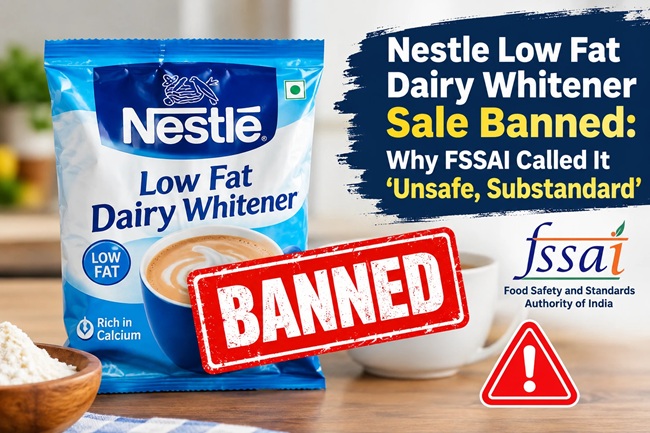
The Food Safety and Standards Authority of India has ordered an immediate ban on the sale of Nestle’s Low Fat Dairy Whitener after a sample collected from a New Delhi hotel failed laboratory testing and was declared both “unsafe” and “substandard.” The finding adds to a string of regulatory run-ins Nestle India has had with FSSAI this year, and it’s worth understanding both what actually happened with this specific product and the pattern it fits into.
Here’s what FSSAI found, where the sample came from, how Nestle has responded, and what this means if you’ve been using this product.
What Happened
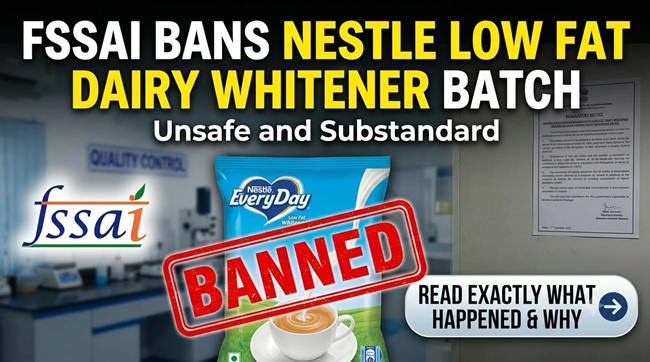
FSSAI confirmed the action in a post on X, stating that a sample of Nestle’s “Low Fat Dairy Whitener” collected from M/s Bharat Hotels Ltd. (The Lalit), New Delhi, had been declared unsafe and substandard by Food Analyst reports under the Food Safety and Standards Act, 2006. Following the lab result, the regulator directed the hotel to immediately halt the sale of the affected batch.
It’s worth being precise about the scope here: this action targets a specific batch of the product tested from one location, not a nationwide recall of every unit of Nestle’s Low Fat Dairy Whitener currently on shelves across India. FSSAI’s order specifically covers the batch in question and directs the hotel where the sample was taken to stop selling it.
Why “Unsafe” and “Substandard” Are Two Different Findings
These aren’t interchangeable terms in food safety law, and the distinction matters. Under the Food Safety and Standards Act, 2006, a product classified as “unsafe” is one found to pose an actual risk to health, something in its composition that could genuinely harm a consumer. A “substandard” classification, by contrast, generally means the product failed to meet the specific compositional or quality parameters prescribed for that category of food, without necessarily indicating an immediate health hazard on its own. FSSAI’s statement classified this sample as both, which is a more serious combined finding than either label alone would represent.
Nestle’s Response
Nestle India is contesting the findings. According to reports on the matter, the company has pointed to what it describes as a technical difference in how phosphorus was tested in the sample, suggesting the methodology used in the lab analysis may be the basis of dispute rather than an acknowledgment of a genuine safety issue with the product. This is a familiar pattern in regulatory disputes of this kind, where the company’s disagreement centers on testing methodology or technical classification rather than a direct admission of fault, and it typically plays out through further clarification, re-testing, or formal appeal processes available under the FSS Act.
This Isn’t an Isolated Incident This Year
To understand why this particular finding is getting attention, it helps to see it alongside what’s already been a difficult stretch for Nestle India with the regulator in 2026.
In September, FSSAI initiated three separate legal adjudication cases against Nestle India over its infant nutrition products, specifically NAN Excella Pro Stage 1, Lactogen Pro Stage 1, and a follow-up formula. Two of those products were found in violation of Regulation 4(2) of the Food Safety and Standards (Foods for Infant Nutrition) Regulations, 2020, which restricts promotional claims intended to boost the saleability of infant foods, specifically around marketing language referencing “5 HMOs” (human milk oligosaccharides) and “easy to digest whey” protein. Separately, a sample of the follow-up formula was sent for re-analysis and found non-conforming with the prescribed Biotin requirement under the same 2020 regulations, a substandard finding on an actual nutritional specification rather than just a labelling dispute.
Nestle disputed that action too, stating its products were “fully compliant with all applicable regulations” and noting that the labels for NAN Excella Pro and Lactogen Pro had been approved by an expert committee of FSSAI itself, a detail that adds a layer of complexity to the dispute, since it raises the question of how a previously approved label is now being cited as non-compliant.
| Date | Product(s) | FSSAI Finding | Nestle’s Response |
|---|---|---|---|
| September 18, 2026 | NAN Excella Pro, Lactogen Pro, follow-up formula | Non-compliant promotional claims (Regulation 4(2)); follow-up formula sample found non-conforming on Biotin content | Disputed; says labels were FSSAI-approved and products are fully compliant |
| Late September/October 2026 | Low Fat Dairy Whitener | Sample declared “unsafe” and “substandard” under the FSS Act, 2006 | Contesting; cites technical differences in phosphorus testing methodology |
This broader scrutiny isn’t limited to Nestle either. FSSAI issued over 150 notices in August 2026 to multiple major food companies, including Nestle India, PepsiCo and Coca-Cola, over misleading advertising and labelling non-compliance, suggesting a period of genuinely heightened regulatory activity across the packaged food sector generally, rather than a pattern targeted solely at one company.
Market Reaction
Nestle India’s shares fell nearly 2% following the September infant nutrition action, reversing earlier gains even as the broader Nifty 50 index advanced that day, a sign that investors were treating the regulatory overhang as a genuine concern rather than routine noise. Infant nutrition products reportedly represent a meaningful share of Nestle India’s overall revenue, which is part of why repeated regulatory friction in that specific category draws more market attention than an isolated finding on a single product might otherwise get.
What This Means If You Have This Product at Home
If you have Nestle Low Fat Dairy Whitener currently in your kitchen, the most useful thing to check is the batch or lot number against any specific batch details FSSAI or Nestle publish in connection with this action, since the order as reported applies to a specific batch sold through a specific hotel, not a blanket recall of the product nationwide. If specific batch information becomes available, checking your own packaging against it is the most direct way to know whether your particular product is affected.
More broadly, when a packaged food product you use faces a regulatory finding like this, it’s worth checking for an official recall notice or batch-specific guidance from the company or FSSAI directly, rather than assuming either that the entire product line is unsafe, or that an isolated finding at one location has no bearing on you at all. Both overreactions are unhelpful; the useful middle path is checking the specific, verifiable detail that actually applies to what’s in your pantry.
You May Also Like To Read About:
Common Mistakes People Make When This Kind of News Breaks
A frequent mistake is assuming a single batch finding at one location means every unit of that product across the country is affected, when FSSAI’s actions in cases like this are typically specific to the tested batch and location named in the order. Another is dismissing the finding entirely just because the company disputes it, since a company contesting a regulatory finding is a normal part of the process and doesn’t on its own resolve the underlying question, that generally gets settled through further testing, appeal, or adjudication. People also sometimes conflate separate regulatory actions against the same company into one undifferentiated story, when, as in this case, the infant nutrition labelling dispute and the dairy whitener safety finding are genuinely different issues involving different products, different regulations, and different types of findings.
My Take
What stands out across both of Nestle India’s recent run-ins with FSSAI this year is the company’s consistent position: compliance on its end, and a dispute over either testing methodology or the validity of a finding that was previously cleared by the regulator’s own expert committee. Whether that holds up is ultimately a matter for the adjudication process and further testing to settle, not something a single social media post from either side resolves definitively.
What’s genuinely useful to take from this, beyond the specific Nestle story, is a reminder that FSSAI’s enforcement activity has clearly picked up pace through 2026, with over 150 notices issued across the industry in August alone. That’s a meaningful shift in how actively India’s food regulator is testing and flagging packaged products, and it’s worth consumers treating these notices individually, checking the specific product, batch, and claim involved, rather than reacting to the general headline that a familiar brand name is “in trouble” again.
Frequently Asked Questions
1. Has Nestle’s Low Fat Dairy Whitener been completely banned across India? Based on current reporting, the action targets a specific batch sampled from a New Delhi hotel, not a nationwide recall of the entire product line. Check for official batch-specific guidance for the most accurate picture.
2. What’s the difference between FSSAI calling a product “unsafe” versus “substandard”? “Unsafe” generally indicates the product poses an actual health risk, while “substandard” means it failed to meet prescribed compositional or quality parameters, without necessarily indicating an immediate hazard on its own. This sample was classified as both.
3. Where was the sample that triggered this action collected from? From M/s Bharat Hotels Ltd. (The Lalit), a hotel in New Delhi.
4. Is Nestle disputing the finding? Yes. Nestle is contesting the result, citing what’s described as a technical difference in how phosphorus was tested in the sample.
5. Is this related to Nestle’s earlier infant nutrition issues with FSSAI this year? It’s a separate action involving a different product and different regulations, but it adds to a broader pattern of regulatory scrutiny Nestle India has faced through 2026, including the September infant nutrition adjudication cases.
6. What happened with Nestle’s infant nutrition products in September 2026? FSSAI filed three adjudication cases over non-compliant promotional claims on NAN Excella Pro and Lactogen Pro, and a Biotin non-conformance finding on a follow-up formula sample.
7. Did FSSAI only target Nestle this year, or other companies too? FSSAI issued over 150 notices to multiple food companies in August 2026, including Nestle India, PepsiCo and Coca-Cola, as part of broader enforcement activity on misleading advertising and labelling.
Disclaimer
This article is for general informational purposes only and does not constitute health, legal or investment advice. Details reflect publicly available regulatory statements and news reporting at the time of writing. The dispute between FSSAI and Nestle India over these findings may be subject to further clarification, re-testing or legal proceedings. Readers with specific product safety concerns should refer to official FSSAI notices or contact Nestle India directly. FinanceChecks.com is not affiliated with FSSAI or Nestle India.
Last reviewed and fact-checked on October 1, 2026 by the FinanceChecks.com Editorial Team.

Shuchi founded Finance Checks after spending 16+ years working in corporate, managing operations and distribution. She managed her own finances, learned and read regularly and helped people make sense of their savings, loans, insurance, and investments.
She started this site to offer the kind of clear, honest financial guidance she wished was more available when she was learning to manage her own money. Every article is researched personally, checked against official sources such as the Reserve Bank of India, SEBI, or the Income Tax Department, and revisited whenever regulations or figures change. She is upfront about how the site earns money through ads and select affiliate partnerships, and she does not let either influence what she actually recommends to readers.


[…] Nestle Low Fat Dairy Whitener Sale Banned: Why FSSAI Called It ‘Unsafe, Substandard’ […]
[…] Nestle Low Fat Dairy Whitener Sale Banned: Why FSSAI Called It ‘Unsafe, Substandard’ […]