
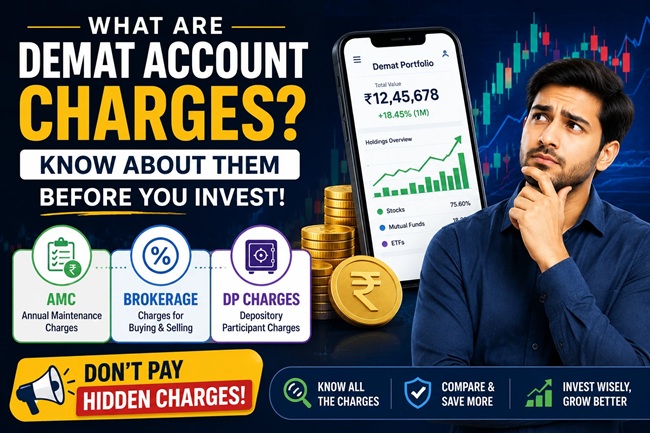
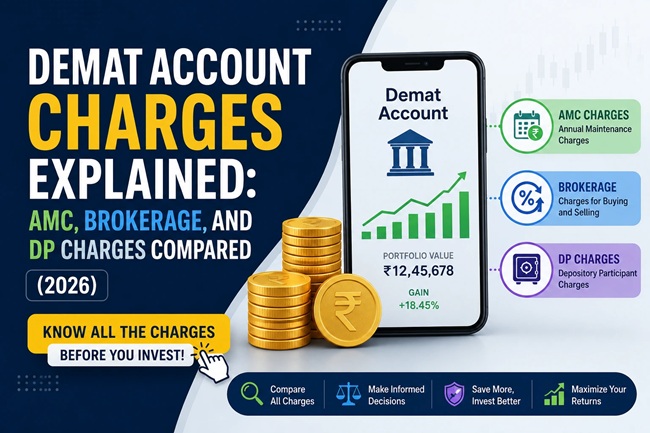
Demat Account Charges Explained: AMC, Brokerage, and DP Charges Compared (2026)

Last updated: July 2026
About This Guide: Written by the Financechecks.com Editorial Team, Personal Finance Researchers. This article has been researched using publicly disclosed broker fee schedules, SEBI/depository guidelines, and CDSL/NSDL charge structures, and is reviewed for accuracy as broker pricing changes.
A cousin of mine opened his first demat account last year, lured in almost entirely by a giant “ZERO BROKERAGE” banner on the app’s download page. Six months later, he messaged me, genuinely confused, asking why ₹300 had quietly vanished from his account without him buying or selling a single share, and why another ₹15 disappeared every time he actually sold something. Zero brokerage, it turned out, was never the same thing as zero cost.
This mix-up happens constantly, and it’s not because people are careless — it’s because broker marketing leads with the one number that sounds most impressive (brokerage) and says almost nothing about the two other charges that quietly add up over time: the AMC and the DP charge. If you’re opening your first demat account, or trying to figure out why your existing one costs more than you expected, this guide breaks down exactly what you’re actually paying for, and what a fair price looks like in 2026.
First, What Is a Demat Account, Quickly?
A Demat (Dematerialised) Account is an electronic account that holds your shares, mutual fund units, bonds, and ETFs in digital form — the same way a bank account holds your money, except this one holds your securities. You cannot buy or sell shares in India without one. It works alongside a separate trading account, which is what you actually use to place buy and sell orders; the demat account is simply where whatever you own actually sits.
Your demat account is opened through a Depository Participant (DP) — typically a stockbroker like Zerodha, Groww, or Angel One, or a bank — who acts as the middleman between you and one of India’s two depositories, CDSL or NSDL, where your holdings are actually, legally registered. Every charge covered in this guide flows from this basic structure: the DP is the entity billing you, even though your shares ultimately sit with the depository.
The Three Charges That Actually Matter
Most demat account comparisons throw around a dozen different fee names, but almost everything boils down to three categories. Understanding these three is genuinely enough to compare any two brokers intelligently.
1. AMC (Annual Maintenance Charge)
This is a recurring fee, charged yearly (sometimes billed quarterly), simply for the DP maintaining your demat account — regardless of whether you buy, sell, or do absolutely nothing with it all year. Think of it like a locker rental fee: you pay it whether or not you ever open the locker.
AMC varies significantly across brokers:
| Broker Type | Typical Annual AMC |
|---|---|
| Groww, Dhan | ₹0 (lifetime free) |
| Zerodha | ₹300/year (often free in year one) |
| Upstox | ₹150-₹300/year, depending on plan |
| Angel One | ₹240/year (often free in year one) |
| m.Stock (Mirae Asset) | ₹999 one-time, lifetime zero AMC thereafter |
| Full-service brokers (ICICI Direct, HDFC Securities, Kotak Securities) | ₹400-₹750/year |
| Bank-linked DPs (SBI, Bank of Baroda) | ₹400-₹600/year |
This is exactly the charge that caught my cousin off guard — an AMC is deducted automatically, often without a specific notification tied to a transaction, which is precisely why it feels like money is “just disappearing.”
2. Brokerage Charges
This is the fee charged every time you actually buy or sell shares, and it’s the one every broker advertises loudly, since “zero brokerage” is the easiest headline to market. Here’s the nuance most people miss: “zero brokerage” almost always applies only to equity delivery trades — meaning you buy shares and hold them in your demat account, rather than selling the same day.
- Equity delivery (buy and hold): Most major discount brokers — Zerodha, Groww, Upstox, Angel One — charge ₹0 brokerage
- Intraday trading (buy and sell the same day): Typically ₹20 per executed order, or a small percentage of the trade value, whichever is lower
- F&O (Futures & Options): Also typically a flat ₹20 per executed order across most discount brokers
- Full-service brokers: Often charge a percentage-based brokerage even on delivery trades, commonly ranging from roughly 0.27% to 0.55% of the transaction value, which can add up to a significantly higher cost than a flat-fee discount broker, especially for larger trade values
3. DP Charges — The One Almost Nobody Explains Properly
This is the charge my cousin genuinely didn’t know existed, and it’s arguably the most misunderstood fee in the entire demat ecosystem. Here’s the key thing to understand: a DP charge is not the same as brokerage, and it’s not charged by your broker — it’s charged by the depository (CDSL or NSDL) for the act of electronically moving shares out of your demat account.
Every single time you sell shares that are in delivery (i.e., they were already sitting in your demat account, not bought and sold the same day), a DP charge is deducted — typically somewhere between ₹13.50 and ₹20 per scrip (per company), per day, including GST, regardless of how many shares of that company you sold in that transaction. This applies on top of any brokerage, which is why a “zero brokerage” trade can still show a small deduction when you actually sell.
A few specifics worth knowing:
- DP charges apply only on the sell side, when shares are debited (moved out) of your demat account. Buying shares (which credits your account) is generally free of DP charges across most major discount brokers
- It’s charged per scrip, not per share. Selling 500 shares of one company in a single sell order attracts the DP charge once; selling shares of five different companies in one day attracts it five times
- Some depositories offer a small discount — for instance, CDSL has offered a modest per-transaction discount specifically for accounts where a female investor is listed as the first holder
You May Also Like To Read:
- What Is an IPO? How a Company Goes Public, and How Allotment and Pricing Actually Work
- Best Stocks Under ₹50 in India: How to Actually Evaluate Them (Not Just a Tip List) — 2026 Guide
- Stock Market Technical Analysis Basics for Beginners: How to Read Trends, Not Just Prices
- Understanding Sensex and Nifty: What Stock Market Indices Actually Mean
- How to Read a Stock Quote and Stock Chart: A Complete Beginner’s Guide
Putting It All Together: A Realistic Annual Cost Example
Let’s say you use a typical discount broker, hold a portfolio you rarely trade, and sell shares of three different companies across the year, a few times each.
- AMC: ₹0 to ₹300, depending on your broker
- Brokerage on delivery buys/sells: ₹0 (assuming a zero-brokerage discount broker)
- DP charges: Roughly ₹15-₹20 per scrip, each time you sell — for occasional selling across a handful of companies, this might add up to somewhere in the range of ₹100-₹300 over the year
For a genuinely long-term, buy-and-hold investor, the AMC often ends up being the single largest recurring cost, simply because it’s charged regardless of activity — which is exactly why brokers offering ₹0 AMC (like Groww or Dhan) have become particularly attractive to that specific type of investor.
What Is a BSDA, and Can It Reduce Your Charges?
If you’re a smaller investor, there’s a genuinely useful account type worth knowing about: a BSDA (Basic Services Demat Account). If the total value of securities in your demat account stays below a certain threshold (commonly ₹2 lakh, with reduced AMC continuing up to ₹4 lakh in many cases), you can request your DP to convert your account to a BSDA, which either significantly reduces or completely eliminates your AMC.
This is a simple, one-time request to your broker’s support team, and it’s worth checking if you qualify — a lot of smaller investors pay full AMC for years without realising this option exists.
Common Mistakes People Make While Comparing Demat Accounts
- Only comparing brokerage and ignoring AMC and DP charges entirely. A broker with “zero brokerage” but a high AMC can end up costing more overall than one with a small AMC but genuinely lower total fees, depending on your trading pattern
- Not checking whether “zero brokerage” applies to all segments. It usually applies specifically to equity delivery — intraday and F&O trades almost always carry a separate flat fee
- Assuming DP charges are a broker error. Since this fee isn’t always clearly itemised in a simple trade confirmation, it’s often mistaken for a mistake or a hidden broker fee, when it’s actually a standard, depository-level charge applied industry-wide
- Not checking BSDA eligibility if you’re a smaller investor. Many investors with modest portfolios continue paying full AMC unnecessarily
- Opening multiple demat accounts without accounting for AMC on each. You can legally hold multiple demat accounts with different brokers using the same PAN, but AMC is charged separately per account — holding three accounts you don’t actively use can mean paying AMC three times over for no real benefit
- Forgetting to check the first-year AMC waiver expiry. Several brokers waive AMC in the first year specifically to attract new users, and the recurring charge only kicks in from year two onward — worth marking on a calendar so it isn’t a surprise
How to Choose Based on Your Actual Usage
- If you’re a long-term, buy-and-hold investor who trades rarely: Prioritise low or zero AMC above all else, since that’s the cost you’ll pay year after year regardless of activity
- If you’re an active trader placing frequent intraday or F&O trades: Brokerage per order matters more than AMC, since it accumulates quickly with trading frequency
- If you’re a smaller investor: Check BSDA eligibility on any account you’re considering, and factor that reduced-AMC threshold into your comparison
- Either way: Always calculate a realistic total annual cost based on your own likely trading pattern, rather than comparing a single headline number across brokers
Frequently Asked Questions
1. What are DP charges in a demat account? DP (Depository Participant) charges are fees levied by the depository (CDSL or NSDL) every time shares are electronically debited (sold) from your demat account, typically ranging from ₹13.50 to ₹20 per scrip, per day, including GST. They apply on top of, and separately from, any brokerage charged by your broker.
2. Does zero brokerage mean my demat account is completely free? No. “Zero brokerage” typically applies only to equity delivery trades and doesn’t cover AMC (annual maintenance charge) or DP charges, both of which continue to apply regardless of your broker’s brokerage structure.
3. How much does a demat account cost per year? It depends heavily on the broker and your trading pattern. AMC alone can range from ₹0 (Groww, Dhan) to over ₹700/year (some full-service brokers), and DP charges add up separately based on how often you sell shares. A low-activity investor with a zero-AMC broker could pay close to nothing annually, while an active trader with a high-AMC full-service broker could pay several hundred to over a thousand rupees a year.
4. What is the difference between AMC and DP charges? AMC is a recurring annual fee for simply maintaining your demat account, charged regardless of whether you trade at all. DP charges are transaction-specific fees, charged only when you sell shares held in delivery, applied by the depository rather than your broker directly.
5. Why was money deducted from my demat-linked account even though I didn’t place a buy order? This is most likely either your AMC being auto-debited (usually annually or quarterly) or a DP charge applied when you sold shares in a delivery transaction, since selling attracts this depository-level fee even under a zero-brokerage plan.
6. What is a BSDA and how does it reduce charges? A Basic Services Demat Account (BSDA) is a category of demat account for smaller investors, where holdings below a certain value threshold (commonly ₹2 lakh, with a reduced rate continuing up to ₹4 lakh in many cases) qualify for significantly reduced or fully waived AMC. You can request conversion to BSDA through your broker if your portfolio value qualifies.
7. Are DP charges applicable when I buy shares? Generally, no. DP charges apply specifically when shares are debited (sold) from your demat account. Buying shares, which credits your account, is typically free of DP charges across most major discount brokers.
8. Can I have multiple demat accounts, and does that cost more? Yes, you can legally hold multiple demat accounts with different brokers using the same PAN. However, AMC is charged separately for each account you hold, so maintaining accounts you don’t actively use can mean paying multiple AMCs for no added benefit.
9. Is a full-service broker’s percentage-based brokerage always worse than a discount broker’s flat fee? For most retail investors trading moderate amounts, a flat-fee discount broker generally works out cheaper, since a percentage-based brokerage scales up with trade value. However, full-service brokers often bundle research, advisory, and relationship manager support into that cost, which some investors may value enough to offset the higher fee.
10. How can I reduce my overall demat account charges? Check BSDA eligibility if your holdings are modest, choose a broker with zero or low AMC if you’re a long-term, low-frequency investor, avoid holding multiple unused demat accounts, and factor in DP charges (not just brokerage) when estimating your realistic annual trading cost.
Final Thoughts
The honest takeaway here is simple: no demat account is truly free, no matter what the banner ad says. Somewhere between the AMC quietly billed each year, the brokerage on your trades, and the DP charge on every sale, there’s always a real, ongoing cost to holding and trading securities in India — and that’s a completely normal, regulated part of how the system works, not a hidden trap.
The investors who end up genuinely paying less aren’t the ones chasing the flashiest “zero brokerage” banner. They’re the ones who took ten minutes to actually map AMC, brokerage, and DP charges against their own realistic trading habits before choosing a broker — which, now that you’ve read this, you’re already equipped to do.
Disclaimer: This article is for general informational and educational purposes only and should not be treated as investment or financial advice. Broker charges, AMC rates, and DP charge figures mentioned above are illustrative, based on publicly available fee schedules current as of the stated dates, and are subject to change by individual brokers and depositories without notice. Please verify current charges directly on your broker’s official website or contract note before making a decision, and consult a qualified financial advisor if needed.

Shuchi founded Finance Checks after spending 16+ years working in corporate, managing operations and distribution. She managed her own finances, learned and read regularly and helped people make sense of their savings, loans, insurance, and investments.
She started this site to offer the kind of clear, honest financial guidance she wished was more available when she was learning to manage her own money. Every article is researched personally, checked against official sources such as the Reserve Bank of India, SEBI, or the Income Tax Department, and revisited whenever regulations or figures change. She is upfront about how the site earns money through ads and select affiliate partnerships, and she does not let either influence what she actually recommends to readers.



[…] of account you might hold — bank accounts, SIPs and mutual funds, insurance policies, and your demat/stock market account — and exactly what your family has to go through if that field was ever left […]
[…] useful for someone wanting to build a gold holding gradually, a little at a time, without needing a demat account or any other formal investment […]