
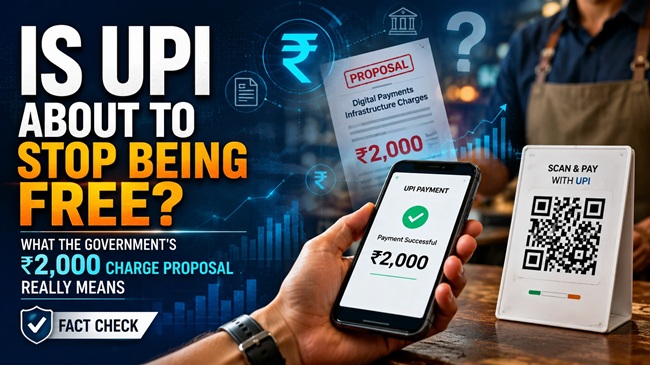
Is UPI About to Stop Being Free? What the Government’s New Rs 2,000 Charge Proposal Really Means

A shopkeeper near my house has a laminated UPI QR code taped to his counter that’s been there for years, and it’s genuinely changed how he runs his shop. No cash drawer to reconcile, no card machine rental, payments settle instantly. When news started circulating this week about the government possibly allowing charges on UPI payments, his first reaction was panic, assuming customers would suddenly have to pay to scan his code.
That’s not actually what’s on the table, and the confusion around this story is exactly why it’s worth breaking down properly. Here’s what the government has actually proposed, where things stand as of this week, and who would really end up paying if this goes through.
What Actually Happened This Week
The government has introduced amendments to the Payment and Settlement Systems Act in Parliament, a legislative step that opens the door for reintroducing something called the Merchant Discount Rate, or MDR, on certain UPI transactions. This is a real, formal legislative move, not just speculation, though it’s important to be clear that no final decision has been taken yet. This is the government creating the legal pathway to allow such a charge, not confirming the charge itself.
What MDR Actually Is, and Why It Was Removed in the First Place
MDR is a small fee charged to a merchant every time a customer pays them digitally, historically standard on credit and debit card transactions. Credit card MDR in India is currently unregulated and can run as high as 3 percent of the transaction value. Debit card MDR is capped, generally around 0.4 percent for transactions up to 20 lakh rupees and 0.9 percent above that.
When UPI was scaling up, the government set MDR on person-to-merchant UPI transactions to zero, effective January 2020, specifically to encourage merchants of all sizes to adopt digital payments without absorbing a transaction cost. This zero MDR policy is widely credited as one of the reasons UPI grew as explosively as it did across small shops, street vendors and large retailers alike.
Why the Government Is Reconsidering This Now
UPI’s own numbers are the reason this conversation is happening. The system processed 23.6 billion transactions worth roughly 29.9 lakh crore rupees in July 2026 alone. That kind of scale comes with a real operating cost for banks and payment service providers, who have been processing transactions for years without earning any fee on them, while the government separately compensates some of that cost through an incentive scheme aimed at small merchants, which cost the exchequer over 3,600 crore rupees in a recent financial year alone.
A Parliamentary Standing Committee on Finance report from March 2026 specifically flagged this as an unsustainable long term model for the banks and payment providers actually running the infrastructure, even while acknowledging that zero MDR helped make UPI as widely accessible as it became. The committee also projected UPI could add another 600 million users and scale to 100 to 150 billion transactions a month over the next five to seven years, which makes the underlying sustainability question harder to ignore as volumes keep climbing.
What’s Actually Being Proposed
Based on current reporting, here’s the shape of the proposal under discussion, though exact figures have varied slightly across different reports and nothing is finalized.
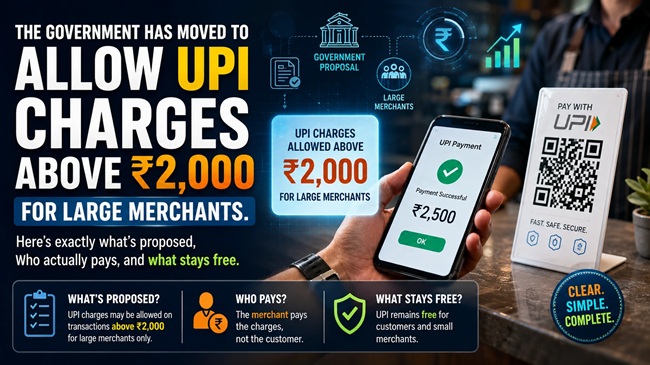
The charge would apply to UPI payments above Rs 2,000, made to merchants, not to person-to-person transfers. Sending money to a friend or family member would remain unaffected regardless of transaction size.
The rate being discussed is somewhere between 0.25 percent and 0.5 percent, considerably lower than unregulated credit card MDR, and even below the current cap on higher value debit card transactions.
Small merchants would be exempted. Reports consistently indicate that businesses with annual turnover up to Rs 1.5 crore would not be charged this MDR regardless of transaction size, meaning the neighbourhood shopkeeper scenario above wouldn’t actually be affected under the current proposal.
The charge, if implemented, would apply to the merchant, not directly to the consumer. Whether that cost eventually gets passed on to customers through pricing is a separate commercial decision merchants would make, similar to how card MDR works today, where most merchants absorb the cost rather than charging customers extra at checkout.
Quick Reference: What Changes and What Doesn’t
| Transaction Type | Current Status | Under the Proposal |
|---|---|---|
| Person-to-person UPI transfers | Free | Remains free |
| Payments to small merchants (turnover under Rs 1.5 crore) | Free | Remains free, regardless of amount |
| Payments to large merchants, under Rs 2,000 | Free | Remains free |
| Payments to large merchants, above Rs 2,000 | Free | May attract MDR of roughly 0.25% to 0.5%, paid by the merchant |
You May Also Like:
- Filed Your ITR? Here’s Why Some Refunds Take 10 Days and Others Take 10 Months
- SIP vs Gold vs Fixed Deposit: Where Should Your Next 10,000 Rupees Actually Go
- The Gold Investment Everyone Recommends That You Literally Cannot Buy in 2026
- New Bank Charges August 2026: What’s Changing on Your Account
- Home Loan EMI Calculator – Know How Much You Will Have to Pay Based on Your Interest Rate and Tenure
Common Misunderstandings About This News
- “UPI is going to start charging customers directly”: This isn’t what’s being proposed. The charge under discussion is a merchant side fee, similar to how card payment MDR already works, not a fee deducted from the customer’s payment.
- “This affects every shop I use UPI at”: Only large merchants above the Rs 1.5 crore annual turnover threshold would be affected under the current proposal, which excludes the vast majority of small shopkeepers and street vendors.
- “This is already final and will start soon”: As of now, this is a legislative amendment that creates the pathway for such a charge, not a confirmed, dated rollout. The actual rate, effective date and final structure haven’t been confirmed.
- “My UPI app will start deducting money automatically”: Even if this is implemented, any change would happen at the payment processing and settlement level between banks, payment providers and merchants, not as a new deduction visible in your personal UPI app for sending money.
What to Actually Watch For Next
Since this story is still developing, here’s what would signal it’s moving from proposal to reality: a formal notification or gazette publication specifying the exact MDR rate and effective date, confirmation from NPCI on implementation timelines, and communication from major UPI apps or your bank about any changes to merchant settlement. Until those specific confirmations appear, treat reported percentage ranges and turnover thresholds as indicative, not final.
Frequently Asked Questions
1. Will I have to pay extra when I scan a UPI QR code to buy something? Not directly, based on the current proposal. The discussed charge would apply to the merchant receiving the payment, not as a fee deducted from your payment. Any downstream price change would be a separate decision by the merchant, similar to how card payment costs work today.
2. Does this affect sending money to friends and family via UPI? No. All reporting on this proposal specifically excludes person-to-person UPI transfers, which are expected to remain free regardless of the amount.
3. Which merchants would actually be affected? Based on current reports, only merchants with annual turnover above Rs 1.5 crore would be subject to the proposed MDR, and only on transactions above Rs 2,000. Small businesses below that turnover threshold would remain exempt.
4. Has this been officially confirmed and given an effective date? No. As of this week, the government has introduced enabling amendments in Parliament, which is a real legislative step, but the specific rate, final structure and effective date have not been officially confirmed.
5. Why is the government considering this after years of promoting free UPI? The zero MDR policy has been financially unsustainable for banks and payment service providers who bear the operational cost of processing UPI transactions at massive scale, a concern specifically flagged by a Parliamentary Standing Committee report earlier this year as UPI volumes continue to grow rapidly.
6. How does the proposed UPI MDR compare to credit and debit card charges? It would be considerably lower. Credit card MDR is unregulated and can reach up to 3 percent, while debit card MDR is capped around 0.4 to 0.9 percent depending on transaction value. The UPI MDR under discussion is in the 0.25 to 0.5 percent range.
7. Will GST apply to this new UPI charge if it’s implemented? The government has previously clarified that GST applies to MDR-related charges where MDR exists. If MDR is reintroduced on eligible UPI transactions, it’s reasonable to expect standard GST treatment would follow, though this hasn’t been separately confirmed for this specific proposal yet.
8. I run a small business, should I be worried about this? If your annual turnover is under Rs 1.5 crore, current reporting suggests you would remain exempt from this proposed charge entirely, regardless of individual transaction size. It’s still worth staying updated as the proposal develops in case final thresholds change.
9. Why does the charge apply only above Rs 2,000 and not to every transaction? This threshold appears designed to keep everyday small-value UPI usage, which represents the bulk of transaction volume and is central to UPI’s mass adoption, completely unaffected, while targeting the fee at higher value merchant transactions where the proposed percentage would generate more meaningful revenue for the payment ecosystem.
10. Where can I get official updates on this as it develops? The most reliable sources will be official notifications from the Ministry of Finance, RBI, or NPCI, rather than news speculation. Given how fast this story is moving, treat any specific rate or date you see in current coverage as provisional until an official notification confirms it.
About This Guide
This article reflects publicly reported developments on the proposed UPI Merchant Discount Rate as of early August 2026, including the introduction of amendments to the Payment and Settlement Systems Act in Parliament. This remains an active, evolving policy proposal, and specific details including the final rate, applicable thresholds and effective date may change before or during implementation. FinanceChecks.com is an independent personal finance resource and is not affiliated with the Government of India, RBI, or NPCI.
Disclaimer
This article is for informational purposes only and reflects publicly available reporting as of the date of publication. This proposal was not finalized at the time of writing, and details including rates, thresholds and timelines are subject to change. Please refer to official government, RBI or NPCI communications for confirmed, binding information before making any business or personal financial decisions based on this topic. FinanceChecks.com does not accept responsibility for decisions made based on this article.

Shuchi founded Finance Checks after spending 16+ years working in corporate, managing operations and distribution. She managed her own finances, learned and read regularly and helped people make sense of their savings, loans, insurance, and investments.
She started this site to offer the kind of clear, honest financial guidance she wished was more available when she was learning to manage her own money. Every article is researched personally, checked against official sources such as the Reserve Bank of India, SEBI, or the Income Tax Department, and revisited whenever regulations or figures change. She is upfront about how the site earns money through ads and select affiliate partnerships, and she does not let either influence what she actually recommends to readers.



[…] October 15, 2026, NPCI will levy a 0.4 percent MDR on person-to-merchant, or P2M, UPI transactions above ₹2,000. The fee is capped at ₹300 for any single transaction of ₹75,000 or more, so the charge stops […]