

Mutual Fund Taxation Explained: LTCG, STCG, and the Rules Everyone Gets Wrong

A friend called me in a bit of a panic last year, right after filing her taxes. She’d redeemed a debt mutual fund she’d held for four years, expecting some kind of long-term tax benefit like she’d gotten on an equity fund before. Instead, the entire gain got added to her income and taxed at her slab rate, which for her meant 30 percent. She hadn’t done anything wrong exactly. She just hadn’t heard that the rules for debt funds had quietly changed a couple of years earlier, and nobody had explained it to her before she hit redeem.
This mix-up is more common than you’d think. Mutual fund taxation in India isn’t one uniform rule, it depends on what kind of fund you hold, how long you’ve held it, and even which date you bought your units on. Get any one of those wrong and your actual tax bill can look very different from what you expected. Here’s how it actually works for FY 2026-27.
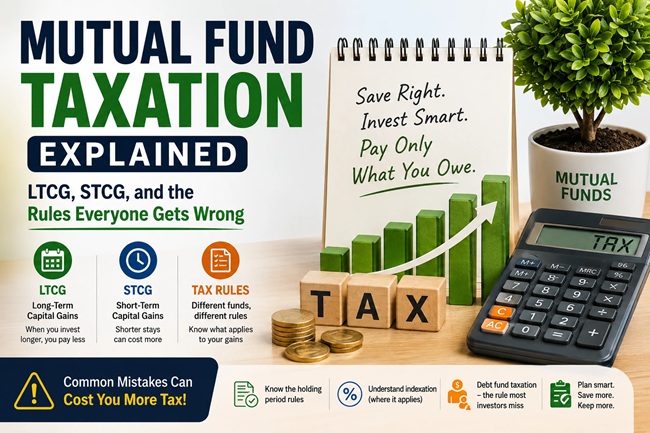
The Two Things That Decide Your Tax Rate
Every mutual fund gain in India is taxed based on two factors: what kind of fund it is, and how long you held it before selling. The fund type determines which set of rules applies to you, equity taxation or debt taxation, and the holding period determines whether you fall into the short-term or long-term bucket within that category.
A fund is treated as equity-oriented if it invests at least 65 percent of its assets in equity shares of domestic companies. Anything below that threshold, most debt funds and several hybrid funds, gets taxed under a completely different set of rules. This 65 percent line is the single most important number in this entire topic, because it decides which tax regime you fall under.
Equity Mutual Funds: STCG and LTCG
If you sell your equity fund units within 12 months of buying them, the gain is classified as short-term capital gains, taxed at a flat 20 percent under Section 111A. There’s no exemption threshold here. Every rupee of short-term gain is taxable, regardless of your income slab. Someone in the 5 percent tax bracket and someone in the 30 percent bracket both pay the same 20 percent STCG rate on equity funds.
Hold the units for more than 12 months, and the gain becomes long-term capital gains, taxed at 12.5 percent under Section 112A. Here’s where the exemption comes in: the first 1.25 lakh rupees of your total equity LTCG in a financial year, combining gains from both stocks and equity mutual funds, is completely tax-free. Only the amount above that threshold gets taxed at 12.5 percent.
It’s worth knowing that these rates changed with the Union Budget in July 2024. Before that, equity STCG was 15 percent and LTCG was 10 percent with a 1 lakh rupee exemption. The current 20 percent and 12.5 percent rates, along with the higher 1.25 lakh exemption, have been in place since July 23, 2024, and neither Budget 2025 nor Budget 2026 changed them further. Also worth noting, the indexation benefit that used to reduce your taxable long-term gains no longer applies to equity funds under the current regime.
Debt Mutual Funds: The Rule Most People Get Wrong
This is where my friend’s confusion came from, and honestly, it’s the single biggest source of mutual fund tax mistakes right now.
For debt mutual funds, meaning funds with less than 65 percent equity exposure, units purchased on or after April 1, 2023 are taxed entirely at your income tax slab rate, no matter how long you hold them. There is no long-term capital gains benefit anymore. Whether you sell after six months or six years, the entire gain gets added to your taxable income and taxed at whatever slab you fall into.
This is a fundamental shift from how debt funds used to work. Older investors who bought debt fund units before April 1, 2023 and held them for more than three years may still get the earlier treatment, which allowed indexation benefits on long-term gains. But that grandfathering only applies to units bought before that cutoff date. Anything purchased after it follows the new slab-rate rule, permanently.
If you’re someone who assumed debt funds are more tax-efficient than fixed deposits because of some long-term benefit, it’s worth checking your purchase dates carefully. For most debt fund investments made in the last couple of years, that long-term advantage simply doesn’t exist anymore.
Hybrid Funds: It Depends on the Equity Split
Hybrid funds don’t have one fixed tax treatment because they sit between equity and debt. If a hybrid fund maintains 65 percent or more in equity, it gets taxed exactly like an equity fund, 20 percent STCG within 12 months, 12.5 percent LTCG above the 1.25 lakh exemption after that.
If the equity allocation stays below 65 percent, the fund is treated like a debt fund and taxed at your slab rate regardless of holding period. This is why it matters to actually check a hybrid fund’s equity allocation before assuming how it will be taxed, rather than guessing based on the fund’s name or category label.
Dividends and IDCW: A Different Kind of Tax Entirely
If you’ve opted for the IDCW option instead of growth, any payout you receive gets added to your total income and taxed at your income tax slab rate. This has been the rule since 2020. If your IDCW payout from a single fund crosses 5,000 rupees in a financial year, the AMC deducts 10 percent TDS at source, though that’s just a deduction against your final tax liability, not the final tax itself. You still need to report the full amount in your return and settle any difference based on your slab rate.
This is one of the reasons growth option tends to be more tax-efficient than IDCW for most investors, especially those in higher tax brackets. With growth, you don’t pay any tax until you actually redeem, and the gain is then taxed as capital gains rather than at your full slab rate every time a payout happens.
How SIP Investments Get Taxed
If you invest through a SIP, each individual installment is treated as a separate investment with its own purchase date. This means a single SIP that’s been running for two years doesn’t have one uniform holding period. The first installment might qualify for long-term treatment while your most recent ones are still short-term.
When you redeem, most AMCs apply the FIFO method, first in, first out, meaning your oldest units are sold first. A single redemption can end up creating both STCG and LTCG simultaneously if it includes units bought at different times. This catches a lot of SIP investors off guard when they redeem a lump sum expecting one clean tax outcome and instead find their statement split across two categories.
Equity vs Debt Fund Taxation at a Glance
| Aspect | Equity-Oriented Funds | Debt Funds (post April 2023) |
|---|---|---|
| Minimum equity exposure | 65% or more | Below 65% |
| Short-term holding period | 12 months or less | Not applicable |
| Short-term tax rate | 20% flat, no exemption | Slab rate |
| Long-term holding period | More than 12 months | Not applicable, no LTCG benefit |
| Long-term tax rate | 12.5% above ₹1.25 lakh exemption | Slab rate regardless of holding period |
| Indexation benefit | Not available | Not available (for post-2023 units) |
| IDCW/dividend taxation | Slab rate, 10% TDS above ₹5,000 | Slab rate, 10% TDS above ₹5,000 |
About This Guide
This article reflects mutual fund capital gains rules as they stand for FY 2026-27, based on the changes introduced in the July 2024 Union Budget and the Finance Act 2023 provisions for debt funds. Tax rules, especially around capital gains, can be revised in future budgets, so please cross-check the current applicable rates on the Income Tax Department’s website or with a qualified chartered accountant before making redemption decisions or filing your return, particularly if your mutual fund units were purchased both before and after the relevant cutoff dates mentioned here.
Common Mistakes Investors Make With Mutual Fund Taxes
The most frequent one, by far, is assuming debt funds still get a long-term capital gains benefit the way they used to. As covered above, this hasn’t been true for units bought after April 1, 2023, and it trips up even experienced investors who haven’t kept up with the change.
Another common mistake is not tracking purchase dates carefully, especially for SIP investments or for anyone who bought units both before and after a key policy cutoff. Since your holding period and applicable rules can vary unit by unit, redeeming without checking this first can lead to unpleasant surprises at tax filing time.
People also frequently assume the 1.25 lakh exemption applies separately to each equity fund they hold. It doesn’t. It’s a combined annual limit across all your equity LTCG, including direct stock holdings, not a per-fund allowance.
Choosing IDCW over growth purely because it sounds like “earning extra income” is another mistake worth avoiding. As explained earlier, IDCW payouts are simply your own money being paid back to you, and they get taxed at your full slab rate each time, which is usually less efficient than growth for most investors.
My Take
The debt fund rule change is the one I’d flag hardest here, because it fundamentally altered why a lot of people held debt funds in the first place. If you built your portfolio’s debt allocation around the assumption of long-term tax efficiency, it’s genuinely worth revisiting that assumption now, not out of panic, but because the numbers may no longer support the same strategy. Tax rules on capital gains have shifted meaningfully in the last couple of years, and the investors who keep quietly checking these changes tend to end up with noticeably better post-tax returns than those who just assume the old rules still apply.
Frequently Asked Questions
1. What is the LTCG tax rate on equity mutual funds in 2026? Long-term capital gains on equity mutual funds are taxed at 12.5 percent on gains above 1.25 lakh rupees per financial year, applicable when units are held for more than 12 months.
2. What is the STCG tax rate on equity mutual funds? Short-term capital gains on equity mutual funds, for units held 12 months or less, are taxed at a flat 20 percent with no exemption threshold.
3. Do debt mutual funds still get long-term capital gains benefits? No, not for units purchased on or after April 1, 2023. These are taxed entirely at your income tax slab rate regardless of how long you hold them. Units bought before that date may still follow older rules if held long enough.
4. How are hybrid mutual funds taxed? It depends on their equity allocation. Hybrid funds with 65 percent or more equity exposure are taxed like equity funds. Those below that threshold are taxed like debt funds, at slab rate.
5. Is there any tax-free limit for mutual fund gains? Only for equity-oriented funds. The first 1.25 lakh rupees of combined equity LTCG, from both stocks and equity funds, is tax-free each financial year. Debt funds have no such exemption.
6. How are mutual fund dividends or IDCW payouts taxed? IDCW payouts are added to your total income and taxed at your income tax slab rate. TDS of 10 percent is deducted if payouts from a single fund exceed 5,000 rupees in a year.
7. How is SIP investment taxed differently from a lump sum? Each SIP installment has its own purchase date and holding period. A single redemption can include both short-term and long-term gains if it covers units bought at different times, typically calculated using the FIFO method.
8. Does indexation benefit still apply to any mutual funds? No, not under the current regime for units purchased after the relevant cutoff dates. Indexation was removed for equity funds by the July 2024 Budget and for debt funds by the Finance Act 2023, for units bought after April 1, 2023.
9. Are ELSS funds taxed differently from other equity funds? No, ELSS funds follow the same equity LTCG and STCG rules as other equity-oriented funds once the mandatory three-year lock-in period ends. The tax benefit they offer is under Section 80C at the time of investment, not a different capital gains rate at redemption.
10. Which is more tax-efficient, growth or IDCW option? Growth is generally more tax-efficient for most investors, since you only pay tax at redemption under capital gains rules, rather than at your full slab rate every time an IDCW payout happens.
Disclaimer
This article is for informational and educational purposes only and does not constitute tax or financial advice. Mutual fund taxation rules depend on individual circumstances, including purchase dates, fund category, and applicable budget amendments, and can change with future Union Budgets. Please consult a qualified chartered accountant or tax professional before making investment or redemption decisions based on tax considerations. FinanceChecks.com has made reasonable efforts to ensure the accuracy of the rates and rules mentioned here as of publishing, based on the Finance Act 2023 and the July 2024 Union Budget provisions.

Shuchi founded Finance Checks after spending 16+ years working in corporate, managing operations and distribution. She managed her own finances, learned and read regularly and helped people make sense of their savings, loans, insurance, and investments.
She started this site to offer the kind of clear, honest financial guidance she wished was more available when she was learning to manage her own money. Every article is researched personally, checked against official sources such as the Reserve Bank of India, SEBI, or the Income Tax Department, and revisited whenever regulations or figures change. She is upfront about how the site earns money through ads and select affiliate partnerships, and she does not let either influence what she actually recommends to readers.



[…] equity mutual funds for more than a year and have meaningful gains, redeeming them means paying long-term capital gains tax at 12.5 percent on gains above the 1.25 lakh rupee annual exemption. Pledging those same units […]