
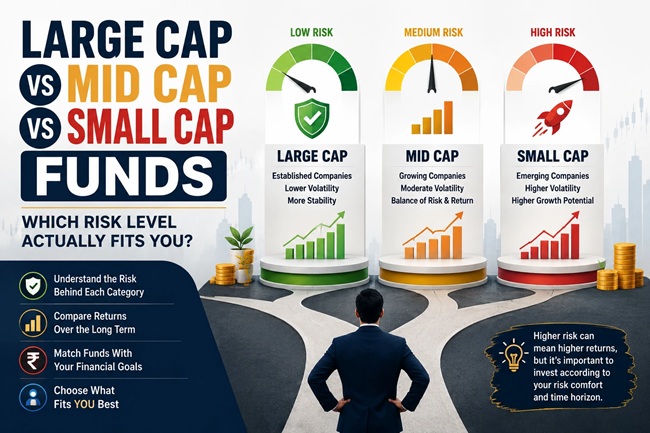
Large Cap vs Mid Cap vs Small Cap Funds: Which Risk Level Actually Fits You

A colleague once told me his small cap fund had given him 40 percent returns in a year, and he said it like it was a permanent feature of the fund rather than a particularly good year in a particularly good market cycle. Two years later, the same fund was down almost 25 percent, and he wanted to know what had “gone wrong.” Nothing had gone wrong. Small cap funds are simply built to swing harder in both directions, and he’d only ever seen one side of that swing.
This is the confusion at the heart of large cap versus mid cap versus small cap investing. People often pick based on whichever category posted the best returns last year, without understanding that the return and the risk are two sides of the same coin. Here’s what actually separates these categories, and a more useful way to think about which one fits your situation.
How SEBI Actually Defines These Categories
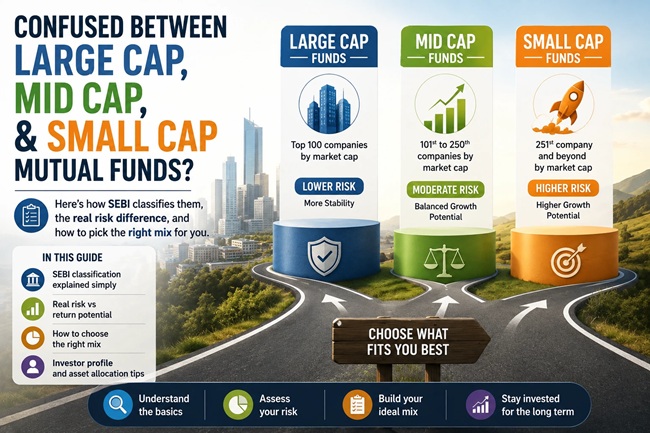
This isn’t a loose, subjective grouping. SEBI has a specific, rank-based definition that every mutual fund in India has to follow. Companies listed on Indian stock exchanges are ranked by their full market capitalisation, and that ranking decides which bucket a stock falls into.
The top 100 companies by market cap are classified as large cap. Companies ranked 101 to 250 are mid cap. Everything ranked 251 and below is small cap. AMFI, the mutual fund industry body, publishes and updates this list every six months, in January and July, based on each company’s average market cap over the preceding six months. Fund houses then get roughly a month to rebalance their portfolios if any stock has moved between categories.
This matters because it means the categories themselves are dynamic. A company that was mid cap two years ago might be large cap today simply because its market value grew and it moved up the rankings, not necessarily because the fund manager made a new decision to include it.
It’s also worth knowing that SEBI tightened the rules around these fund categories, requiring large cap funds to hold at least 80 percent of assets in large cap stocks, up from the earlier 65 percent minimum, while mid cap and small cap funds must still hold at least 65 percent in their respective categories. This means large cap funds today are more strictly “pure” large cap than they used to be, with less room for fund managers to sneak in mid or small cap bets for extra return.
Large Cap Funds: The Stability Layer
Large cap funds invest predominantly in the 100 biggest, most established companies in the country, the kind of businesses that are usually already part of the Nifty 50 or Sensex. These are companies with long track records, strong balance sheets, and enough market presence that they don’t disappear during a rough economic quarter.
The tradeoff is that this stability comes with more modest growth. A company that’s already among the 100 largest in the country has, by definition, less room to grow explosively compared to a smaller, younger business. Large cap funds tend to move less dramatically during both market rallies and market crashes, which makes them a reasonable core holding for anyone who doesn’t want to watch their portfolio value swing wildly month to month.
Mid Cap Funds: The Middle Ground
Mid cap funds sit in the space between stability and aggressive growth. These are companies that have already proven themselves to some degree, they’re past the earliest, riskiest stage of a business, but still have meaningfully more room to grow than an already-dominant large cap company.
Historically, mid caps have delivered stronger long-term returns than large caps, but they come with a noticeably rougher ride to get there. A mid cap fund can fall harder during a market downturn than a large cap fund would, and investors who can’t stomach that volatility often end up selling at the worst possible time, locking in losses that a more patient investor would have eventually recovered from.
Small Cap Funds: Higher Ceiling, Higher Floor Risk
Small cap funds invest in companies ranked 251st and beyond, many of which are still in early growth stages or operate in niche segments of the economy. This is where the highest long-term growth potential in the equity market tends to live, and also where the sharpest drawdowns happen.
Small cap companies are more vulnerable to economic slowdowns, have less financial cushion to survive a bad year, and can see their stock prices swing dramatically on relatively minor news. A small cap fund that returns 40 percent in a strong year can just as easily fall 25 to 30 percent in a weak one. Neither number tells you the fund is “good” or “bad.” It tells you the category is doing exactly what it’s designed to do, amplify both the ups and the downs.
You May Also Like To Read About:
- Mutual Fund Taxation Explained: LTCG, STCG, and the Rules Everyone Gets Wrong
- The Gold Investment Everyone Recommends That You Literally Cannot Buy in 2026
- Growth vs IDCW in Mutual Funds: The “Extra Income” That’s Secretly Just Your Own Money Coming Back to You
- Direct vs Regular Mutual Funds: Same Fund, Same Manager, Different Returns — Here’s Why
- Types of Mutual Funds in India (Equity, Debt, Hybrid & More Explained
Comparing the Three at a Glance
| Factor | Large Cap Funds | Mid Cap Funds | Small Cap Funds |
|---|---|---|---|
| Company ranking (SEBI) | Top 100 by market cap | 101st to 250th | 251st onwards |
| Minimum fund allocation | 80% in large cap stocks | 65% in mid cap stocks | 65% in small cap stocks |
| Volatility | Lowest of the three | Moderate | Highest |
| Growth potential | Steady, more modest | Higher than large cap | Highest, but least predictable |
| Suitable investment horizon | 3+ years | 5-7+ years | 7-10+ years |
| Best suited for | Core portfolio stability | Investors who can tolerate mid-cycle drops | Investors comfortable with sharp swings |
| Typical role in a portfolio | Anchor holding | Growth booster | Small satellite allocation |
So Which One Actually Fits You
The honest answer is that for most investors, it’s not really a choice between the three. It’s a question of how much of each to hold, based on your time horizon and how you personally react to seeing your portfolio drop in value.
If you’re investing for a goal that’s less than five years away, or if a 20 percent drop in your portfolio value would genuinely stress you out or tempt you to sell in a panic, leaning heavily toward large cap funds makes sense. The steadier ride matters more than squeezing out extra returns when your timeline is short.
If your horizon stretches beyond seven or eight years and you’ve sat through at least one real market correction without panic-selling, a mix that includes meaningful mid cap exposure, and a smaller allocation to small cap, can genuinely improve your long-term returns. The key word is smaller. Even investors with a high risk appetite rarely benefit from putting the majority of their portfolio into small caps alone, simply because the volatility can be severe enough to derail even a long-term plan if it hits right when you need the money.
A reasonable starting framework many advisors use is weighting more heavily toward large cap as a base, adding mid cap for growth, and treating small cap as a smaller, higher-risk slice rather than a core holding. The exact percentages should shift based on your age, goals, and how much volatility you can genuinely sit through without making an emotional decision.
About This Guide
This article reflects SEBI’s mutual fund categorisation rules and AMFI’s market cap classification methodology as they stand in 2026, including the updated minimum equity allocation requirements for large cap funds. These classification lists are reviewed and updated every six months, so specific companies can move between categories over time even though the underlying ranking rules stay the same. Please verify current fund allocations and AMFI’s latest classification list before making investment decisions, and consider speaking with a financial advisor to determine the right mix for your specific goals.
Common Mistakes Investors Make With Market Cap Funds
The most common mistake is chasing last year’s best performer. Small cap funds often top the return charts in strong bull markets, which tempts investors to pile in right at the point when valuations are already stretched and a correction becomes more likely, not less.
Another frequent mistake is holding a portfolio that’s unintentionally overweight in one category because several different funds happen to hold similar stocks. Someone might own a large cap fund, a flexi cap fund, and a multi cap fund without realizing all three overlap heavily in the same top 20 large cap names, giving far less real diversification than the fund count suggests.
People also tend to abandon mid or small cap investments the moment there’s a sharp downturn, exactly when staying invested matters most for that category to eventually deliver on its long-term potential. Volatility is the cost of admission for higher growth, not a sign that something has gone wrong with the fund.
Lastly, some investors assume a fund’s name guarantees its category purity. With SEBI’s tightened allocation rules, this has become somewhat more reliable than before, but it’s still worth checking a fund’s actual portfolio composition rather than assuming based on the category label alone.
My Take
If I had to boil this down to one idea, it’s that large cap, mid cap, and small cap aren’t really competing options, they’re tools for different jobs within the same portfolio. The mistake most investors make isn’t picking the “wrong” category, it’s picking based on recent returns instead of their own actual timeline and temperament. A 25-year-old investing for retirement and a 55-year-old investing for a goal five years away have no business holding the same market cap mix, even if they’re both technically “long-term investors” on paper. Know your own timeline first. The category mix should follow from that, not from whichever fund had the flashiest return last year.
Frequently Asked Questions
1. What is the difference between large cap, mid cap, and small cap funds? The difference lies in the size of companies each fund invests in, based on SEBI’s market cap ranking. Large cap funds invest in the top 100 companies, mid cap funds in companies ranked 101 to 250, and small cap funds in companies ranked 251 and beyond.
2. Which is riskier, mid cap or small cap funds? Small cap funds are generally riskier than mid cap funds, since smaller companies tend to have less financial stability and can see sharper price swings during market downturns.
3. Can a large cap company become a mid cap company? Yes. Since SEBI’s classification is rank-based and updated every six months by AMFI, a company’s category can change if its market capitalisation rises or falls relative to other listed companies.
4. How much of my portfolio should be in small cap funds? There’s no universal number, but many advisors suggest keeping small cap exposure as a smaller portion of an equity portfolio rather than a core holding, given the higher volatility involved. The right percentage depends on your risk tolerance and investment horizon.
5. Are large cap funds safe from losses? No fund is free from risk. Large cap funds are relatively more stable than mid or small cap funds, but they can still lose value during broad market downturns, just typically less sharply.
6. What is a good investment horizon for small cap funds? Small cap funds are generally better suited to investors with a horizon of seven to ten years or longer, since this gives enough time to ride out periods of sharp volatility.
7. Do mid cap funds outperform large cap funds? Historically, mid cap funds have often delivered higher long-term returns than large cap funds, but this comes with meaningfully higher volatility, and past performance doesn’t guarantee the same pattern will continue.
8. What is a multi cap fund, and how is it different? A multi cap fund is required to hold a minimum allocation across large, mid, and small cap stocks simultaneously, offering built-in diversification across all three categories within a single fund.
9. How often does SEBI update the large, mid, and small cap classification list? AMFI updates the classification list every six months, in January and July, based on each company’s average market capitalisation over the preceding six months.
10. Should a beginner start with large cap, mid cap, or small cap funds? Beginners are generally better served starting with large cap or flexi cap funds, which offer more stability while they get comfortable with how equity markets move, before gradually adding mid or small cap exposure if their risk tolerance allows.
Disclaimer
This article is for informational and educational purposes only and does not constitute investment advice. Mutual fund investments are subject to market risk, and the categorisation rules, allocation requirements, and classification lists referenced here are based on SEBI and AMFI guidelines as of 2026, which may be revised over time. Please read all scheme-related documents carefully and consult a qualified financial advisor before making investment decisions based on risk tolerance and financial goals.

Shuchi founded Finance Checks after spending 16+ years working in corporate, managing operations and distribution. She managed her own finances, learned and read regularly and helped people make sense of their savings, loans, insurance, and investments.
She started this site to offer the kind of clear, honest financial guidance she wished was more available when she was learning to manage her own money. Every article is researched personally, checked against official sources such as the Reserve Bank of India, SEBI, or the Income Tax Department, and revisited whenever regulations or figures change. She is upfront about how the site earns money through ads and select affiliate partnerships, and she does not let either influence what she actually recommends to readers.



[…] since you have enough time to ride out volatility. The specific mix within equity, how much large cap versus mid cap versus small cap, still depends on your comfort with risk, but the broader category choice becomes much clearer once […]