
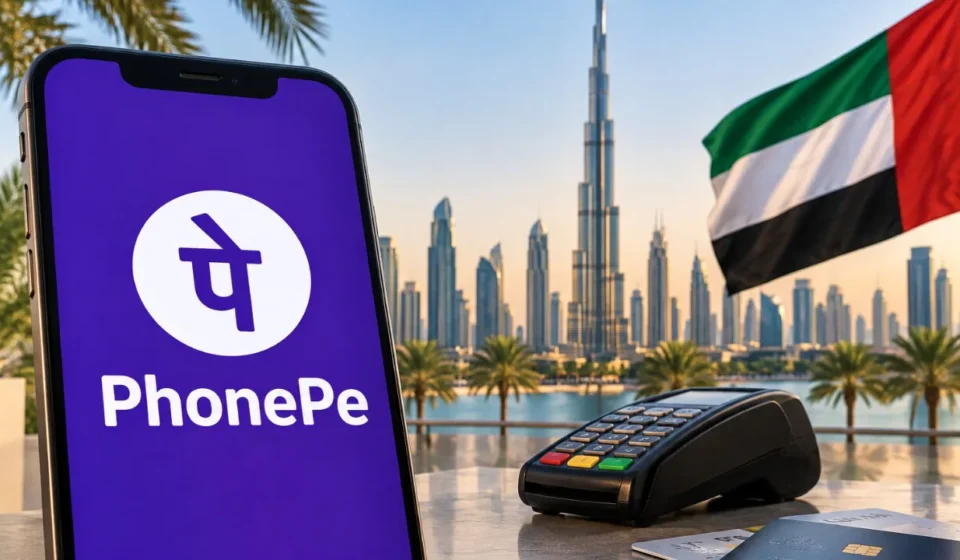
IPO-Bound PhonePe Secures In-Principle Nod For UAE Payments Business: What It Means

Last updated: September 22, 2026
Editor’s Note: This post will be updated when PhonePe receives final CBUAE authorization
Quick Facts: PhonePe’s UAE Approval at a Glance
| Detail | Information |
|---|---|
| What happened | In-principle approval from Central Bank of the UAE (CBUAE) |
| Licenses covered | Retail Payment Services & Card Schemes (RPSCS); Stored Value Facilities (SVF) |
| Announced | September 22, 2026 |
| Significance | PhonePe’s first overseas regulatory approval |
| Still required | Final CBUAE sign-off before commercial launch |
| IPO status | Revived after March 2026 pause; targeting Feb–March 2027 |
| Target IPO valuation | $9 billion–$10.5 billion |
| India UPI market share | 45.9% (August 2026), down from 46.1% in July |
| FY26 net loss | ₹2,792 crore, up 62% YoY from ₹1,727.4 crore |
What Actually Happened With PhonePe’s UAE Approval
PhonePe has received in-principle approval from the Central Bank of the UAE (CBUAE) for two separate payment licenses: one covering Retail Payment Services and Card Schemes, the other covering Stored Value Facilities — essentially the regulatory category that allows a company to legally hold customer balances. This is worth being precise about, because “in-principle approval” is not a launch. It means the CBUAE is satisfied, in broad terms, with PhonePe’s compliance framework and business model after an initial due-diligence review. Commercial operations can’t begin until final sign-off is granted, and PhonePe hasn’t given a launch date.
It’s also worth separating this from something PhonePe already offers: UPI-based cross-border payments for Indian travelers, which are already live in the UAE, Singapore, Nepal, Sri Lanka, Bhutan, France, Qatar, and Mauritius through NPCI International Payments infrastructure. That’s a fundamentally different product — it lets Indian users pay abroad using their Indian UPI accounts. What this approval sets up is a locally regulated, UAE-resident-facing payments business: something UAE citizens and businesses, not just visiting Indians, could eventually use directly.
Why This Matters for PhonePe’s IPO Timeline
The timing here isn’t incidental. PhonePe put its IPO on hold in March 2026, citing geopolitical tensions in West Asia and volatility in global equity markets. Since then, the bigger swing factor for its India business has been the reintroduction of the Merchant Discount Rate (MDR) on certain UPI merchant transactions — a policy shift that directly affects how PhonePe can monetize its core product, given it processes nearly 46% of all UPI transaction volume in the country.
With that MDR clarity now in place, sources have indicated PhonePe is targeting a public listing between February and March 2027, at a valuation range of roughly $9 billion to $10.5 billion. The IPO structure, per earlier filings, involves Walmart trimming its stake by about 12%, while existing investors Tiger Global and Microsoft plan to exit their positions entirely.
The UAE approval slots into this story as a credibility marker more than a revenue driver, at least for now. A UAE regulatory nod signals to prospective IPO investors that PhonePe isn’t just an India-dependent UPI app — it’s building the beginnings of an international fintech footprint, which matters for how the company gets valued and positioned during roadshows.
PhonePe’s Underlying Numbers: Scale, and a Widening Loss
It’s worth looking past the headline here, because the UAE news arrives alongside a more complicated financial picture. PhonePe processed approximately 11.25 billion transactions worth ₹14.26 lakh crore in August 2026 alone, holding a 45.9% share of UPI transaction volume — still the largest player in the market, though that share slipped slightly from 46.1% in July.
At the same time, PhonePe’s net loss widened sharply, up 62% year-on-year to ₹2,792 crore in FY26, compared to ₹1,727.4 crore the year before. That’s the tension any IPO-stage investor will be watching closely: dominant transaction volume, but a loss that’s growing faster than the top line, in a business where regulatory changes (like MDR) directly move the monetization needle. International expansion into a market like the UAE is, in that context, as much about diversifying revenue potential as it is about geographic prestige.
What’s Next: The Real Gating Factors
A few things determine whether this becomes a genuine business line or stays a regulatory footnote:
- Final licensing. PhonePe still needs full CBUAE sign-off, and the company hasn’t disclosed a target date. Until that happens, there’s no commercial UAE business to speak of.
- Local partnerships. PhonePe has said that once approved, it plans to work with regional banks, licensed payment service providers, and local technology vendors — a strategy that mirrors how most foreign fintechs enter the UAE rather than building fully standalone infrastructure.
- Competitive positioning. The UAE payments market already includes established players like e&, Careem Pay, regional banks, exchange houses, and global wallets such as Google Pay and Apple Pay. PhonePe’s likely early wedge is the India-UAE remittance corridor and the large Indian diaspora and merchant base in the UAE, rather than broad-based local consumer adoption from day one.
- IPO sequencing. Whether the UAE approval materially moves PhonePe’s IPO valuation conversation, or simply adds a line to the prospectus, will become clearer as the company finalizes its DRHP ahead of the targeted early-2027 listing window.
PhonePe UAE Approval: FAQ
Has PhonePe been approved to operate in the UAE?
PhonePe has received in-principle approval from the Central Bank of the UAE for two payment licenses. This is a preliminary step — final regulatory sign-off is still required before PhonePe can begin commercial operations in the UAE.
What licenses did PhonePe get approval for?
Two licenses: Retail Payment Services and Card Schemes (RPSCS), and Stored Value Facilities (SVF), which permits holding customer balances.
Is this PhonePe’s first international expansion?
Yes. This is described as PhonePe’s first overseas regulatory approval, marking its first step toward a locally regulated business outside India.
When is PhonePe’s IPO expected?
PhonePe paused its IPO in March 2026 but has since revived plans, with sources indicating a targeted listing window between February and March 2027, at a valuation of roughly $9 billion to $10.5 billion.
Does PhonePe already operate in the UAE?
PhonePe’s UPI-based cross-border payment service is already available to Indian users traveling in the UAE, via NPCI International Payments infrastructure. This is separate from the locally regulated UAE business covered by the new CBUAE approval.
Is PhonePe profitable?
No. PhonePe’s net loss widened 62% year-on-year to ₹2,792 crore in FY26, even as it maintained its position as India’s largest UPI app by transaction volume.
Disclaimer: This article is based on publicly available regulatory disclosures and financial news reporting as of September 22, 2026, drawing on reporting from sources including Inc42, Business Standard, and Reuters. Figures, approval status, and IPO timelines are as disclosed at the time of publication and are subject to change as PhonePe finalizes regulatory and listing processes. This is not investment advice. Readers should conduct independent research or consult a licensed financial advisor before making any investment decisions related to PhonePe or companies mentioned in this article. FinanceChecks.com is not affiliated with PhonePe, Walmart, the Central Bank of the UAE, or any parties named herein.

Shuchi founded Finance Checks after spending 16+ years working in corporate, managing operations and distribution. She managed her own finances, learned and read regularly and helped people make sense of their savings, loans, insurance, and investments.
She started this site to offer the kind of clear, honest financial guidance she wished was more available when she was learning to manage her own money. Every article is researched personally, checked against official sources such as the Reserve Bank of India, SEBI, or the Income Tax Department, and revisited whenever regulations or figures change. She is upfront about how the site earns money through ads and select affiliate partnerships, and she does not let either influence what she actually recommends to readers.