
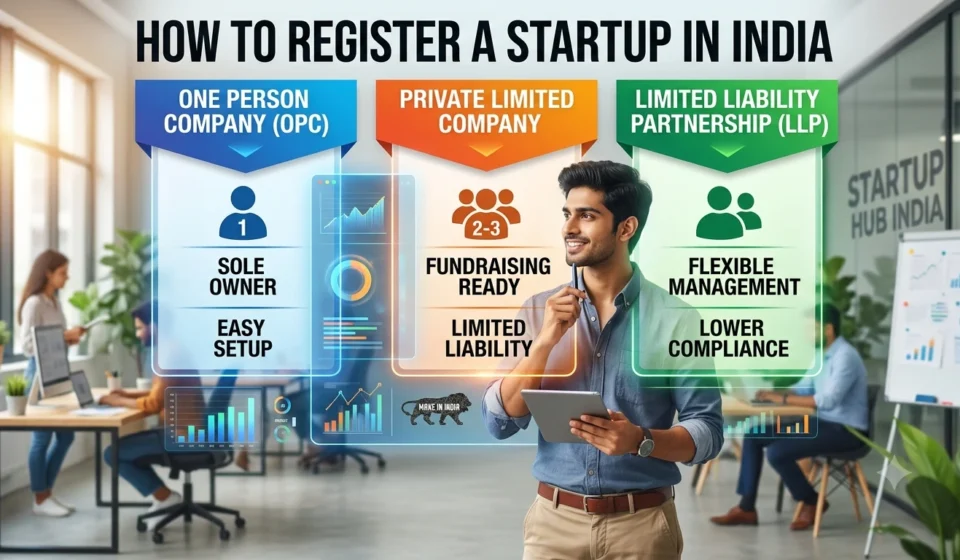
How to Register a Startup in India: OPC vs Pvt Ltd vs LLP Explained

Aditi had been freelancing as a UI/UX designer for three years when two of her clients asked her to build a small product studio instead of taking one-off projects. She said yes before she’d fully thought it through, and then spent the next two weeks stuck on a question that sounds simple but isn’t: how do you actually register a business in India, and which structure do you pick?
Her CA gave her three options — One Person Company (OPC), Private Limited Company (Pvt Ltd), and Limited Liability Partnership (LLP) — and told her each one changes how much she pays in compliance, how investors will see her later, and how much personal liability she’s carrying. This is the same decision every founder in India eventually has to make, usually earlier than they expect. Here’s how the three actually compare.
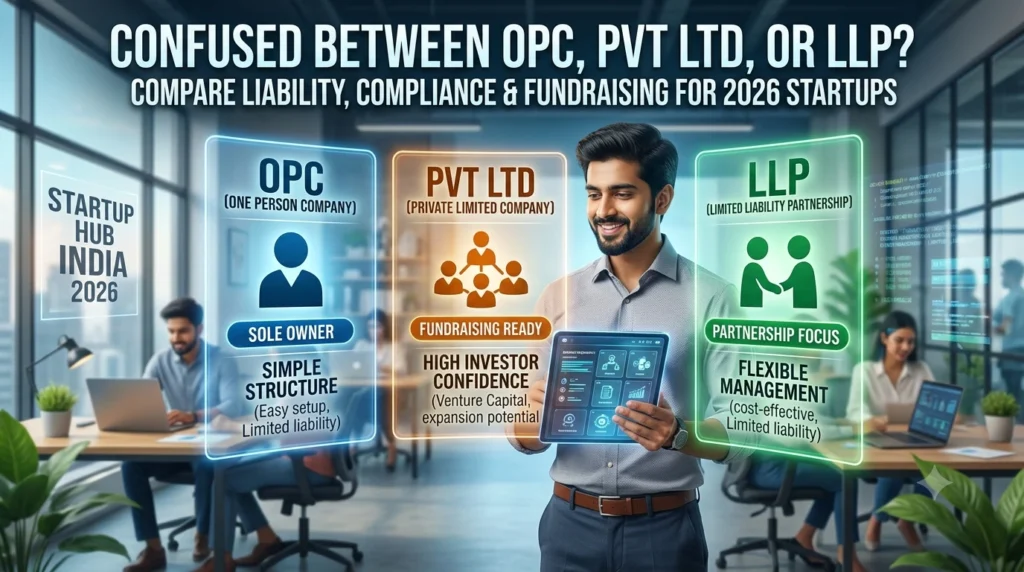
Why the Structure You Pick Matters More Than It Seems
The entity you register isn’t just a formality for the Ministry of Corporate Affairs (MCA) — it decides:
- Who’s liable if the business runs into debt or a lawsuit. A sole proprietorship gives you none of the protections below; your personal assets are on the line.
- How much you’ll spend on compliance every year, in filings, audits, and CA fees.
- Whether you can raise funding. Most VCs and angel investors in India will only invest in a Private Limited Company — not an OPC, not an LLP.
- How you’re taxed, since companies and LLPs fall under different tax provisions.
- How easy it is to add co-founders, issue ESOPs, or eventually exit through an acquisition or IPO.
Getting this wrong doesn’t usually break a business, but it often means an expensive, time-consuming conversion later — for instance, converting an LLP into a Pvt Ltd company once investors show interest.
One Person Company (OPC): Built for Solo Founders
An OPC lets a single individual own and run a company with limited liability — something a sole proprietorship never offers. You get a separate legal identity for the business, so your personal assets stay protected from company debts.
Best for: solo founders who want limited liability but don’t need co-founders or external investors yet — consultants, single-owner service businesses, or someone testing an idea before scaling.
Key features:
- Only one member (shareholder) is allowed, though the OPC must nominate a second person as a nominee director in case of the owner’s death or incapacity.
- Minimum one director, and the sole member can also be the director.
- Mandatory conversion into a Pvt Ltd company once the OPC crosses ₹2 crore in average annual turnover or ₹50 lakh in paid-up capital, as per the Companies Act.
- Cannot raise equity funding from outside investors, since there’s only one shareholder by design.
- Compliance is lighter than a Pvt Ltd but still includes annual filings with the Registrar of Companies (RoC).
Where it falls short: the moment you want a co-founder with equity, or an investor wants a stake, you’ll need to convert to a Pvt Ltd company. Many founders who plan to raise funding skip OPC entirely for this reason.
Private Limited Company (Pvt Ltd): The Default for Startups That Plan to Scale
This is the structure most Indian founders end up choosing, especially if fundraising is anywhere on the roadmap. A Pvt Ltd company is a separate legal entity, offers limited liability to all shareholders, and is the only structure of the three that most VCs and angel investors will actually invest in.
Best for: startups planning to raise external funding, bring on co-founders, issue ESOPs, or scale into a larger team.
Key features:
- Requires a minimum of two directors and two shareholders (can be the same people), and a maximum of 200 shareholders.
- Shares can be issued to investors, employees (via ESOPs), and co-founders, making it the natural fit for equity-based fundraising.
- Liability of each shareholder is limited to their shareholding — personal assets stay protected.
- Compliance is the heaviest of the three: mandatory annual audits regardless of turnover, RoC filings, board meetings, and statutory registers.
- Eligible for Startup India recognition (DPIIT), which unlocks tax exemptions, easier compliance, and access to government funding schemes.
Where it costs you: higher setup cost, more ongoing compliance (₹40,000–₹1,00,000+ annually in many cases depending on scale), and mandatory audits from year one — even before you’re profitable.
Limited Liability Partnership (LLP): The Middle Ground
An LLP combines the limited liability of a company with the operating flexibility of a partnership. Partners aren’t personally liable for the LLP’s debts beyond their agreed contribution, and there’s no requirement for a board or elaborate governance structure.
Best for: professional services firms (consulting, design studios, legal or CA practices), or founders who want liability protection without company-level compliance, and who don’t plan to raise VC funding.
Key features:
- Requires a minimum of two partners, with no upper limit.
- Governed by an LLP Agreement rather than Articles of Association, giving partners more flexibility in defining profit sharing and roles.
- Compliance is lighter than a Pvt Ltd — audit is mandatory only if turnover exceeds ₹40 lakh or capital contribution exceeds ₹25 lakh.
- Cannot issue equity shares, which means it’s structurally incompatible with most startup fundraising and ESOP plans.
- Cheaper to run long-term, but converting an LLP into a Pvt Ltd later (a common move once funding talks start) involves its own filing process and cost.
You May Also Like To Read About:
- Government Schemes for Women Entrepreneurs in India: The Complete 2026 Guide to Loans, Subsidies and Support
- CGSS Explained: How the Government Is Backing ₹20 Crore Startup Loans Without a Single Rupee of Collateral
- PMEGP (Prime Minister Employment Generation Program) Explained: How the Government Is Quietly Funding Thousands of First-Time Entrepreneurs Every Month
- DPIIT Recognition: The One Government Certificate Every Indian Startup Needs Before Anything Else
- Startup India Seed Fund Scheme (SISFS): The Complete Guide Every Indian Founder Should Read Before Applying
- Government Schemes for Startups and Small Businesses in India: The Complete 2026 Guide to Funding, Tax Breaks and Ease of Doing Business
Side-by-Side Comparison
| Factor | OPC | Pvt Ltd | LLP |
|---|---|---|---|
| Minimum owners | 1 | 2 | 2 |
| Liability protection | Yes | Yes | Yes |
| Can raise VC/angel funding | No | Yes | No |
| Can issue ESOPs | No | Yes | No |
| Annual compliance cost | Moderate | High | Low–Moderate |
| Mandatory audit | Yes | Yes | Only above turnover/capital threshold |
| Startup India (DPIIT) eligible | Limited | Yes | Yes |
| Best suited for | Solo founders | Funded/scaling startups | Professional services, bootstrapped businesses |
So Which One Should You Actually Pick?
A useful way to think about it: structure for where you’re headed in 12–18 months, not just where you are today.
- If you’re a solo founder with no immediate plans to raise money or add a co-founder with equity, an OPC gives you liability protection without the full weight of Pvt Ltd compliance.
- If you’re building something you intend to pitch to investors, hire aggressively, or offer ESOPs, go straight to a Pvt Ltd company — converting later costs more in time and legal fees than starting there.
- If you’re running a service-based business with a partner or two and funding isn’t part of the plan — a design studio, consultancy, or agency — an LLP keeps costs down while still protecting personal assets.
Aditi, in the end, went with a Pvt Ltd company. Her clients had started asking about long-term contracts that needed a “proper company,” and she suspected she’d want to bring on a co-founder within the year. The extra compliance cost, she figured, was cheaper than doing the conversion twice.
Registration Process at a Glance
Regardless of which structure you choose, registration happens through the MCA’s SPICe+ (Simplified Proforma for Incorporating Company Electronically Plus) portal, and broadly involves:
- Obtaining a Digital Signature Certificate (DSC) for all directors/partners.
- Applying for Director Identification Number (DIN).
- Reserving your company/LLP name through the RUN or SPICe+ Part A service.
- Filing incorporation documents (MOA and AOA for companies, LLP Agreement for LLPs).
- Receiving your Certificate of Incorporation along with PAN and TAN.
- Opening a current bank account and registering for GST if applicable.
Most founders route this through a CA or company secretary rather than doing it solo — the forms are straightforward, but errors in name reservation or MOA drafting can cost weeks in resubmissions.
Frequently Asked Questions
1. Can I convert my business structure later if I start with the wrong one?
Yes, but it’s rarely simple or free. An OPC can convert into a Pvt Ltd company voluntarily, or must convert once it crosses the ₹2 crore turnover / ₹50 lakh paid-up capital threshold. An LLP can also convert into a Pvt Ltd company, but this involves a fresh incorporation process, transfer of assets and liabilities, and fresh RoC filings — typically taking 4–8 weeks and costing more than if you’d registered as a Pvt Ltd from day one. If there’s any realistic chance you’ll raise funding within 1–2 years, it’s usually cheaper to start as a Pvt Ltd.
2. Which structure is cheapest to register and maintain?
LLP is generally the cheapest to both set up and run, since audits are only mandatory above certain turnover/capital thresholds and there’s no requirement for board meetings or elaborate statutory registers. OPC comes next, and Pvt Ltd is the most expensive due to mandatory annual audits from year one, ROC filings, and board compliance regardless of revenue.
3. Can an OPC have more than one owner in the future?
Not directly. If you want to add a co-founder or investor as a shareholder, the OPC must first convert into a Pvt Ltd company. This is one of the most common reasons founders outgrow the OPC structure within the first year or two.
4. Do I need a physical office to register any of these structures?
You need a registered office address, but it doesn’t have to be a dedicated commercial space — a residential address or a virtual/co-working office address is commonly used and accepted by the MCA, as long as you can provide proof of address (utility bill, rent agreement, or NOC from the owner).
5. What’s the difference between an LLP Agreement and a company’s MOA/AOA?
An LLP Agreement is a contract between partners defining profit-sharing ratios, roles, responsibilities, and decision-making — it’s flexible and can be amended relatively easily by mutual agreement. A Pvt Ltd company’s Memorandum of Association (MOA) and Articles of Association (AOA) are more rigid, legally standardized documents that define the company’s objectives and internal governance rules, and amending them requires board and shareholder resolutions plus RoC filings.
6. Can foreign nationals or NRIs be directors/partners in these structures?
Yes, with conditions. A Pvt Ltd company can have foreign nationals as directors and shareholders, subject to FDI (Foreign Direct Investment) norms depending on the sector. An LLP can have foreign partners too, but FDI in LLPs is more restricted and requires government approval in certain sectors. An OPC, however, currently requires the sole member and nominee to be Indian residents — so it’s not an option for foreign-owned solo ventures.
7. Is GST registration mandatory when I incorporate?
Not automatically. GST registration is separate from company/LLP incorporation and becomes mandatory once your turnover crosses ₹40 lakh (₹20 lakh for services, lower thresholds in some special category states), or if you’re doing inter-state supply, e-commerce, or specific notified categories of business — regardless of turnover. Many founders register for GST voluntarily at incorporation anyway, since it’s often required to open a current account or work with larger B2B clients.
8. How long does registration actually take?
Through the SPICe+ portal, a Pvt Ltd or OPC incorporation typically takes 7–15 working days if documents are in order, including DSC and DIN issuance, name approval, and certificate of incorporation. LLP registration follows a similar timeline through the LLP-specific forms (FiLLiP). Delays usually come from name rejection (picking a name too similar to an existing registered entity or trademark) or incomplete address proof — not from the process itself.
9. Do I need a CA or company secretary, or can I register myself?
Technically, you can file everything yourself through the MCA portal. In practice, most founders use a CA or CS because the forms require precise drafting (especially MOA/AOA objects clauses and LLP Agreements), and errors trigger resubmission cycles that cost more time than the professional fee would have. Expect to pay roughly ₹5,000–₹15,000 in professional fees for straightforward incorporations, on top of government filing fees and stamp duty.
10. Which structure is best if I want Startup India (DPIIT) recognition?
Pvt Ltd companies and LLPs are both eligible for DPIIT recognition under Startup India, provided the entity is under 10 years old, has turnover under ₹100 crore in any financial year, and is working toward innovation or improvement of products/services/processes. OPCs have more limited eligibility here since DPIIT recognition criteria are built around structures that can bring in outside capital and scale — so if Startup India benefits (tax holidays, easier compliance, access to the Fund of Funds) are part of your plan, Pvt Ltd is the safer bet.
11. What happens to my personal liability if the business fails or is sued?
In all three structures — OPC, Pvt Ltd, and LLP — your personal assets are protected beyond your investment/shareholding in the business, which is the core reason founders move away from sole proprietorships. The exception is if you’ve personally guaranteed a loan (common with bank lending to small companies) or engaged in fraud — in those cases, liability protection doesn’t apply, structure notwithstanding.
12. Can I run my startup as a sole proprietorship first and formalize later?
You can, and many freelancers do exactly this in the early testing phase — it’s the fastest and cheapest way to start (often just a GST or Udyam/MSME registration). But there’s no liability protection, it’s harder to open a dedicated business bank account or raise funding, and converting a sole proprietorship into a Pvt Ltd or LLP later means effectively re-registering the business, transferring contracts, and sometimes losing continuity with existing GST or MSME registrations. It works as a stopgap, not a long-term plan.
This article is for general informational purposes and shouldn’t be treated as legal or tax advice. Company structure decisions have long-term consequences — consult a qualified CA or company secretary before incorporating.

Shuchi founded Finance Checks after spending 16+ years working in corporate, managing operations and distribution. She managed her own finances, learned and read regularly and helped people make sense of their savings, loans, insurance, and investments.
She started this site to offer the kind of clear, honest financial guidance she wished was more available when she was learning to manage her own money. Every article is researched personally, checked against official sources such as the Reserve Bank of India, SEBI, or the Income Tax Department, and revisited whenever regulations or figures change. She is upfront about how the site earns money through ads and select affiliate partnerships, and she does not let either influence what she actually recommends to readers.



[…] incorporation, or picking a structure that doesn’t match your plans (see our comparison of OPC vs Pvt Ltd vs LLP), creates problems that compound. Sole proprietorships offer no liability protection. LLPs […]