
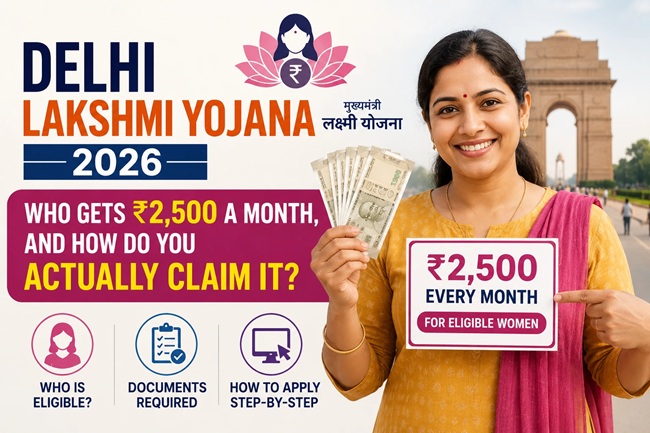
Delhi Lakshmi Yojana 2026: Who Gets ₹2,500 a Month, and How Do You Actually Claim It?

If you’ve been searching for “Laxmi Yojna Delhi” and feeling a little lost about which scheme you’re even reading about, you’re genuinely not alone. This scheme has gone through three names in under eighteen months, first announced as the Mukhyamantri Mahila Samman Yojana, then reworked as the Mahila Samriddhi Yojana, and finally launched to the public as the Delhi Lakshmi Yojana in July 2026. If you’ve seen conflicting information across different websites, that’s exactly why, most of it was written at a different stage of the same scheme’s journey, before the final rules were locked in.
So let’s clear the confusion right at the start and walk through this properly, from what the scheme actually is, to whether you or someone in your family qualifies, right down to the exact documents you’ll need open on your desk before you sit down to apply.
Quick answer: The Delhi Lakshmi Yojana gives eligible women in Delhi ₹2,500 every month, but with an interesting twist most cash transfer schemes don’t have, only part of it comes as cash, the rest goes into a government-backed fixed deposit. To qualify, you need to be a woman aged 21 to 60, the eldest eligible woman in your family, a registered Delhi voter, either you, your husband, or a parent must have lived in Delhi for at least 10 years, and your family’s annual income must be ₹2.5 lakh or below. Applications are open now at dly.delhi.gov.in, and the first payments are expected around Raksha Bandhan 2026.
About This Guide: Written by the Finance Checks Editorial Team, Personal Finance Researchers. This article is based on the official eligibility and documentation guidelines released by the Department of Women and Child Development, Government of NCT of Delhi, along with the scheme details published on the official portal, dly.delhi.gov.in. Last updated: August 2026.
First, Let’s Sort Out the Name Confusion
Here’s the timeline in plain terms, since understanding it actually helps you trust that you’re reading about the right scheme. The scheme was first promised as the Mukhyamantri Mahila Samman Yojana in the BJP’s manifesto ahead of the 2025 Delhi Assembly election. The Delhi cabinet gave it initial approval on 8 March 2025, but no payments actually went out under that name while the government worked out the eligibility rules and built the application system. Along the way, it was referred to as the Mahila Samriddhi Yojana in several official communications and news reports. Then, on 13 July 2026, the government formally renamed it to the Delhi Lakshmi Yojana, and the final eligibility conditions were cleared by the cabinet in the last week of July 2026. The application portal went live on 1 August 2026.
If you’ve bookmarked a page or read an article using either of the older names, the scheme, the ₹2,500 monthly amount, and the underlying purpose have all stayed the same throughout. Only the name, the final eligibility rules, and the official portal have been updated. There is no separate Mahila Samriddhi Yojana application process anymore, everything now runs through the Lakshmi Yojana portal.
What Delhi Lakshmi Yojana Scheme Actually Gives You
The Delhi Lakshmi Yojana provides ₹2,500 per month to eligible women, adding up to ₹30,000 over a year, delivered through Direct Benefit Transfer straight into your bank account. The Delhi government has set aside ₹5,110 crore for this scheme in the 2026-27 budget, with an expectation that it will reach more than 17 lakh women across the city.
Here’s the part that genuinely sets this scheme apart from most cash transfer programmes you might have heard of, and it’s worth paying close attention to, since it directly affects how you’ll actually receive your money. The ₹2,500 isn’t handed over entirely as spendable cash. Under the default structure, ₹1,000 comes to you as cash you can use immediately, while the remaining ₹1,500 gets automatically invested into a fixed deposit backed by a sovereign guarantee from the Delhi government, with a three-year lock-in period. If you’d rather build savings even faster, the scheme also gives you the option to redirect the entire ₹2,500 into the fixed deposit instead of taking any cash component at all. This structure is a deliberate design choice, aimed at giving immediate relief while also nudging long-term financial habits and formal savings, something worth genuinely appreciating even if it means you won’t see the full amount in hand every month.
Who Actually Qualifies: The Five Conditions
Every single one of these five conditions needs to be met, this isn’t a “meet most of them” situation.
- You need to be between 21 and 60 years old, calculated as on the date you submit your application.
- You need to be the eldest eligible woman in your family. If there’s more than one woman in your household who would otherwise qualify, only the eldest among them is entitled to apply and receive the benefit, not each qualifying woman individually.
- You, your husband, or either of your parents must have lived in Delhi for at least 10 years as on the date of your application. This residency requirement can be satisfied through any one of these three people, it doesn’t have to be your own personal decade-long residency specifically.
- You must be a registered voter in Delhi. Your name needs to appear on the Delhi electoral rolls, since your Voter ID plays a direct role in the verification process.
- Your family’s annual income must not exceed ₹2.5 lakh. This is assessed at the family unit level, not just your personal income, so it accounts for the combined earnings of your household.
Who Cannot Apply, Even If the Five Conditions Are Met
Meeting the eligibility conditions above isn’t the whole picture. The scheme also lays out specific exclusions, and falling into any of these categories rules you out regardless of your age, residency, or income.
You’re excluded if you’re already receiving a pension of any kind from the Central or State Government. You’re excluded if you’re an income tax payee, meaning you file and pay income tax. You’re excluded if you’re a GST filer, meaning you’re registered and filing returns under GST, which typically applies if you run a registered business. You’re excluded if you’re a government servant currently in service, or if you hold any public office. And you’re excluded if you have more than three living children.
It’s genuinely worth checking your own situation against this list carefully before you invest time filling out the application, since these exclusions apply strictly and won’t be waived based on how close you otherwise come to qualifying.
The Documents You’ll Need Ready Before You Start
Having everything ready before you open the application form makes the entire process considerably smoother, since the online form doesn’t save your progress indefinitely if you’re hunting for a missing document halfway through.
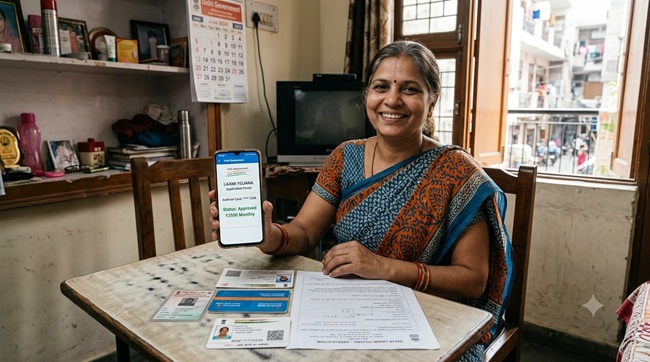
You’ll need your Aadhaar card, with the name matching exactly across your other documents. You’ll need your Delhi Voter ID card. You’ll need proof of long-term residency in Delhi, which can typically be satisfied through documents like a ration card, an old voter ID, or similar long-standing residence proof for yourself, your husband, or a parent. You’ll need your bank passbook or account details, and this is a detail worth flagging clearly: your bank account needs to be with one of the participating banks connected to the CBDC (Central Bank Digital Currency) ecosystem, since the scheme’s payment structure runs through this system rather than a standard bank transfer alone. It’s worth checking the official portal’s current list of participating banks and confirming your account qualifies before you begin.
And finally, you’ll need a signed endorsement letter from your local MP or MLA. This is a mandatory document, your application genuinely stays incomplete without it, and it’s worth reaching out to your constituency’s MLA office early, since most offices have now set up a process for issuing these letters given how many applicants need one.
How to Actually Apply for Delhi Lakshmi Yojana, Step by Step
Head to the official portal at dly.delhi.gov.in, and be careful here, since several unofficial-looking websites have appeared online using similar names and design, and applying through anything other than this official government portal puts your personal and banking information at risk. Once you’re on the official site, you’ll register and enter your personal details, including your Aadhaar information. Next, you’ll fill in your family member details, which the system uses to verify things like your eldest-eligible-woman status and your family’s combined income. You’ll then provide your bank account details, making sure the account belongs to one of the CBDC-participating banks mentioned earlier. After that, you’ll upload your required documents, including your signed MP or MLA endorsement letter. Review everything carefully before hitting submit, since errors or mismatches here are a common reason applications get delayed or rejected. Once submitted, download and safely save your acknowledgement receipt, which you’ll need for tracking your application status going forward.
What Happens After You Apply
Your application doesn’t get approved instantly. The Department of Women and Child Development verifies your eligibility, residency, income details, and submitted documents before any payment is released, so don’t expect the ₹2,500 to land the moment you hit submit. Only fully verified applications move forward to receive the monthly instalment. Registrations opened on 1 August 2026, and within the first two days alone, over 147,000 women had already registered, giving you a sense of how much demand this scheme has generated right out of the gate. No closing date has been announced yet, but the first payment cycle is expected to align with Raksha Bandhan 2026, so applying sooner rather than later genuinely improves your chances of being included in that very first round of disbursements.
What You Can and Cannot Do With the Central Bank Digital Currency (CBDC) Wallet Portion
Since part of your benefit flows through the CBDC digital wallet system, it’s worth knowing there are specific restrictions on what that wallet balance can be used for. It cannot be used to purchase alcoholic beverages, tobacco products, narcotic drugs or psychotropic substances, lottery tickets, or gambling and betting services, along with any other category the government may restrict from time to time. This is a deliberate design feature meant to ensure the assistance genuinely supports household and essential needs, worth keeping in mind as you plan how you’ll use the monthly amount.
Common Mistakes to Avoid While Applying
The most frequent mistake right now is applying through an unofficial website or third-party portal that looks similar to the real one, simply because it ranks well in a search or looks convincing at a glance. Always double-check that you’re on dly.delhi.gov.in specifically before entering any personal or banking information.
Another common mistake is underestimating how long the MP or MLA endorsement letter takes to arrange, and starting the online application before actually having this document in hand, which can leave your submission incomplete or stuck midway.
A third mistake is not checking whether your existing bank account belongs to a CBDC-participating bank before filling in your account details, only to discover later that the account you entered doesn’t support the scheme’s payment structure, requiring you to redo that portion of your application with a different account.
A fourth, easily overlooked mistake is assuming every eligible woman in a household can apply separately. Only the eldest eligible woman in the family is entitled to apply, so if a younger family member submits an application without checking this first, it’s likely to be rejected during verification.
My Take
What I genuinely appreciate about how this scheme is structured is the built-in savings component, most direct cash schemes hand over money with no strings attached, and while that has its place, embedding a portion into a sovereign-guaranteed fixed deposit is a thoughtful way to nudge long-term financial security alongside immediate relief. Where I’d encourage caution is exactly where the scheme itself demands care, the eligibility and exclusion criteria here are genuinely strict and specific, so it’s worth going through the five conditions and the exclusion list carefully before investing time gathering documents and chasing an MLA endorsement letter for an application that might not clear verification. If you do qualify, don’t wait, given how quickly registrations have been coming in, applying early gives you the best shot at the first disbursement cycle.
Frequently Asked Questions
What is the Delhi Lakshmi Yojana? It’s a Delhi government scheme providing ₹2,500 per month to eligible women from economically weaker families, delivered partly as cash and partly into a government-backed fixed deposit, aimed at providing immediate financial support alongside long-term savings.
Is Delhi Lakshmi Yojana the same as Mahila Samriddhi Yojana? Yes. The scheme was first promised as the Mukhyamantri Mahila Samman Yojana, later referred to as the Mahila Samriddhi Yojana, and was officially renamed to the Delhi Lakshmi Yojana in July 2026. The monthly benefit amount has remained ₹2,500 throughout.
Who is eligible for Delhi Lakshmi Yojana? Women aged 21 to 60, who are the eldest eligible woman in their family, are registered Delhi voters, have either themselves, their husband, or a parent resident in Delhi for at least 10 years, and belong to a family with annual income not exceeding ₹2.5 lakh.
Who is excluded from Delhi Lakshmi Yojana even if they meet the basic eligibility? Women receiving a Central or State government pension, income tax payees, GST filers, government servants or public officeholders, and women with more than three living children are excluded from the scheme.
Do I get the full ₹2,500 as cash every month? Not by default. Under the standard structure, ₹1,000 is given as cash and ₹1,500 is invested into a sovereign-guaranteed fixed deposit with a three-year lock-in. Applicants can also choose to direct the entire ₹2,500 into the fixed deposit instead of receiving any cash component.
How do I apply for Delhi Lakshmi Yojana? Applications are submitted online through the official portal, dly.delhi.gov.in, where you register with your Aadhaar and family details, provide bank account information, upload required documents including a signed MP or MLA endorsement letter, and submit your application for verification.
Is the MP or MLA endorsement letter really mandatory? Yes. The application is considered incomplete without a signed endorsement letter from the applicant’s local MP or MLA, so it’s important to arrange this document before or alongside starting the online application.
What bank account do I need for Delhi Lakshmi Yojana? Your bank account needs to be with a bank participating in the CBDC (Central Bank Digital Currency) ecosystem, since the scheme’s payment structure runs through this system. It’s advisable to check the current list of participating banks on the official portal before applying.
When will I receive my first payment under Delhi Lakshmi Yojana? No fixed date has been officially confirmed, but the first payment cycle is expected to align with Raksha Bandhan 2026. Only applications that clear the department’s eligibility and document verification process will receive the monthly instalment.
Can more than one woman in the same family receive benefits under this scheme? No. Only the eldest eligible woman in a family is entitled to apply for and receive the Delhi Lakshmi Yojana benefit, even if multiple women in the household would otherwise meet the individual eligibility conditions.
Disclaimer: This article is for general informational and educational purposes only and does not constitute legal or financial advice. Government scheme names, eligibility criteria, and application processes are subject to change. Please verify the latest details directly on the official Delhi Lakshmi Yojana portal, dly.delhi.gov.in, before applying or making any decisions based on this information.

Shuchi founded Finance Checks after spending 16+ years working in corporate, managing operations and distribution. She managed her own finances, learned and read regularly and helped people make sense of their savings, loans, insurance, and investments.
She started this site to offer the kind of clear, honest financial guidance she wished was more available when she was learning to manage her own money. Every article is researched personally, checked against official sources such as the Reserve Bank of India, SEBI, or the Income Tax Department, and revisited whenever regulations or figures change. She is upfront about how the site earns money through ads and select affiliate partnerships, and she does not let either influence what she actually recommends to readers.