
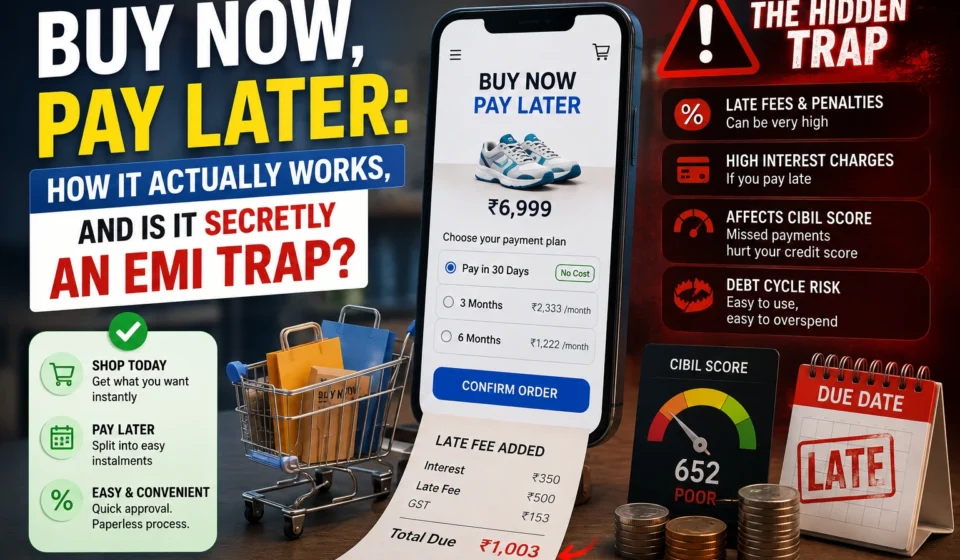
Buy Now, Pay Later: How It Actually Works, and Is It Secretly an EMI Trap?

Priyanka bought a pair of ₹4,500 sneakers on Simpl last month without giving it a second thought. No card details typed in, no interest mentioned anywhere, just a single tap and the shoes were on their way. Two weeks later, a payment reminder popped up, she was mid-flight to a work trip, missed it by four days, and came back to a late fee plus a slightly sinking feeling that she’d just paid extra for something that had promised to be completely free. She wasn’t wrong to feel confused. BNPL genuinely can cost you nothing, and it genuinely can quietly become one of the more expensive ways to borrow money in India today. The difference between the two comes down to a handful of details almost nobody explains clearly before you tap “pay later.”
Quick answer: Buy Now, Pay Later lets you complete a purchase instantly and pay for it afterward, either as a single lump sum within an interest-free window, typically 15 to 30 days, or by converting it into EMIs that carry real interest, often between 18% and 42% annualized if not paid on time. It isn’t inherently a trap, used correctly and paid in full within the free window, it’s genuinely interest-free short-term credit. It becomes a trap specifically when payments are missed or purchases get converted into EMIs without realizing the actual cost, and it’s now reported to CIBIL and other credit bureaus, so it behaves like real debt whether you think of it that way or not.
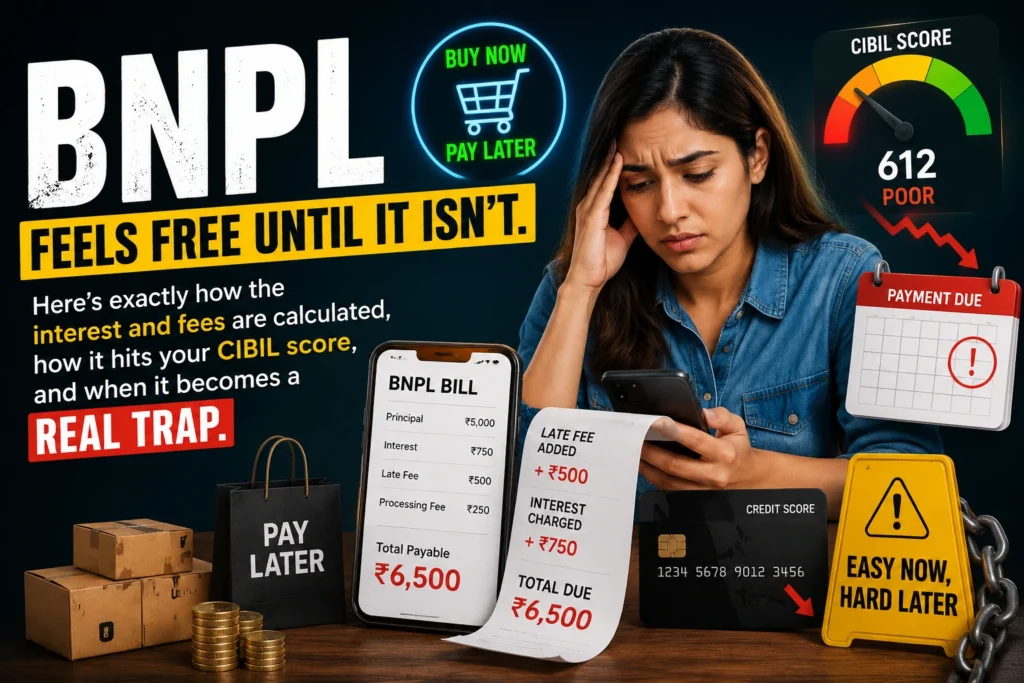
What BNPL Actually Is, in Plain Terms
Buy Now, Pay Later is a short-term credit facility that lets you buy something immediately and defer the actual payment to a later date, without needing a credit card or a lengthy loan approval process. It’s now built directly into checkout flows on Amazon, Flipkart, and dozens of other platforms, and increasingly, it’s tied straight to your UPI ID through apps like Simpl, LazyPay, and Slice, meaning you can effectively “pay later” at your local grocery store, petrol pump, or even a tea stall, not just online.
Functionally, most BNPL products work the same way underneath. You make a purchase, the BNPL provider pays the merchant on your behalf, and you owe that amount back to the provider, either as one full payment by a set date, or spread across several instalments if you choose the EMI route.
The Interest-Free Window: Where the “Free” Part Genuinely Comes From
Here’s the part that’s actually true, and worth understanding clearly rather than dismissing as marketing. Most BNPL platforms offer a genuine interest-free period, commonly 15 to 30 days, sometimes running until a fixed date the following month. If you pay your entire outstanding amount within this window, you pay exactly what you would have paid in cash, no interest, no processing fee, nothing extra. This isn’t a gimmick, it’s a real, functioning short-term credit line, similar in spirit to a credit card’s grace period, and for someone with disciplined repayment habits, it can be a genuinely useful cash flow tool.
The moment you step outside that window, either by missing the full payment date or by choosing to convert your purchase into EMIs instead, the economics change considerably, and this is where most of the confusion, and most of the actual cost, tends to show up.
How the Interest Actually Gets Calculated
If you don’t clear your bill within the free window and instead let it roll into interest, or if you deliberately convert your purchase into an EMI plan, the interest rate applied typically ranges from around 18% to 42% annualised, depending on the specific platform and plan. This is meaningfully close to, and in some cases higher than, standard credit card interest rates, despite BNPL often being marketed and perceived as a gentler, more casual form of credit.
Take a concrete example. Suppose you make a ₹10,000 purchase and convert it into EMI at a fairly typical BNPL interest rate of 24% per annum, along with a processing fee of around 1.5% of the loan amount, roughly ₹150 in this case. Over a 3-month EMI tenure, you’d end up paying meaningfully more than ₹10,000 by the time the loan is fully repaid, purely due to interest and the upfront processing fee, even though the checkout screen at the time of purchase likely just showed you a clean monthly instalment figure without spelling out the total cost in rupee terms.
Late Fees: The Part That Catches Even Careful Users
Even if you never intend to carry a balance, missing your payment date, even by a few days, triggers a late fee, typically ranging from around ₹100 to ₹600, plus GST, depending on your outstanding amount and the specific platform’s fee structure. This is exactly what happened to Priyanka. A short trip, a missed notification, and a purchase that was meant to cost nothing ended up costing a modest, but entirely avoidable, penalty.
It’s worth building a simple habit here: setting up autopay for your BNPL dues, the same way you might for a credit card bill, removes almost all of this risk, since the entire late fee problem stems from timing slips rather than any inability to pay.
The “No-Cost EMI” Trap Hiding in Plain Sight
This deserves its own explanation, since it’s closely related to BNPL and catches even more people off guard. When a purchase, whether through BNPL or a credit card’s built-in EMI conversion, is marketed as “no-cost EMI,” there are two costs that are easy to miss entirely.
First, “no-cost” typically means the bank’s or platform’s own interest component is waived, but you’re still charged GST on that underlying interest amount, which shows up on your statement as a processing fee rather than being fully absent. Second, and this is the one that surprises people most, if you’re using a credit card for the EMI, the full value of your purchase gets blocked against your total credit limit immediately, not just the monthly instalment amount. Buy a ₹60,000 television on a 12-month no-cost EMI with a ₹1,00,000 credit limit, and your usable credit drops to ₹40,000 for the entire year, not by ₹5,000 a month as many people assume. This quietly restricts your available credit for other genuine needs and can also affect your credit utilization ratio, a factor that influences your credit score.
How BNPL Affects Your CIBIL Score
This is genuinely the most underappreciated part of the entire BNPL conversation, and it’s worth being completely clear about it: BNPL is not “soft,” invisible credit. BNPL providers in India are now required to report your transaction and repayment history to credit bureaus like CIBIL and Experian, exactly like a personal loan or credit card. Each BNPL account typically shows up on your credit report as a consumer durable loan or personal loan.
Used responsibly, with on-time repayment, this can genuinely help build a credit history, which is particularly useful for younger users who don’t yet have a credit card or an established credit profile. But the reverse is equally true, and considerably more common than most users expect. Data from credit bureaus shows BNPL-linked missed payment reports running at a meaningfully higher rate than credit card EMI defaults, and among users aged 18 to 25, the large majority of first-time CIBIL score declines have been directly attributable to missed BNPL payments specifically, not credit cards or personal loans. From July 2026, credit bureau reporting has also moved to a weekly cycle, meaning a missed BNPL payment now becomes visible to every lender in the country within about a week, rather than the older monthly reporting cycle that gave a slightly longer buffer.
Opening too many BNPL accounts across different apps compounds this risk further, since each one shows up as a separate credit line on your report, which can make you appear as a heavier borrower than you actually are, even if each individual balance is genuinely small.
Has RBI Actually Regulated BNPL?
Yes, and this matters for how safe the underlying system is, even if it doesn’t remove the risk of misusing it. BNPL in India operates under RBI oversight, typically structured through partnerships between the app you see (Simpl, LazyPay, Slice, and similar platforms) and RBI-regulated banks or NBFCs that actually extend the underlying credit. This means fee disclosures, data protection, and lending practices are held to regulatory standards, rather than operating in an unregulated grey zone. Recent RBI directions have also tightened credit card and EMI-linked practices more broadly, including capping late payment fees by slab and introducing a short grace period before a missed payment gets reported as “past due” to credit bureaus, protections that indirectly benefit BNPL users too, given how closely these products are now regulated alongside traditional credit cards.
This regulatory oversight is a genuine reassurance on the safety and transparency front. It doesn’t, however, change the basic math of interest and late fees covered above, which remain entirely real costs if you don’t manage the repayment carefully.
How BNPL Has Changed Indian Buying Behaviour
It’s worth stepping back and looking at just how significant this shift has been. India’s BNPL market processed roughly ₹1.5 lakh crore in transaction value in a recent full year, used by well over 8 crore people, with an average transaction size of around ₹1,800, small, frequent, everyday purchases rather than big-ticket splurges. This is precisely what makes BNPL such a different animal from a traditional loan. Nobody sits down and consciously decides to “take a loan” for a ₹1,800 purchase, yet that’s functionally what’s happening every time a payment gets deferred.
The genuine shift in buying behaviour is this: purchases that once required either having the cash on hand or consciously deciding to put something on a credit card now happen with almost no friction at all, no card entry, no visible interest rate, sometimes no login required beyond a UPI PIN. This lowers the psychological barrier to spending considerably, which is exactly why so many everyday, small purchases are increasingly happening through BNPL rather than accumulating into a single, more consciously considered credit card bill at the end of the month.
BNPL vs Credit Card EMI: Which Actually Costs Less
For a straightforward, one-time purchase where you have an existing credit card, a no-cost EMI on that card is generally the more favourable option for most buyers, provided you’re aware of the credit-limit-blocking issue covered earlier and don’t have foreclosure charges working against you if you plan to pay it off early. BNPL tends to work out better specifically for smaller, frequent transactions, or for people who don’t have a credit card at all and want a lightweight, fast way to access short-term credit, as long as the balance gets cleared within the free window every single time.
Where BNPL genuinely loses to a credit card EMI is when a balance gets carried for multiple months without full repayment, since BNPL’s annualised interest rates in that scenario, often landing above 24-30%, tend to run higher than what many credit card EMI conversions charge for the same purchase.
When BNPL Genuinely Becomes a Trap
The trap isn’t the product itself, it’s a specific pattern of use, and it’s worth naming clearly. It becomes a trap when you’re using it primarily to buy things you couldn’t otherwise afford right now, rather than as a short-term cash flow convenience for a purchase you’d have made anyway. It becomes a trap when multiple small BNPL purchases across different apps pile up simultaneously, each individually manageable but collectively adding up to a real monthly obligation you hadn’t consciously budgeted for. And it becomes a trap the moment a balance rolls past the free window without a clear plan to pay it off quickly, since that’s exactly when the 18-42% interest range starts working against you in earnest.
Common Mistakes People Make With BNPL
The most frequent mistake, and Priyanka’s mistake specifically, is treating BNPL as inherently risk-free simply because the checkout screen never mentions interest, without setting up a reminder or autopay to make sure the free window is actually honoured.
Another common mistake is using multiple BNPL apps simultaneously without tracking the combined outstanding balance across all of them, since each app shows only its own dues, making it easy to lose sight of your total short-term obligation across several small, seemingly harmless purchases.
A third mistake, and a costly one, is assuming BNPL doesn’t affect your credit score simply because it feels casual and app-based, when in reality it’s reported to credit bureaus exactly like any other loan, and missed payments here can meaningfully damage a credit history, particularly for younger users who are just starting to build one.
My Take
BNPL genuinely isn’t the villain it sometimes gets painted as, used exactly as designed, paid in full within the free window, it’s a legitimately useful, interest-free short-term credit tool, and the RBI oversight behind it means the underlying system is more accountable than it might feel from a simple one-tap checkout experience. Where I’d push back hard is the casualness with which it gets used. The absence of a visible interest rate on the checkout screen doesn’t mean the absence of real financial consequence, and treating five ₹2,000 BNPL purchases across different apps as somehow lighter than one ₹10,000 credit card bill is exactly the kind of thinking that turns a convenient tool into a genuine debt spiral. Track it like you’d track any other credit, because that’s precisely what it is.
Frequently Asked Questions
Is Buy Now, Pay Later a debt trap? Not inherently. If you pay the full amount within the interest-free window, typically 15 to 30 days, BNPL costs nothing extra. It becomes a trap specifically when payments are missed, when purchases are converted into EMIs without understanding the interest cost, or when multiple BNPL balances across different apps pile up unnoticed.
How is BNPL interest calculated if I don’t pay on time? If you miss the interest-free window or choose to convert your purchase into an EMI plan, interest typically applies at an annualised rate ranging from around 18% to 42%, depending on the platform, along with a processing fee, usually around 1.5% of the purchase amount.
Does BNPL affect my CIBIL score? Yes. BNPL providers in India are required to report transaction and repayment history to credit bureaus like CIBIL and Experian, and each account typically appears as a consumer durable loan or personal loan on your credit report. On-time payments can help build credit history, while missed payments can meaningfully damage your score.
What is the interest-free period for BNPL in India? Most BNPL platforms offer a 15 to 30 day interest-free window, though the exact duration and cut-off date vary by provider. Paying your full outstanding amount within this window means no interest or processing fee is charged.
Is “no-cost EMI” really free? Not entirely. While the bank’s or platform’s interest component may be waived, GST is still charged on that underlying interest amount, usually appearing as a processing fee. If using a credit card, the full purchase value also gets blocked against your credit limit immediately, not just the monthly instalment amount.
How much is the late fee if I miss a BNPL payment? Late fees typically range from around ₹100 to ₹600, plus GST, depending on the outstanding amount and the specific BNPL platform’s fee structure.
Is BNPL regulated by the RBI? Yes. BNPL products in India are typically offered through partnerships between the consumer-facing app and RBI-regulated banks or NBFCs, which extend the actual underlying credit. This means the product operates under regulatory oversight for fee disclosures and lending practices.
Is BNPL better than credit card EMI? It depends on the situation. For a one-time purchase with an existing credit card, no-cost EMI is often more favourable if managed carefully. BNPL tends to work better for smaller, frequent purchases or for users without a credit card, provided the balance is cleared within the free window every time.
Can I have multiple BNPL accounts at once? Yes, but each account is typically reported separately to credit bureaus, and having several open simultaneously can make you appear as a heavier borrower than you actually are, even if each individual balance is small. It’s important to track your combined outstanding balance across all BNPL apps you use.
Why has BNPL changed how Indians shop? BNPL removes much of the friction involved in spending, no card entry, no visible interest rate, and in many cases no login beyond a UPI PIN, which lowers the psychological barrier to making a purchase. This has led to a rise in small, frequent transactions that might not have happened as readily with a traditional credit card or cash payment.
Disclaimer: This article is for general informational and educational purposes only and does not constitute financial advice. Interest rates, fees, and terms vary by BNPL provider and are subject to change. Please read the terms and conditions of your specific BNPL platform carefully and consult a qualified financial advisor if you’re managing significant outstanding credit.

Shuchi founded Finance Checks after spending 16+ years working in corporate, managing operations and distribution. She managed her own finances, learned and read regularly and helped people make sense of their savings, loans, insurance, and investments.
She started this site to offer the kind of clear, honest financial guidance she wished was more available when she was learning to manage her own money. Every article is researched personally, checked against official sources such as the Reserve Bank of India, SEBI, or the Income Tax Department, and revisited whenever regulations or figures change. She is upfront about how the site earns money through ads and select affiliate partnerships, and she does not let either influence what she actually recommends to readers.



[…] Buy Now, Pay Later: How It Actually Works, and Is It Secretly an EMI Trap? […]