
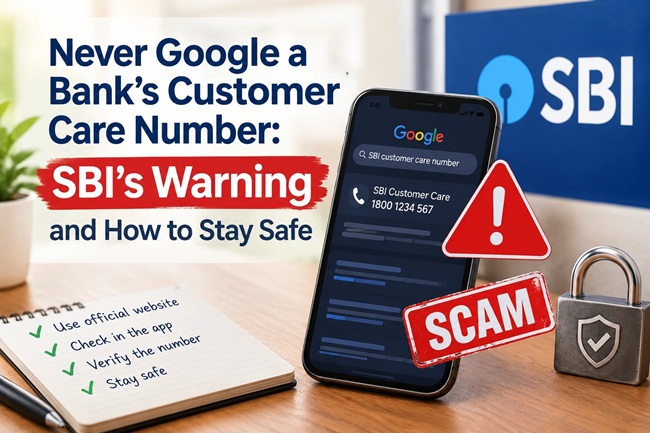
Never Google a Bank’s Customer Care Number: SBI’s Warning and How to Stay Safe

By Shuchi, FinanceChecks.com | Published 22 October 2026 | Category: Banking Insurance and Loans | Reading time: about 10 minutes
Farhan, who runs a small grocery shop in Hyderabad, had his debit card declined at a petrol pump one evening. He was in a hurry, the queue was building, and he did what almost all of us do. He typed “SBI customer care number” into Google, tapped the first result, and called.
The man who answered was calm and professional. He said the card had been blocked for a KYC update and offered to fix it on the spot. To “help”, he asked Farhan to install a small app so he could see the screen and guide him. Farhan did. Ten minutes later, his phone buzzed with a debit alert for a large amount, then another. The call had been disconnected. The number never worked again.
Farhan is an imagined character, but the story is built from patterns that police departments across India keep reporting. The first number you see in a search result is not necessarily your bank’s number. And a scammer who answers the phone sounds exactly like a real customer care executive, because that is the whole point of the trick.
State Bank of India has again warned customers against searching online for a bank’s customer care number, as fraudsters publish fake helpline listings to steal sensitive details or money. This guide explains how the scam works, how to find a genuine number every time, what to do if you have already called a fake one, and how to report it.
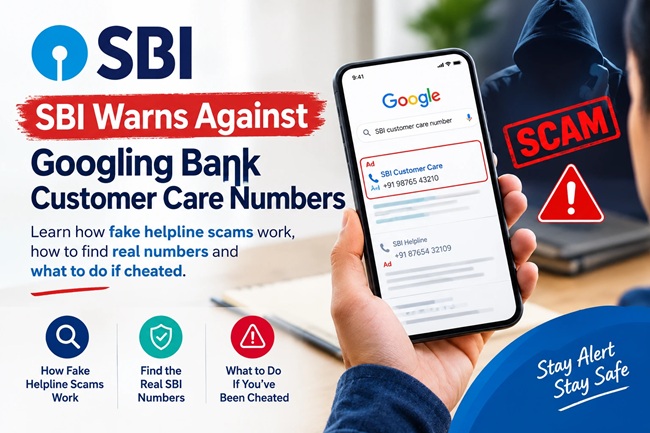
Quick Answer
Do not search Google or social media for your bank’s customer care number. Fraudsters push fake numbers into search results, maps listings and social media replies, and the person who answers will pose as a bank executive. SBI advises customers to take contact details only from the bank’s official website, and never to share account numbers, card details, CVV, OTP, PIN or passwords with anyone. Never install a screen-sharing or remote access app at a caller’s request. If you are cheated, call your bank at once and report it on the national cyber crime helpline 1930 or at cybercrime.gov.in.
About This Guide
This article is written by the editorial desk of FinanceChecks.com, an independent Indian personal finance publication, to help ordinary bank customers avoid a very common fraud. It draws on SBI’s public advisories on fake customer care numbers, police warnings from Kerala, Hyderabad and Odisha, a Canara Bank advisory on fraudulent search engine advertisements, and fact-checking reports on fake listings on search and map services. The advice is general and applies to every bank, wallet, airline, e-commerce firm and telecom company, not just SBI. SBI has issued this warning several times over the years, and I could not confirm the exact date of the latest social media post, so I have described it as a repeated advisory. This is educational content and not legal advice.
Why Searching for a Customer Care Number Is Risky
Many people assume search results are checked for accuracy. They are not. Cyberabad police have said publicly that search engines do not verify whether a listed website or number is genuine, and fraudsters know it. There are three common ways fake numbers reach you.
| How the fake number reaches you | What the fraudster does |
|---|---|
| Search results and sponsored ads | Builds a fake website and uses search tricks or paid ads to push a fake number to the top |
| Map and business listings | Creates or edits a listing for the bank or company, sometimes with a fake verified look, and adds a personal number |
| Social media replies | Watches customers’ complaints on the bank’s official social media pages and replies within minutes with a fake helpline |
The last method is the sneakiest. You post a complaint publicly, and a helpful “support” account answers before the real bank does. Canara Bank has warned its customers about exactly this pattern.
How the Scam Usually Unfolds
The details change, but the script is almost always the same.
| Step | What you see | What is really happening |
|---|---|---|
| 1 | You call the number from the search result | You have reached the fraudster, not the bank |
| 2 | The “executive” sounds polite and knowledgeable | Scripts and practice make them convincing |
| 3 | You are asked for details to “verify” you, such as card number, date of birth or account number | They are collecting the information they need |
| 4 | You are told to install an app to fix the problem | The app gives them control of your phone and screen |
| 5 | You are asked to do a small test payment or share an OTP | The test is a trick, and the OTP authorises the real theft |
| 6 | Money leaves your account and the number goes dead | The fraud is complete |
Kerala Police have specifically warned that victims are asked to install remote access or screen-sharing applications. Another case reported from Chennai involved a teacher who followed a “refund” instruction that began with a small test recharge and lost nearly ₹75,000 within minutes. In the Hyderabad police warning, a “refund” of a small amount led to a victim’s whole balance being debited. In Bhubaneswar, police said a man who searched online for an SBI customer care number lost ₹2 lakh, and that officers were seeing around ten such complaints in a month at the time.
Why This Matters More After the SBI Data Leak
If you have read about the recent report of customer data from SBI appearing on the dark web, you will see why this warning is timely. When a fake “customer care” caller already knows your name, mobile number or branch, the call becomes far more believable. That is why the rule has to be absolute. The caller’s knowledge proves nothing. A real bank will never need you to prove your identity by reading out an OTP or PIN.
You May Also Like To Read About:
- Online Scams in India 2026: 67% Get No Money Back—Shopping, Job and Lottery Fraud Warning
- Festive Sale Scams in India: How Fraudsters Target People Hunting for Cheap Deals, and How to Stay Safe
- SBI Warns of UPI Fraud: How the ‘Jumped Deposit Scam’ Can Drain Your Bank Account
- Insurance Scams in India Explained: Real Cases, How They Work, and How to Verify a Genuine Policy
How to Find a Genuine Customer Care Number
Here is a simple routine that works for any bank, and takes less than a minute.
- Use the bank’s official website, which for SBI is bank.sbi. Type the address yourself in the browser, or use a bookmark you saved earlier, instead of clicking a search result.
- Use the bank’s official mobile app, which has a contact or help section.
- Check the back of your debit or credit card, your passbook or your latest statement, where the bank prints its helpline numbers.
- Visit your home branch if the matter is not urgent.
- Save the genuine numbers in your phone’s contacts under the bank’s name today, so you never need to search during an emergency.
For SBI’s own phishing reporting address, the bank has mentioned report.phishing@sbi.co.in in its advisories. Check the official site to confirm it is still current before using it.
Red Flags During a Call
Hang up the moment any of these happen.
| Red flag | Why it is a warning sign |
|---|---|
| The caller asks for your OTP, PIN, CVV, full card number or password | A genuine bank does not need these |
| You are asked to install any app | Screen-sharing and remote access apps give fraudsters control |
| You are asked to make a small payment to receive a refund | Real refunds go to the source of payment without such steps |
| The caller insists on urgency, such as “your account will be blocked in 10 minutes” | Panic is a weapon |
| You are asked to move to WhatsApp or to a different number | Fraudsters avoid recorded and monitored lines |
| The caller asks you to click a link sent by SMS | The link leads to a fake page that steals your details |
| You are told not to tell anyone or not to visit the branch | Secrecy keeps you from help |
If You Have Already Called a Fake Number: The First Hour
Speed matters more than anything else. Here is what to do, in this order.
- Stop the call. Do not follow any further instruction.
- Uninstall any app you were asked to install, and switch on airplane mode or switch off mobile data and Wi-Fi if you suspect your phone is being controlled.
- Call your bank using a number from its official website or the back of your card, and ask them to block your card, UPI and net banking immediately.
- Report on the national cyber crime helpline 1930, or file a complaint at cybercrime.gov.in. Police can sometimes ask the receiving wallet or bank to freeze the money, and in the Chennai case mentioned above, quick action led to most of the money being recovered.
- Note down the number you called, the time, the transaction details and any screenshots.
- Change your net banking and UPI passwords and PINs from a safe device.
- Visit your branch and submit a written complaint, and keep the acknowledgement.
On the question of who bears the loss, RBI’s framework on unauthorised electronic transactions gives customers strong protection when they report promptly, but where a customer has knowingly shared credentials such as an OTP, a bank may treat it as customer negligence. That is a general description and not a guarantee in any case, so report within hours, not days, and ask your bank about the rules that apply to you.
Common Mistakes to Avoid
The most common mistake is trusting the first search result because it looks official or shows a business listing. The second is sharing an OTP to “cancel” a transaction, when the OTP is exactly what authorises it. The third is installing a support app on a stranger’s instructions. The fourth is calling the number that sent you an SMS or that appeared in a social media reply. The fifth is hesitating to tell family or the bank out of embarrassment, which gives fraudsters more time. The sixth is relying on the caller’s knowledge of your name or account as proof that they are genuine.
Another habit that helps: when you call the real bank, you start the call. If someone calls you claiming to be from the bank, hang up and call back using the official number. Banks do not mind.
My Take
I think the single most useful habit for any customer is boring: save your bank’s real number in your contacts before you need it. Almost every victim in these cases was in a hurry, with a card declined, a refund pending or an app that stopped working. Scammers wait for that moment of stress.
I also think platforms must do more. Letting anyone add a phone number to a business listing, or sell a top search position to an impostor, turns a convenience into a trap. Police departments have been saying this for years. Until that changes, the responsibility falls on you to look for the number where the bank has put it, not where an algorithm happens to show it.
One last point. If you are an older parent or relative’s go-to person for tech problems, take ten minutes this week to save their bank’s genuine numbers in their phone and show them the rule: never install an app on a stranger’s instruction. It might save them more than any insurance policy.
Frequently Asked Questions
1. Why does SBI warn customers against searching for customer care numbers online? Because fraudsters publish fake helpline numbers in search results, maps listings and social media replies. A customer who calls one reaches a scammer posing as a bank executive, who then tries to steal sensitive details or money.
2. Where can I find SBI’s genuine customer care number? On the bank’s official website, bank.sbi, in the official mobile app, on the back of your card, in your passbook or on your statement. Type the website address yourself instead of clicking a search result.
3. Can I find a real customer care number on Google? Sometimes a genuine number does appear, but you cannot be sure, because fake numbers are pushed to the top with ads and listing tricks. Use Google only to reach the official website if you must, and confirm the web address before relying on any number.
4. What do fake customer care agents usually ask for? They ask for card numbers, CVV, OTP, UPI PIN, net banking passwords and personal details. They may also ask you to install a screen-sharing app, make a small test payment, or click a link sent by SMS.
5. Why do scammers ask me to install an app? Remote access or screen-sharing apps let them see and sometimes control your phone, so they can read OTPs, open your banking app and move money without needing you to share anything else.
6. What should I do if I already called a fake number? Stop the call, remove any app you installed, call your bank using an official number to block your cards and accounts, and report on 1930 or at cybercrime.gov.in immediately. Keep records of the number, the time and the transactions.
7. What is the national cyber crime helpline number? The national cyber crime helpline is 1930, and complaints can also be filed at cybercrime.gov.in. Some older articles mention 155260, so use 1930 as the current number given in recent police advisories.
8. Will the bank refund money lost to a fake customer care scam? It depends on the facts. RBI’s framework on unauthorised electronic transactions gives customers protection when they report quickly, but if you shared credentials such as an OTP, a bank may treat it as customer negligence. Report immediately and ask your bank about the rules applicable to your case.
9. Does this scam affect only SBI customers? No. The same method is used against customers of every bank, e-commerce platform, airline, telecom company and delivery service. Police warnings in several states mention fake numbers for banks and food delivery apps alike.
10. How can I protect my family from this scam? Save the genuine customer care numbers of your family’s banks in their phones, teach them never to share OTPs or install apps for a caller, and agree on a rule that anyone claiming to be from the bank gets hung up on and called back on the official number.
Disclaimer
This article is for general information and education only. It is not legal, financial or cybersecurity advice. Phone numbers, email addresses and procedures change, so always confirm contact details on your bank’s official website or app. If you have lost money to fraud, contact your bank and the police immediately.
Sources Consulted
SBI public advisories on fraudulent customer care numbers and its official social media posts. Reports in Outlook India, Moneylife and The420 on SBI’s warnings. Kerala Police advisory on fake customer care numbers as reported by Outlook India. Cyberabad police advisory as reported by The News Minute. Canara Bank advisory on fraudulent search engine advertisements. Fact Crescendo explainer on fake numbers on Google and maps listings. Reports from Bhubaneswar and Chennai police on victims of fake customer care calls.

Shuchi founded Finance Checks after spending 16+ years working in corporate, managing operations and distribution. She managed her own finances, learned and read regularly and helped people make sense of their savings, loans, insurance, and investments.
She started this site to offer the kind of clear, honest financial guidance she wished was more available when she was learning to manage her own money. Every article is researched personally, checked against official sources such as the Reserve Bank of India, SEBI, or the Income Tax Department, and revisited whenever regulations or figures change. She is upfront about how the site earns money through ads and select affiliate partnerships, and she does not let either influence what she actually recommends to readers.



[…] Never Google a Bank’s Customer Care Number: SBI’s Warning and How to Stay Safe […]
[…] Never Google a Bank’s Customer Care Number: SBI’s Warning and How to Stay Safe […]
[…] Never Google a Bank’s Customer Care Number: SBI’s Warning and How to Stay Safe […]