
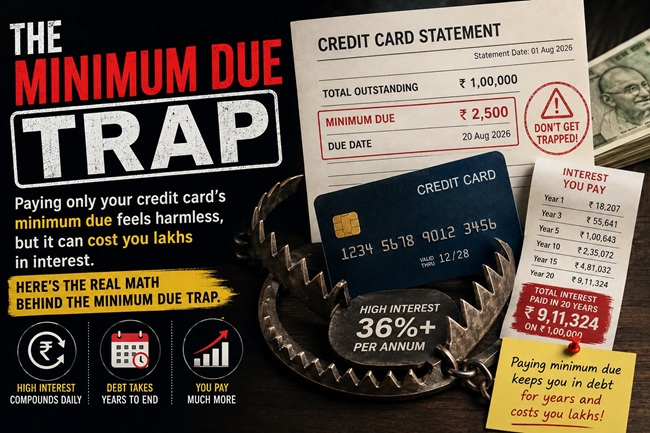

Deepa’s credit card bill read 50,000 rupees, and right below it, in smaller, friendlier text, was another number: minimum amount due, 2,500 rupees. She paid the 2,500, felt relieved her account was “in good standing,” and moved on with her month. She did this for almost three years before she actually sat down and calculated how much she’d paid the bank in total. The number made her sick. She’d paid more in interest alone than her original bill.
This is the minimum due trap, and it’s designed to feel completely harmless in the moment. Your account stays active, no late fee shows up, your credit score doesn’t take an immediate hit. But underneath that small, manageable-looking number is one of the most expensive forms of borrowing available in India, and most people don’t realize how expensive until they’ve already paid for it many times over.
What Minimum Due Actually Is
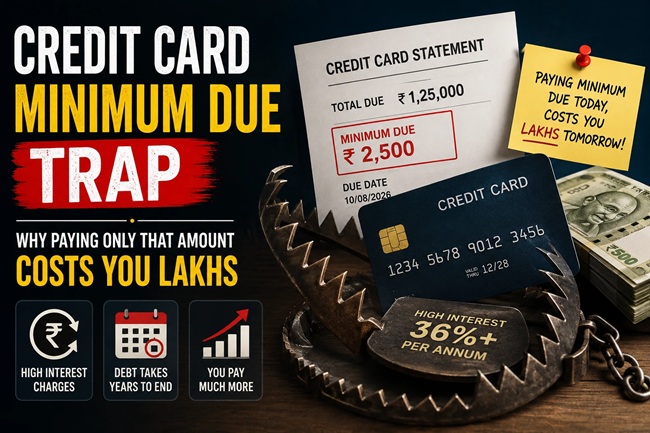
Every credit card bill shows two numbers, the total amount due and the minimum amount due. The minimum due is typically calculated as around 5 percent of your total outstanding balance, sometimes with a floor amount and adjustments for any EMIs, over-limit amounts, or previous unpaid dues added in. Paying this amount by your due date keeps your account in good standing. It avoids the late payment fee, and it prevents your card from being reported as delinquent to credit bureaus for that billing cycle.
That’s genuinely all it does. It does not mean you’ve avoided interest. It does not mean your debt is shrinking at any reasonable pace. It’s a mechanism designed to keep your account technically compliant, not to help you pay off what you owe.
Why the Remaining Balance Gets So Expensive So Fast
Credit card interest rates in India typically range from 30 to 45 percent per year, usually charged monthly at somewhere between 3 and 3.75 percent. This is dramatically higher than a personal loan, which usually runs in the 10 to 20 percent range, or a home loan, which is often under 10 percent. Credit cards are, almost without exception, the most expensive form of borrowing most people have access to.
Here’s the part that catches people off guard the most. The moment you don’t pay your full bill by the due date, you don’t just lose the interest-free period on your existing balance, you lose it on every new transaction too. Normally, credit cards offer a genuinely interest-free window of 20 to 55 days on new purchases, provided you pay your full statement balance each cycle. Once you’re carrying a balance forward, that interest-free period disappears entirely. Every new swipe starts accruing interest from the date of the transaction, not from your next due date.
What Paying Only the Minimum Actually Costs
Let’s run the numbers on a fairly typical scenario: a 50,000 rupee outstanding balance, 42 percent annual interest (3.5 percent monthly), and a minimum due of 5 percent, or 2,500 rupees, assuming no new purchases are added on top.
If you kept paying that same 2,500 rupees every month, it would take roughly 35 months, just under 3 years, to fully clear the balance, and you’d end up paying approximately 87,500 rupees in total, about 1.75 times your original balance, meaning nearly 37,500 rupees in interest alone on a 50,000 rupee bill.
That’s actually the more forgiving version of this trap. In reality, most banks recalculate your minimum due each month as 5 percent of your current outstanding balance, not a fixed amount. As your balance slowly shrinks, your minimum due shrinks right along with it, which means you’re paying a smaller amount each month even as interest continues compounding on what’s left. This can stretch repayment out far longer than 3 years, and in some cases, if you’re only ever paying the recalculated minimum with no extra payments, the balance can shrink so slowly that it barely resolves within any reasonable timeframe at all.
Illustrative Repayment Scenarios at Different Balances
The table below assumes a 42 percent annual interest rate, an initial minimum due of 5 percent of the balance held as a fixed monthly payment, and no new purchases added during the repayment period. Real-world figures will vary based on your specific bank’s minimum due formula, whether it recalculates monthly, and whether you continue using the card.
| Outstanding Balance | Fixed Monthly Payment (5%) | Time to Clear | Total Amount Paid | Extra Paid Over Original |
|---|---|---|---|---|
| ₹30,000 | ₹1,500 | ~35 months (2.9 years) | ~₹52,500 | ~₹22,500 |
| ₹50,000 | ₹2,500 | ~35 months (2.9 years) | ~₹87,500 | ~₹37,500 |
| ₹1,00,000 | ₹5,000 | ~35 months (2.9 years) | ~₹1,75,000 | ~₹75,000 |
If your bank recalculates the minimum due lower every month as your balance shrinks, rather than keeping your payment fixed, these numbers get considerably worse, both in total interest paid and in how long the balance takes to actually disappear.
The Second Cost: Your Credit Score
Paying the minimum due avoids an immediate ding to your credit score from a missed payment, but it doesn’t protect you from a different, slower kind of damage. Credit utilisation, how much of your available credit limit you’re currently using, is one of the biggest factors in your credit score. Carrying a large balance month after month keeps your utilisation high, which drags your score down gradually, even while your payment history looks perfectly clean.
This means someone paying minimum due religiously, on time, every single month, can still watch their credit score decline simply because their utilisation stays elevated for years. It’s a quieter form of damage than a missed payment, but it compounds just as steadily.
You May Also Like To Read:
When Paying Only the Minimum Is Genuinely Okay
To be fair, there are situations where paying the minimum due makes sense as a short-term bridge, not a long-term habit. If you’re facing a genuine, temporary cash flow gap and know you’ll be able to pay down the balance substantially within a month or two, minimum due can buy you breathing room without an immediate late fee or credit score hit.
The trap isn’t in using this option once. It’s in treating it as a normal, repeatable way to manage a credit card bill, month after month, without a clear plan to actually clear the balance.
What to Do Instead If You’re Already Stuck
If you’re currently only able to manage the minimum due, the priority should be stopping new spending on that card immediately, since every new purchase is now accruing interest from day one with no grace period at all. Beyond that, paying any amount above the minimum, even a small extra amount, meaningfully speeds up how fast the balance actually shrinks, since more of each payment goes toward principal rather than just covering that month’s interest.
If the balance has grown large enough to feel unmanageable, it’s worth exploring a balance transfer to a card offering a lower promotional interest rate, or converting the outstanding amount into a structured EMI through your bank, which usually carries a lower interest rate than the card’s standard revolving rate. Both options are generally better than continuing to revolve an unmanageable balance at 40-plus percent interest indefinitely.
About This Guide
This article uses commonly cited Indian credit card interest rates of 30 to 45 percent annually and a standard 5 percent minimum due calculation to illustrate the mechanics of minimum due repayment. The repayment scenarios shown are simplified illustrations based on a fixed monthly payment assumption and don’t account for new purchases, bank-specific minimum due formulas, GST on interest and fees, or floor amounts, all of which vary by issuer and can meaningfully change the actual numbers. Please check your specific card’s terms and conditions, or use your bank’s own minimum due calculator, for figures accurate to your exact situation.
Common Mistakes People Make With Minimum Due
Believing that paying the minimum due is “handling” the bill is the most common one. It handles the bank’s compliance requirement, not your actual debt. The balance is still very much there, quietly accruing interest at one of the highest rates you’ll encounter anywhere.
Continuing to use the card for new purchases while carrying a balance is another frequent mistake, and possibly the most costly one. Since the grace period disappears entirely once you’re revolving a balance, every new swipe adds interest from day one, compounding the problem faster than most people realize.
People also often assume their credit score is protected as long as they’re never late, without realizing that high credit utilisation from a large, slowly shrinking balance drags the score down separately from payment history.
Lastly, many people wait far too long before exploring alternatives like a balance transfer or EMI conversion, continuing to revolve debt at the card’s full interest rate for months or years when a lower-cost option might have been available much earlier.
Get the regular updates on Credit Cards and Loans , Follow us on Instagram and Youtube
My Take
The minimum due amount is, by design, the number that makes carrying a balance feel manageable. That’s exactly what makes it dangerous. A 2,500 rupee payment feels completely reasonable next to a 50,000 rupee bill you can’t fully cover, so it’s an easy, understandable choice to make once. The problem is that it’s engineered to be an easy choice to make again the next month, and the month after that, while the actual cost quietly climbs in the background. If you find yourself paying only the minimum for two or three months in a row, that’s the moment to stop and look at the real balance and the real interest rate, not the moment to keep coasting on the small number at the top of the bill.
Frequently Asked Questions
1. What happens if I only pay the minimum due on my credit card? You avoid a late payment fee and keep your account in good standing, but interest continues to accrue on the remaining balance at your card’s full rate, typically 30 to 45 percent annually, and you also lose the interest-free grace period on any new purchases.
2. How is minimum due calculated on a credit card? Minimum due is typically calculated as around 5 percent of your total outstanding balance, though the exact formula, including floor amounts, EMI components, and over-limit charges, varies by bank.
3. Does paying minimum due affect my credit score? It protects your score from a missed-payment mark, but carrying a high balance month after month keeps your credit utilisation elevated, which can gradually lower your score even with a perfect payment history.
4. How much interest do I actually pay if I only pay the minimum due? This depends on your balance, interest rate, and how your bank recalculates the minimum due each month, but it’s common to end up paying 1.5 to 2.5 times your original balance, or more, in total by the time the debt is cleared.
5. Is there a grace period if I only pay the minimum due? No. Once you carry forward a balance, you lose the interest-free grace period entirely, and any new purchases start accruing interest immediately from the transaction date.
6. What’s the difference between minimum due and total amount due? Total amount due is your full outstanding balance for that billing cycle. Minimum due is a small fraction, usually around 5 percent, that keeps your account compliant but leaves the rest of the balance accruing interest.
7. Should I ever pay only the minimum due? It can work as a short-term bridge during a genuine, temporary cash crunch, but it isn’t a sustainable way to manage a credit card bill and should never become a regular habit.
8. What should I do if I can’t pay my full credit card bill? Beyond paying more than the minimum whenever possible, consider a balance transfer to a lower interest rate card or converting the outstanding balance into an EMI through your bank, both of which are typically cheaper than continuing to revolve the balance at the card’s standard rate.
9. Why does my minimum due amount change every month? Most banks recalculate the minimum due as a percentage of your current outstanding balance, so as your balance shrinks or grows, your minimum due changes along with it.
10. Is credit card interest higher than personal loan interest? Yes, significantly. Credit card interest in India typically runs 30 to 45 percent annually, compared to roughly 10 to 20 percent for most personal loans, making credit card debt one of the most expensive forms of borrowing available.
Disclaimer
This article is for informational and educational purposes only and does not constitute financial advice. Credit card interest rates, minimum due formulas, and repayment terms vary by bank and card, and the illustrative figures in this article are simplified estimates, not exact projections for any specific card. Please refer to your card’s Most Important Terms and Conditions (MITC) document or your bank’s official calculator for figures specific to your account, and consult a financial advisor if you’re managing significant credit card debt.

Shuchi founded Finance Checks after spending 16+ years working in corporate, managing operations and distribution. She managed her own finances, learned and read regularly and helped people make sense of their savings, loans, insurance, and investments.
She started this site to offer the kind of clear, honest financial guidance she wished was more available when she was learning to manage her own money. Every article is researched personally, checked against official sources such as the Reserve Bank of India, SEBI, or the Income Tax Department, and revisited whenever regulations or figures change. She is upfront about how the site earns money through ads and select affiliate partnerships, and she does not let either influence what she actually recommends to readers.



[…] Credit Card Minimum Due Trap: Why Paying Only That Amount Costs You Lakhs […]
[…] unpaid annual fee on a credit card, even one you never use, is treated exactly like any other unpaid credit card bill. If it remains unpaid past the due date, the bank will levy late payment charges and finance […]