
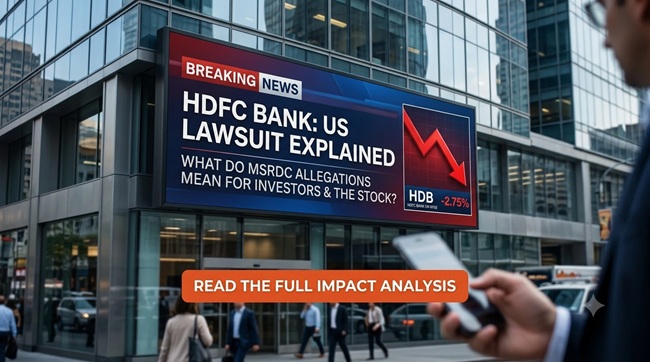
HDFC Bank US Lawsuit Explained: What the MSRDC Allegations Mean for Investors and the Stock

If you own HDFC Bank shares, the latest market move is probably making you ask a simple question:
What is going on with HDFC Bank?
The bank’s shares fell as much as 2.37% during trading on August 27, 2026, touching their lowest level in roughly two-and-a-half years. The stock closed about 2.2% lower, according to Reuters. The fall came as investors reacted to reports of a proposed securities class-action lawsuit filed against HDFC Bank and two senior executives in the US.
But there is an important distinction that investors should understand before jumping to conclusions.
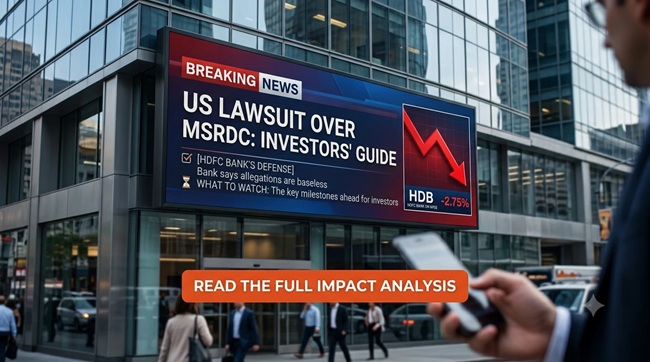
HDFC Bank has been sued. It has not been found guilty of securities fraud
The US case contains allegations made by an investor. Those allegations still have to go through the legal process.
The lawsuit is linked to controversy surrounding HDFC Bank’s arrangements with the Maharashtra State Road Development Corporation (MSRDC) and questions over how certain payments and disclosures were handled.
- So, what exactly is the HDFC Bank US lawsuit about?
- What happened with MSRDC?
- Why did HDFC Bank’s own board penalise its CEO, CFO and another senior executive?
- And does the latest legal development change the investment case for HDFC Bank shares?
Let’s break it down.
HDFC Bank US Lawsuit: What Happened?
A proposed securities class-action lawsuit has been filed in the US District Court for the Southern District of New York against HDFC Bank, Managing Director and CEO Sashidhar Jagdishan, and CFO Srinivasan Vaidyanathan.
The case was filed by investor Jwalant Natvarlal Soneji.
The proposed class period runs from July 17, 2023, to May 26, 2026.
The lawsuit alleges that HDFC Bank and the individual defendants made materially misleading statements or failed to disclose information that investors allegedly needed to properly assess the bank’s business and prospects.
The allegations centre partly on the MSRDC arrangement. Importantly, these are claims made in the lawsuit, not findings by a court. HDFC Bank has said the claims are without merit and that it intends to defend itself.
That distinction should remain clear throughout this story.
What Is the HDFC Bank–MSRDC Controversy?
MSRDC is the Maharashtra State Road Development Corporation, a state-owned infrastructure development organisation.
The controversy concerns arrangements between HDFC Bank and MSRDC for garnering deposits during 2017 and 2021.
The matter came under public scrutiny after reports alleged that HDFC Bank had effectively provided a higher rate of return to MSRDC and that certain payments associated with the arrangement were treated as marketing or sponsorship expenses.
The amount discussed in reports was approximately ₹45 crore.
However, investors should be careful about how this figure is described.
It is better to say:
“The controversy centres on an alleged ₹45 crore arrangement involving MSRDC.”
It would be misleading to state simply that “HDFC Bank made illegal ₹45 crore payments” as though that were an established court finding.
HDFC Bank itself has disputed the characterisation of the matter and subsequently conducted an internal review.
You May Also Like To Read About:
- RBI’s New Framework to Ease Loan Comparisons: How Does Transparency Actually Benefit You?
- Buy Now, Pay Later: How It Actually Works, and Is It Secretly an EMI Trap?
- SMS Fraud Alert: How to Tell a Genuine Bank Message From a Scam
- Bank Locker Rules in India: What to Know Before Renting One
- RBI Just Held Rates Again — Here’s What It Actually Means for Your EMI
- New Bank Charges August 2026: What’s Changing on Your Account
What Did HDFC Bank’s Internal Review Find?
This is one of the most important parts of the story.
On July 27, 2026, HDFC Bank announced the conclusion of an internal review concerning its arrangement with MSRDC for garnering deposits in 2017 and 2021. The review was conducted through a Special Disciplinary Committee of Independent Directors.
According to HDFC Bank’s disclosure, the board concluded that the conduct of the employees involved constituted “business overreach”.
At the same time, the bank said the review did not find anything conclusive that amounted to:
- mala fide action;
- personal enrichment; or
- improper motive.
The board nevertheless considered potential divergence with applicable RBI directions and decided to take disciplinary action.
It imposed:
- ₹1 lakh monetary penalty on MD & CEO Sashidhar Jagdishan
- ₹1 lakh monetary penalty on CFO Srinivasan Vaidyanathan
- ₹1 lakh monetary penalty on Group Head – Retail Assets Arvind Vohra
The bank also issued warning letters to the three executives and other employees involved.
The board directed that the matter be communicated to the Reserve Bank of India.
This is a critical distinction:
HDFC Bank’s internal review did not conclude that the executives acted for personal enrichment or with mala fide intent.
It characterised the conduct as business overreach.
Why Is HDFC Bank Facing a Lawsuit in the US?
At first glance, this may seem unusual. HDFC Bank is an Indian bank. Its main shares trade in India.
So why is a US court involved?
The answer is that HDFC Bank also has American Depositary Shares (ADSs) listed on the New York Stock Exchange under the ticker HDB.
That gives US investors exposure to HDFC Bank. The lawsuit has therefore been brought under US securities laws and concerns alleged disclosures to investors.
This is why the case is relevant not only to HDFC Bank’s US-listed securities but also to the bank’s broader reputation and investor confidence.
What Does the Lawsuit Allegedly Claim?
The lawsuit alleges that investors were not adequately informed about certain aspects of the MSRDC arrangement.
Among the allegations reported in connection with the case are claims that:
- certain payments were allegedly structured or classified improperly;
- the bank allegedly failed to disclose material information concerning the arrangement;
- senior management’s involvement was allegedly not adequately disclosed;
- investors were allegedly given an incomplete picture of the bank’s business and controls; and
- the alleged disclosure failures caused investors to suffer losses when the information became public.
These are allegations by the plaintiff.
They should not be presented as established facts.
That is particularly important in financial journalism because the difference between “alleged” and “proven” is substantial.
Did HDFC Bank Admit to Fraud?
No.
There is currently no court finding in this lawsuit that HDFC Bank committed securities fraud. In fact, HDFC Bank’s own internal review used a very different description of the employee conduct.
The bank said the conduct constituted business overreach rather than mala fide action, personal enrichment or improper motive.
The US plaintiff’s allegations and HDFC Bank’s internal-review findings should therefore be treated as two separate pieces of information.
The final legal outcome remains unknown.
Why Did HDFC Bank Shares Fall on August 27?
HDFC Bank shares fell 2.37% intraday on August 27, with the stock reaching a roughly two-and-a-half-year low. Reuters reported that the shares were down about 2.2% and that the bank’s market value fell by approximately $2.6 billion during the session.
However, it would be incorrect to say that the entire decline was caused by the US lawsuit.
HDFC Bank was already facing several investor concerns.
These include:
- legal and regulatory scrutiny;
- the MSRDC controversy;
- leadership uncertainty;
- questions surrounding the CEO’s tenure; and
- other investor concerns reported around the bank.
Reuters noted that the stock has fallen more than 25% during 2026 and is on track for its weakest annual performance since 2008.
So the lawsuit is better viewed as another negative sentiment trigger, rather than the sole reason for the share-price decline.
HDFC Bank CEO and CFO: Why Leadership Matters Now
Leadership has become another important part of the HDFC Bank story.
Sashidhar Jagdishan remains HDFC Bank’s Managing Director and CEO. His current tenure is due to end in October 2026, adding another layer of uncertainty for investors. Reuters reported that the uncertainty around his tenure is weighing on investor sentiment.
There is also an upcoming CFO transition. HDFC Bank appointed Puneet Sharma as CFO-designate effective September 1, 2026, with Sharma scheduled to become CFO from December 1, 2026.
Srinivasan Vaidyanathan remains CFO until the transition takes effect. HDFC Bank’s regulatory filing formally records the appointment of Sharma as CFO-designate from September 1 and CFO from December 1.
This matters because investors are now evaluating HDFC Bank not just on earnings and asset quality, but also on management continuity and governance.
Is HDFC Bank in Financial Trouble?
The US lawsuit itself does not mean that HDFC Bank is financially distressed. This is an important point for retail investors.
HDFC Bank remains one of India’s largest private-sector banks and continues to report substantial earnings.
For the quarter ended June 30, 2026, the bank reported:
- Net interest income: ₹33,530 crore
- Year-on-year NII growth: 6.7%
- Net interest margin: 3.26% on total assets
- Standalone profit after tax: approximately ₹19,060 crore
HDFC Bank’s official financial results confirm the June 2026 numbers.
These numbers do not remove the governance or legal concerns.
But they do provide necessary context.
A company facing a lawsuit is not automatically a company facing a financial crisis.
Investors need to examine the balance sheet, asset quality, capital strength, profitability and deposit franchise separately.
What Has HDFC Bank Said About the Matter?
HDFC Bank’s May disclosure on the MSRDC matter said the issue did not have a material impact on its financial statements and that its internal controls and oversight remained robust.
The bank subsequently completed its internal review and disclosed the disciplinary action in July.
In response to the US lawsuit, HDFC Bank has maintained that the claims are without merit and said it would defend itself vigorously.
For investors, this means there are currently two competing narratives:
The plaintiff’s narrative: investors were allegedly misled by inadequate disclosures.
HDFC Bank’s position: the claims lack merit and the bank will defend itself.
The courts will determine how the legal claims proceed.
Could the HDFC Bank Lawsuit Affect Indian Shareholders?
Not necessarily in a direct legal sense.
Indian shareholders should not assume that owning HDFC Bank shares automatically makes them members of the US lawsuit. The case concerns securities covered by the US litigation and its proposed class period.
However, the case can still matter indirectly.
A prolonged legal or governance controversy can influence:
- investor confidence;
- valuation multiples;
- institutional investor sentiment;
- management credibility;
- regulatory scrutiny;
- corporate-governance perceptions; and
- the premium investors are willing to pay for the stock.
For a large financial institution, confidence is an important part of the investment story.
Should You Sell HDFC Bank Shares After the Lawsuit?
There is no responsible yes-or-no answer.
The better question is: Has your original investment thesis changed?
If you bought HDFC Bank because you expected:
- strong long-term loan growth;
- a powerful deposit franchise;
- stable asset quality;
- improving profitability;
- strong capitalisation;
- management stability; and
- high governance standards,
then you should reassess whether recent developments change any of those assumptions.
But selling solely because the stock fell 2% on one day can be just as dangerous as buying solely because the stock looks cheaper.
A falling share price does not automatically mean a stock is cheap.
Is HDFC Bank Stock Cheap After the Fall?
This is where investors need to look beyond the headline. Suppose a stock falls from ₹1,000 to ₹700. It may look cheap compared with its previous price. But valuation does not work that way.
For banks, investors typically examine metrics such as:
- Price-to-Book Value;
- Return on Equity;
- Net Interest Margin;
- loan growth;
- deposit growth;
- CASA ratio;
- gross and net NPAs;
- credit costs;
- provision coverage;
- capital adequacy; and
- earnings growth.
A lower valuation can represent an opportunity. It can also represent the market pricing in a genuine deterioration in the business.
The key question is not:
“How much has HDFC Bank fallen?”
It is:
“What is the market now pricing into HDFC Bank’s future earnings and risk?”
What Should HDFC Bank Investors Watch Next?
For existing and prospective investors, these are the developments that matter most.
1. Progress of the US lawsuit
Watch for court orders, responses from HDFC Bank, motions by the defendants, class-certification developments and any settlement discussions.
The case is still at an early stage.
2. Any RBI development
HDFC Bank said its board directed that the MSRDC matter be communicated to the Reserve Bank of India.
Any subsequent regulatory action or clarification could be more significant than the lawsuit headline itself.
3. CEO succession
Investors need clarity on the future leadership structure as Sashidhar Jagdishan’s current tenure approaches its end.
4. CFO transition
Puneet Sharma is scheduled to become HDFC Bank’s CFO on December 1, 2026, following his September 1 appointment as CFO-designate.
5. Deposit growth
For a bank, deposits are fundamental.
Investors should track deposit growth, CASA trends and the cost of deposits.
6. Asset quality
Keep an eye on:
- gross NPA;
- net NPA;
- slippages;
- provisions; and
- credit costs.
A deterioration here could be more fundamental to the investment case than a short-term legal headline.
7. Net interest margin
NIM remains an important indicator of banking profitability.
HDFC Bank reported a 3.26% NIM on total assets for the June 2026 quarter.
HDFC Bank Lawsuit vs HDFC Bank Fundamentals: What Investors Should Separate
There are actually several different stories being discussed under the HDFC Bank headline.
The MSRDC matter
This concerns the underlying deposit arrangements and the bank’s internal review.
The US securities lawsuit
This concerns allegations that investors were not adequately informed about material information.
The stock-price decline
This reflects the market’s response to a broader combination of legal, governance, leadership and business concerns.
HDFC Bank’s financial performance
This is a separate question involving earnings, margins, deposits, loans, asset quality and capital.
These four things are connected, but they are not interchangeable.
A lawsuit does not automatically mean deteriorating fundamentals.
Likewise, strong earnings do not automatically eliminate governance concerns.
That is the distinction investors need to keep in mind.
What Is the Bigger Lesson for Investors?
The HDFC Bank episode offers a useful lesson for anyone investing in individual stocks. When you buy a share, you are not just buying earnings.
You are buying:
the business + management + governance + balance sheet + regulatory environment + future growth.
- A company can report strong profits and still face governance questions.
- A company can face a lawsuit without ultimately being found liable.
- And a share price can fall sharply without the underlying business collapsing.
That is why investors should separate:
- What happened?
- What is alleged?
- What has the company confirmed?
- What has the regulator said?
- What has a court established?
- And what, if anything, has changed in my investment thesis?
Those questions are more useful than reacting to a headline.
HDFC Bank US Lawsuit: Key Takeaways
The latest HDFC Bank controversy is serious enough for investors to monitor, but it should not be described as a proven fraud case.
The proposed US securities class action alleges that HDFC Bank and two executives made misleading disclosures connected to the MSRDC matter.
Those allegations have not been proven in court.
Separately, HDFC Bank’s own internal review concluded that the conduct of employees involved in the MSRDC arrangement amounted to business overreach, while stating that it did not find conclusive evidence of mala fide action, personal enrichment or improper motive. The bank imposed ₹1 lakh penalties on three senior executives and issued warnings to other employees.
HDFC Bank shares fell 2.37% intraday on August 27 and closed around 2.2% lower, according to Reuters. But the stock’s weakness reflects a broader combination of legal, regulatory and leadership concerns rather than the lawsuit alone.
For investors, the next few quarters will be important.
The key areas to monitor are the US court case, any RBI developments, CEO succession, the CFO transition, deposit growth, asset quality, margins and profitability.
Frequently Asked Questions About the HDFC Bank US Lawsuit
1. Why is HDFC Bank being sued in the US?
HDFC Bank is facing a proposed US securities class-action lawsuit alleging that the bank and certain executives made misleading statements or failed to disclose material information concerning the MSRDC arrangement.
The lawsuit has been brought under US securities laws.
2. When was the HDFC Bank lawsuit filed?
The lawsuit was filed in August 2026 and relates to alleged securities-law violations involving HDFC Bank and two senior executives.
3. Who are the defendants in the HDFC Bank lawsuit?
The lawsuit names HDFC Bank Limited, Managing Director and CEO Sashidhar Jagdishan, and CFO Srinivasan Vaidyanathan.
4. What is the HDFC Bank MSRDC controversy?
The controversy concerns arrangements between HDFC Bank and Maharashtra State Road Development Corporation for garnering deposits in 2017 and 2021.
Reports subsequently raised questions about the pricing and treatment of certain payments associated with the arrangement.
5. What is the ₹45 crore HDFC Bank MSRDC matter?
The controversy has been reported as involving approximately ₹45 crore in payments associated with the MSRDC arrangement.
However, investors should describe this as an alleged arrangement/payment issue, rather than saying HDFC Bank has been found to have made illegal payments.
6. Did HDFC Bank’s internal investigation find fraud?
No.
HDFC Bank said its internal review concluded that the conduct constituted business overreach, rather than mala fide action, personal enrichment or improper motive.
7. Did HDFC Bank penalise its CEO and CFO?
Yes.
The bank imposed a ₹1 lakh monetary penalty on each of MD & CEO Sashidhar Jagdishan, CFO Srinivasan Vaidyanathan and Group Head – Retail Assets Arvind Vohra. Warning letters were also issued.
8. Did HDFC Bank admit wrongdoing?
HDFC Bank’s internal review described the conduct as business overreach and did not find conclusive evidence of mala fide action, personal enrichment or improper motive.
The bank has also said the US lawsuit’s claims are without merit.
9. Is HDFC Bank guilty of securities fraud?
No.
The US lawsuit contains allegations. There has been no court finding in the case establishing that HDFC Bank committed securities fraud.
10. Why did HDFC Bank shares fall on August 27, 2026?
HDFC Bank shares fell 2.37% intraday and closed around 2.2% lower as investors reacted to the US lawsuit against the backdrop of wider legal, regulatory and leadership concerns.
11. Is the entire HDFC Bank share-price fall because of the lawsuit?
No.
The stock was already under pressure during 2026. Reuters reported that HDFC Bank shares had fallen more than 25% during the year and that leadership and other investor concerns were also affecting sentiment.
12. Is HDFC Bank financially weak?
The lawsuit itself does not establish that HDFC Bank is financially weak.
The bank reported approximately ₹19,060 crore in standalone profit and ₹33,530 crore in net interest income for the quarter ended June 30, 2026.
Investors should nevertheless monitor asset quality, margins, capital and deposit growth.
13. Who is HDFC Bank’s current CFO?
As of August 27, 2026, Srinivasan Vaidyanathan remains HDFC Bank’s CFO.
Puneet Sharma has been appointed CFO-designate from September 1, 2026 and is scheduled to take over as CFO from December 1, 2026.
14. Who is HDFC Bank’s CEO?
Sashidhar Jagdishan is HDFC Bank’s Managing Director and CEO. His current tenure is due to end in October 2026, making succession an important issue for investors.
15. Does the US lawsuit affect HDFC Bank shareholders in India?
Indian shareholders should not assume that they automatically become part of the US lawsuit.
The legal case concerns securities covered by the US litigation and its proposed class period.
However, the case can indirectly affect Indian investors through sentiment, valuation, governance perceptions and the bank’s reputation.
16. Should investors sell HDFC Bank shares?
There is no universal answer.
Investors should assess whether the recent legal and governance developments have changed their original investment thesis, rather than making a decision solely because the share price has fallen.
17. Is HDFC Bank a good stock to buy after the fall?
A lower share price does not automatically make a stock undervalued.
Investors should examine valuation, earnings growth, asset quality, deposit growth, NIM, capital adequacy, management stability and governance before making an investment decision.
18. What should HDFC Bank investors watch next?
The key developments are:
- progress of the US lawsuit;
- any RBI action;
- CEO succession;
- the CFO transition;
- deposit growth;
- loan growth;
- net interest margin;
- asset quality;
- credit costs; and
- future corporate-governance disclosures.
Final Word
The HDFC Bank story is bigger than one day’s share-price movement.
The US lawsuit has introduced another layer of uncertainty, but it is still an allegation-based legal proceeding, not a finding that HDFC Bank committed securities fraud.
At the same time, investors should not dismiss the issue simply because HDFC Bank continues to report strong profits.
The more useful approach is to watch what happens next.
- Does the US case progress?
- Does the RBI take any action?
- How is the CEO succession handled?
- Does the CFO transition go smoothly?
- Do deposits, margins and asset quality remain strong?
Those answers will tell investors much more about HDFC Bank’s long-term investment case than a single day’s share-price movement.
Editorial & Research Note
This article has been prepared using HDFC Bank’s regulatory disclosures, its US SEC filings and current market reporting available as of August 27, 2026.
Financechecks distinguishes between company-confirmed information, allegations contained in legal proceedings, market data and independent reporting. Allegations in the US lawsuit have not been presented as established facts.
The article will require updating if there are material developments in the lawsuit, RBI proceedings, HDFC Bank’s management succession or other relevant regulatory matters.
Author: Financechecks Editorial Team
Category: Investing in India / Stock Market
Published: August 27, 2026
Last Updated: August 27, 2026
Disclaimer
This article is provided for general educational and informational purposes only. It does not constitute investment advice, financial advice, legal advice, tax advice or a recommendation to buy, sell or hold HDFC Bank shares, HDFC Bank American Depositary Shares or any other security.
The US lawsuit discussed in this article contains allegations made by a plaintiff. The allegations have not been established as facts by a court. The filing of a lawsuit does not by itself establish that HDFC Bank or any individual defendant violated US securities laws.
Market prices change continuously. Share-price figures in this article relate to the specific trading session and date mentioned and may no longer represent the current market price.
HDFC Bank’s financial results, management structure, regulatory position, legal proceedings, share price and other circumstances can change after publication. Readers should verify the latest information through HDFC Bank’s regulatory disclosures, NSE/BSE filings, SEC filings, court records and other primary sources before making investment decisions.
Investing in equities involves market risk, including the risk of losing some or all of the invested capital. Past performance does not guarantee future returns.
Financechecks does not provide personalised investment recommendations. Before investing, readers should consider their financial objectives, investment horizon, risk tolerance and overall portfolio. Where appropriate, consult a SEBI-registered investment adviser or other qualified professional.
Financechecks does not guarantee the accuracy of future market movements, investment returns or any particular outcome from investing in HDFC Bank or any other security.
Primary sources used: HDFC Bank regulatory disclosures and financial filings, US SEC filings, and current Reuters reporting.

Shuchi founded Finance Checks after spending 16+ years working in corporate, managing operations and distribution. She managed her own finances, learned and read regularly and helped people make sense of their savings, loans, insurance, and investments.
She started this site to offer the kind of clear, honest financial guidance she wished was more available when she was learning to manage her own money. Every article is researched personally, checked against official sources such as the Reserve Bank of India, SEBI, or the Income Tax Department, and revisited whenever regulations or figures change. She is upfront about how the site earns money through ads and select affiliate partnerships, and she does not let either influence what she actually recommends to readers.



[…] HDFC Bank US Lawsuit Explained: What the MSRDC Allegations Mean for Investors and the Stock […]