

SIP vs STP vs SWP: The Three Strategies Explained Together, and When to Use Each

Meena got a ₹15 lakh bonus payout from her company’s long service award, an amount large enough that dumping it into equity mutual funds all at once made her genuinely nervous. Her father, meanwhile, retired last year with a ₹1.2 crore mutual fund corpus and wanted a steady monthly income out of it without selling everything and parking it in an FD. And Meena’s younger colleague, just starting his career, had none of these problems, he simply wanted to invest ₹5,000 every month from his salary and let it grow. Three completely different situations, and three completely different tools exist specifically to solve each one. Most people have heard of SIP. Fewer know that STP and SWP exist as its natural siblings, built for exactly the moments SIP wasn’t designed for.
Quick answer
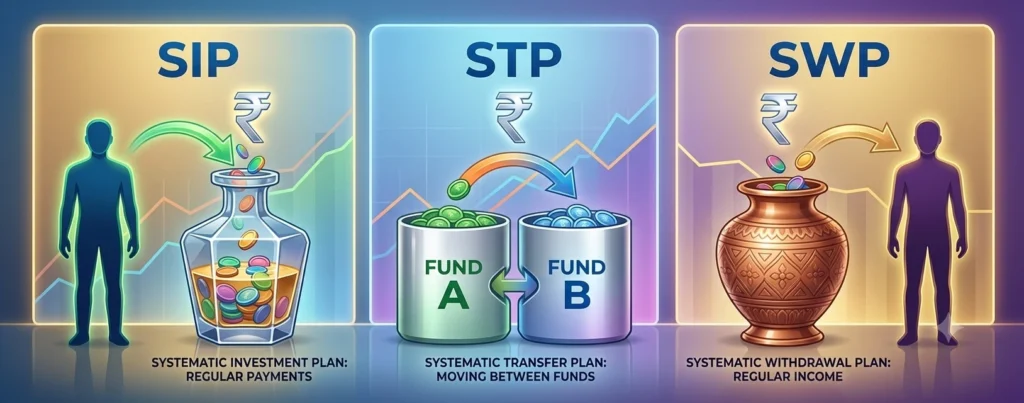
SIP, STP and SWP are three related but distinct mutual fund facilities, each solving a different problem.
A Systematic Investment Plan (SIP), invests a fixed amount from your bank account into a mutual fund at regular intervals, and is the right tool when you’re investing fresh money from income over a long horizon.
A Systematic Transfer Plan (STP), moves a lump sum you already have from one fund to another, typically from a liquid or debt fund into an equity fund, in gradual instalments, and is the right tool when you have a windfall and want to ease it into the market rather than investing it all on one day.
A Systematic Withdrawal Plan (SWP), does the reverse, redeeming a fixed amount from your mutual fund corpus at regular intervals and crediting it to your bank account, and is the right tool when you need a steady income stream from money you’ve already built up, most commonly in retirement. All three are built around the same underlying idea, spreading a large financial decision, investing, deploying, or withdrawing, across time instead of doing it in one shot, but they operate in opposite directions and serve genuinely different life situations.
About this guide
This guide is based on standard mutual fund industry mechanics for SIP, STP and SWP facilities as offered by Indian asset management companies, along with current capital gains tax rules for equity and debt mutual funds applicable from FY 2024-25 onward. FinanceChecks.com is not a SEBI registered investment advisor, and this article does not constitute personalised investment advice. Tax rates, exemption limits and fund-specific rules can change, and returns from market linked investments are never guaranteed. Please consult a qualified financial advisor before setting up any of these facilities.
SIP: the one almost everyone already knows
A Systematic Investment Plan lets you invest a fixed sum, ₹500, ₹5,000, ₹50,000, whatever you choose, into a mutual fund scheme at a set frequency, usually monthly, though weekly and quarterly options exist too. The money comes directly from your bank account through an auto debit mandate, and each instalment buys units at that day’s prevailing NAV. Because markets move up and down, your fixed rupee amount buys more units when prices are low and fewer when prices are high, a mechanism generally referred to as rupee cost averaging. Over years, this smooths out the effect of trying to time the market, which is precisely why SIP has become the default entry point for most first time mutual fund investors in India.
SIP is built for one specific situation: money you don’t have yet, income that will arrive over the coming months and years from your salary or business, that you want to invest consistently rather than in occasional lump sums. It isn’t designed for a lump sum you’re holding today. For that, this is where STP comes in.
STP: what to do when you already have the money
A Systematic Transfer Plan moves your money from one mutual fund scheme into another, automatically and at fixed intervals, usually within the same fund house. The most common use case looks like this: you have a lump sum, say Meena’s ₹15 lakh bonus, and instead of investing it directly into an equity fund on a single day, you first park the entire amount in a liquid or ultra short term debt fund, then set up an STP to transfer a fixed amount, say ₹1.5 lakh, from that debt fund into your chosen equity fund every month over the next ten months.
The logic is straightforward once you see it. Two problems get solved at once. First, your money isn’t sitting idle in a savings account while you gradually deploy it, it’s earning a modest return in the debt fund the whole time. Second, and more importantly, you avoid the very real risk of putting a large lump sum into equity markets on exactly the wrong day, right before a correction. By spreading the transfer over months, you get the same rupee cost averaging benefit that makes SIP effective, except you’re averaging the deployment of money you already have, rather than averaging fresh monthly income.
STP is specifically useful when you’ve received a windfall, a bonus, an inheritance, proceeds from selling a property or another investment, and you’re nervous about the market’s current level but also don’t want that money sitting completely uninvested for months while you decide. It’s the tool for exactly that in between moment.
SWP: turning a corpus into an income
A Systematic Withdrawal Plan works in the opposite direction from both SIP and STP. Instead of putting money in, you’re taking a fixed amount out, on a set schedule, from a mutual fund corpus you’ve already built. Each withdrawal redeems enough units to generate your chosen amount, based on that day’s NAV, and the money is credited straight to your bank account, functioning much like a self managed pension.
This is exactly the tool Meena’s father needs. Rather than withdrawing his entire ₹1.2 crore corpus and parking it in a fixed deposit, which would mean paying tax on the entire redemption in one go and losing the benefit of continued market growth on the remaining amount, he can set up an SWP to withdraw, say, ₹60,000 a month, while the rest of the corpus stays invested and continues compounding. Over a long retirement, this structure can meaningfully outlast simply drawing down a fixed deposit, since the untouched portion of the corpus keeps working rather than sitting static.
SWP is the right tool whenever you need a predictable income stream from an investment corpus you’ve already accumulated, most commonly in retirement, but also for situations like funding a few years of a career break, or supplementing income during a sabbatical, without touching the underlying capital all at once.
The tax treatment, and why this is where people get confused
This is genuinely the part of the comparison most people get wrong, so it’s worth being precise about each one separately.
For SIP, every individual instalment is treated as a completely separate investment for tax purposes, with its own purchase date and its own holding period. This matters specifically when you eventually redeem, since units from your very first SIP instalment three years ago may qualify for long term capital gains treatment, while units from last month’s instalment are still short term, even though they’re sitting in the exact same fund.
For STP, here’s the detail that catches people off guard: every transfer out of your source fund is treated as a redemption, and redemptions are taxable events. If your STP is moving money out of a debt fund, gains on that debt fund redemption are taxed at your income slab rate under current rules, since the indexation benefit on debt funds was removed for units acquired after April 1, 2023. If you’re transferring out of an equity fund instead, short term gains, held under a year, are taxed at 20 percent, and long term gains above ₹1.25 lakh in a financial year are taxed at 12.5 percent. Because an STP typically involves many small transfers over several months, each one is its own small taxable redemption event, which is worth knowing before you assume STP is somehow a tax free way to move money around.
For SWP, the same redemption principle applies. Each withdrawal is treated as a partial redemption of your units, and only the gains portion of that withdrawal is taxed, not the entire withdrawal amount, since part of every withdrawal is simply the return of your own original capital. This is precisely why SWP is often described as more tax efficient than, say, interest income from a fixed deposit, where the entire interest amount is taxed at your slab rate every year regardless of whether you actually withdraw it. With an equity fund SWP, once your cumulative gains for the year cross the ₹1.25 lakh long term exemption threshold, further long term gains are taxed at 12.5 percent, while short term gains, if any units redeemed were held under a year, are taxed at 20 percent.
Side by side comparison
| SIP | STP | SWP | |
|---|---|---|---|
| Direction of money | Bank account into a fund | One fund into another fund | Fund into your bank account |
| Best suited for | Investing regular income over time | Deploying a lump sum gradually | Generating regular income from a corpus |
| Typical source of funds | Salary or regular income | An existing lump sum, often parked in a debt fund | An accumulated mutual fund corpus |
| Core benefit | Rupee cost averaging on fresh investments, builds discipline | Rupee cost averaging on lump sum deployment, avoids bad timing | Steady income while remaining capital stays invested |
| Typical life stage | Working years, wealth accumulation | Right after receiving a windfall | Retirement or any income drawdown phase |
| Tax treatment | Each instalment taxed separately on eventual redemption | Every transfer is a redemption, taxed immediately based on gains | Each withdrawal taxed on the gains portion only |
How to actually decide which one you need
If you’re earning a regular income and want to build wealth steadily over years, without needing to think about market timing, SIP is your default tool, and for most people in their working years, it should already be running in the background regardless of whatever else you’re doing with STP or SWP.
If you’ve just received a lump sum, a bonus, a maturity payout, an inheritance, or proceeds from selling something, and you want equity exposure but are uneasy about investing it all in a single day, STP lets you ease in over a defined window, commonly six to twelve months, while the uninvested portion still earns something in a debt fund rather than sitting idle.
If you have an existing corpus and need a predictable, regular cash flow from it, whether that’s retirement income, funding a career break, or supplementing another income source, SWP lets you draw down steadily while the remaining corpus continues to stay invested and grow.
It’s also worth knowing these aren’t mutually exclusive across your financial life. Meena can run a SIP from her monthly salary while separately using an STP to deploy her bonus. Years from now, when she retires, she’ll likely switch that same accumulated corpus into an SWP. The three tools aren’t competing options, they’re different phases of the same overall journey, entry, deployment, and eventually, exit.
My take
What I find genuinely useful about laying these three out together, rather than as three separate, disconnected concepts, is that it makes the underlying idea obvious: almost nobody should be making a single, large, one time decision with their money if they can avoid it, whether that’s investing a lump sum on one specific day, or withdrawing an entire retirement corpus in one redemption. SIP, STP and SWP are really the same principle, spreading a big decision across time to reduce the damage a single bad day in the market can do, applied to three different moments in a person’s financial life. Meena, her father, and her colleague aren’t using three unrelated products. They’re using the same idea, at three different points along the same timeline.
Frequently asked questions
What is the main difference between SIP, STP and SWP? SIP invests fresh money from your bank account into a mutual fund. STP transfers a lump sum you already hold from one fund into another, usually from debt into equity. SWP withdraws money from your mutual fund corpus into your bank account at regular intervals.
Can I run an STP from one fund house into a fund at a different fund house? Generally no. STPs typically operate only between schemes within the same fund house or asset management company, not across different AMCs.
Is STP a way to avoid paying tax while moving money into equity? No. Every transfer within an STP is treated as a redemption from the source fund, and any gains on that redemption are taxed based on the fund type and holding period, exactly as if you had redeemed and reinvested manually.
How is SWP taxed compared to fixed deposit interest? With SWP, only the gains portion of each withdrawal is taxed, since part of the withdrawal is a return of your own capital. With a fixed deposit, the entire interest earned is taxed at your income slab rate each year, regardless of whether you actually withdraw it, which generally makes SWP more tax efficient for regular income needs.
What is a typical time period for running an STP? Commonly six to twelve months, though this depends on the size of the lump sum and your comfort with market timing. A longer STP period spreads the deployment further but delays full equity exposure for longer.
Do I need a large lump sum to start an STP, or can I use it for smaller amounts too? STPs can technically be set up for smaller amounts, but they’re most commonly used for genuinely large lump sums where the risk of poor timing on a single investment day is a real concern.
Can I change or stop an SWP once it’s running? Yes. SWP withdrawal amounts, frequency, and the facility itself can typically be modified or stopped at any time, offering considerably more flexibility than a fixed pension or annuity structure.
Is SIP only for equity mutual funds? No, though it’s most commonly associated with equity funds. SIPs can be set up in debt funds, hybrid funds, and other categories as well, including ELSS funds for investors specifically looking to claim the Section 80C tax deduction.
What happens to the units in an SWP once they’re fully withdrawn? Once all units in the source fund are redeemed through ongoing SWP withdrawals, the fund balance reaches zero and the SWP stops generating further payouts, which is why the withdrawal amount and the corpus size need to be planned together to avoid running out of capital too early.
Should I use SIP, STP or SWP if I have both a monthly salary and an existing lump sum? You can use more than one simultaneously. It’s common to run a SIP from ongoing salary income while separately using an STP to gradually deploy an existing lump sum, since the two facilities serve different sources of money at the same time.
Disclaimer
This article is intended for general informational and educational purposes only and does not constitute personalised investment or tax advice. FinanceChecks.com is not a SEBI registered investment advisor. Tax rates, exemption thresholds and fund specific rules referenced here reflect publicly available rules applicable for FY 2024-25 onward as of September 2026, and are subject to change. Mutual fund investments are subject to market risk, and returns are not guaranteed. Please read scheme related documents carefully and consult a qualified financial advisor before setting up a SIP, STP or SWP.

Shuchi founded Finance Checks after spending 16+ years working in corporate, managing operations and distribution. She managed her own finances, learned and read regularly and helped people make sense of their savings, loans, insurance, and investments.
She started this site to offer the kind of clear, honest financial guidance she wished was more available when she was learning to manage her own money. Every article is researched personally, checked against official sources such as the Reserve Bank of India, SEBI, or the Income Tax Department, and revisited whenever regulations or figures change. She is upfront about how the site earns money through ads and select affiliate partnerships, and she does not let either influence what she actually recommends to readers.