
RBI Likely to Raise Repo Rate in October 2026 as West Asia Crisis Fuels Inflation Risks

By the FinanceChecks.com Editorial Team | Published October 4, 2026 | Last reviewed October 4, 2026 | 7-minute read
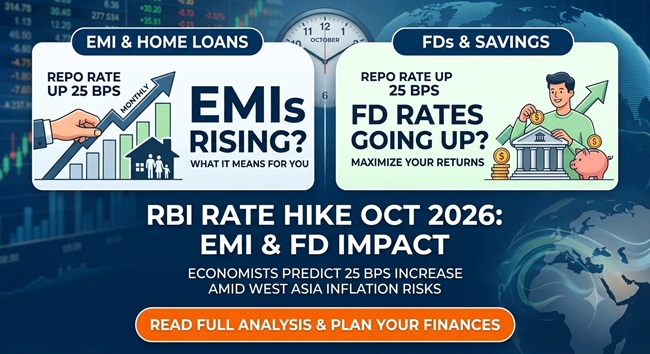
The Reserve Bank of India’s Monetary Policy Committee meets from October 5 to 7, and for the first time in a long while, the smart money isn’t betting on a pause. A majority of economists polled by Reuters and Business Standard now expect the RBI to raise the repo rate by 25 basis points, from its current 5.25% to 5.50%, which would be the first hike since February 2023 and a genuine reversal after a year of rate cuts through 2025.
Here’s what’s actually driving this shift, how confident the predictions really are, and what it would mean for your loans, deposits and investments if the hike goes through.
What’s Expected, and How Confident Are Economists Really
A Business Standard poll of 10 economists found 8 expecting a 25 basis point hike at this meeting. A separate Reuters poll conducted between September 18 and 28, covering 61 economists, found nearly 60% expecting the same move, a quarter-point increase to 5.50%. A Times of India poll of a dozen economists similarly found a majority leaning toward an October hike.
It’s worth being honest that this isn’t unanimous. A meaningful minority, including some voices cited by Fortune India, call it a “close call” and lean toward the RBI holding steady in October and hiking in December instead, once more inflation data is in hand. The RBI’s own recent policy meetings kept rates unchanged with a “neutral” stance, and a neutral stance, by definition, keeps the door open in either direction rather than signalling a clear tightening bias. So while the direction most economists expect is up, the timing is genuinely still a live debate, not a settled call.
Why a Hike Is on the Table at All
Three forces are doing most of the work here, and they’re connected to each other more than they might first appear.
The West Asia conflict and oil prices. Crude oil has pushed back above $100 a barrel as the conflict in West Asia has escalated, and this matters enormously for India specifically, since the country imports the overwhelming majority of its crude. Expensive oil raises the cost of nearly everything downstream, transport, manufacturing inputs, and ultimately consumer prices, making it one of the more direct and immediate inflation channels the RBI has to respond to.
A weakening rupee. The rupee has weakened by roughly 6% against the US dollar this year, according to Reuters. A softer currency makes imports, oil very much included, more expensive in rupee terms, adding another layer of inflationary pressure on top of the direct effect of higher oil prices.
Global central banks moving first. The US, UK and Japan have all raised rates recently, and when major global central banks tighten policy, it tends to put pressure on countries like India to follow suit, partly to protect the currency from further depreciation and partly to avoid falling too far out of step with global monetary conditions, which itself can trigger capital outflows.
Put together, this is a classic imported-inflation scenario: a geopolitical shock out of India’s control is translating into higher prices through two separate channels at once, oil costs directly, and currency weakness indirectly, and the RBI’s basic tool for responding to that kind of pressure is raising rates.
The Last Time Rates Moved, They Were Going Down
Context matters here. This expected hike would represent a genuine reversal in direction. Through 2025, the RBI had been cutting rates as part of an easing cycle, and the repo rate currently sitting at 5.25% reflects that period of monetary support for growth. A hike now, if it happens, would be the first increase since February 2023, meaning the RBI would be stepping away from its easing stance specifically because external, geopolitically-driven inflation risks have become significant enough to outweigh the growth-support rationale behind the recent cuts.
You May Also Like To Read About:
- The Full Math Behind “Minimum Balance” Bank Accounts: Why It’s a Trap, and Why Depositing Money Once Isn’t Enough
- What Happens to Your SIP Autopay If Your Bank Defaults, Merges or Is Restricted by RBI, and How to Manage Your Autopays
- Your Rights When a Bank Charges Hidden Fees or Deducts Money Without Consent: Types of Hidden Charges and How to Spot Them
- Call Forwarding Scam: How It Works, How to Check Your Phone, and How to Stay Safe
What a Rate Hike Would Actually Mean for You
| If You Have… | What a 25 bps Hike Could Mean |
|---|---|
| A floating-rate home loan or personal loan | Your EMI or loan tenure could increase, since floating rates are linked to the repo rate through your bank’s external benchmark |
| A fixed deposit maturing soon | New FDs could offer marginally better interest rates as banks adjust to higher borrowing costs |
| Equity investments | Higher rates generally make borrowing costlier for companies and can pressure stock valuations, particularly for rate-sensitive sectors |
| A new loan you’re about to take | Worth locking in terms before the policy announcement if your bank hasn’t already priced in the expected hike |
| Savings account balances | Minimal direct effect, though some banks may gradually adjust savings rates over time |
A 25 basis point move is, on its own, a relatively modest change, a quarter of one percent. On a large, long-tenure loan like a home loan, it’s enough to nudge your EMI or tenure up noticeably, but it’s not the kind of shift that upends a household budget overnight. The bigger thing to watch isn’t this single meeting, it’s whether this marks the start of a new hiking cycle or a one-off adjustment, since that trajectory matters more for long-term borrowers than any single 25 bps move.
How This Connects to What’s Already Happening in Markets
This expected rate hike isn’t happening in isolation. It’s part of the same broader story behind the recent pressure on Indian equity markets, where rising oil prices and sustained foreign investor selling have already been cited as factors in the Sensex and Nifty’s recent declines. A confirmed rate hike would likely reinforce that same narrative in the near term, since higher rates generally make borrowing costlier for companies and can weigh further on equity valuations, even though the underlying purpose of the hike, controlling inflation, is intended to support longer-term economic stability rather than undermine it.
What Happens If the RBI Holds Instead
It’s worth taking the minority view seriously too, since a meaningful share of economists still expect the RBI to hold rates steady in October and wait for December instead. If that happens, it would likely reflect the RBI wanting more confirmed inflation data before committing to a reversal, particularly given how recently it was still in an easing cycle. A hold wouldn’t mean the inflation risks have disappeared, it would more likely mean the central bank is choosing to wait for clearer evidence before changing course, a reasonably cautious approach given how much of the current pressure is coming from an external, fast-moving geopolitical situation that could still shift in either direction before December.
Common Mistakes People Make When a Rate Decision Is Looming
A frequent mistake is treating a poll of economists as a guaranteed outcome, when even a strong majority expectation, as with the roughly 60% to 80% figures cited here, still leaves real uncertainty, and the RBI’s actual decision depends on data and deliberation that happens right up to the policy announcement. Another common mistake is panicking about loan EMIs before any announcement has even been made, when a 25 basis point move, if it happens, is a modest adjustment rather than a dramatic one, and reacting with a major financial decision based purely on a pre-meeting poll is rarely necessary. People also sometimes assume a rate hike is automatically bad news across the board, when it typically benefits savers and fixed-income investors even as it raises costs for borrowers, so the actual effect on your own finances depends heavily on which side of that equation you’re on.
My Take
What’s genuinely useful about this moment is how clearly it illustrates something true about central bank decisions generally: they’re rarely driven by a single factor, and this one is a textbook case of an external shock, a war thousands of kilometres away, working its way into an Indian household’s loan EMI through a chain of oil prices, currency depreciation and global policy pressure. None of that chain is something the RBI controls directly, which is exactly why its only real lever is adjusting the rate it does control.
If you’re a borrower, the sensible response to a looming, uncertain rate decision isn’t to panic before the announcement, it’s to understand that even if the hike goes through, it’s a modest, 25 basis point move, not a dramatic shift, and to pay more attention to whether this turns into a sustained hiking cycle over the following months than to the single October decision in isolation.
Frequently Asked Questions
1. Is the RBI definitely going to raise rates in October 2026? Not definitely. A majority of polled economists, roughly 60% to 80% depending on the specific poll, expect a 25 basis point hike, but a meaningful minority expect the RBI to hold and hike in December instead. It remains a live decision, not a certainty.
2. Why is the RBI considering a rate hike now? Primarily due to rising crude oil prices linked to the West Asia conflict, a weakening rupee (down about 6% against the dollar this year), and global central banks like the US, UK and Japan having already raised their own rates.
3. What is the current repo rate, and what would it become after a hike? The current repo rate is 5.25%. A 25 basis point hike would take it to 5.50%.
4. When did the RBI last raise rates before this? The RBI last raised rates in February 2023. Since then, it moved into an easing cycle, cutting rates through 2025 before holding steady into 2026.
5. How would a rate hike affect my home loan EMI? If you have a floating-rate loan linked to an external benchmark tied to the repo rate, a 25 basis point hike would typically increase your EMI or extend your loan tenure modestly, depending on how your bank structures the adjustment.
6. Would a rate hike be good or bad for my fixed deposits? Generally positive. Banks often raise FD interest rates when the repo rate rises, so new deposits opened after a hike could offer marginally better returns.
7. How does this relate to the recent stock market falls? Rising oil prices and rate-hike expectations have already been cited as factors behind recent pressure on the Sensex and Nifty, alongside sustained foreign investor selling, so a confirmed hike would likely reinforce that same near-term market narrative.
8. When will the RBI announce its decision? The Monetary Policy Committee meets from October 5 to 7, 2026, with the policy decision and RBI Governor’s statement expected at the end of that meeting.
Disclaimer
This article is for general informational purposes only and does not constitute financial or investment advice. It reflects economist polls and market expectations available before the RBI’s October 2026 policy announcement, and the actual decision may differ from what is predicted here. Readers should refer to the RBI’s official policy statement once announced and consult a financial advisor for decisions specific to their situation. FinanceChecks.com is not a SEBI registered investment adviser.
Last reviewed and fact-checked on October 4, 2026 by the FinanceChecks.com Editorial Team.

Shuchi founded Finance Checks after spending 16+ years working in corporate, managing operations and distribution. She managed her own finances, learned and read regularly and helped people make sense of their savings, loans, insurance, and investments.
She started this site to offer the kind of clear, honest financial guidance she wished was more available when she was learning to manage her own money. Every article is researched personally, checked against official sources such as the Reserve Bank of India, SEBI, or the Income Tax Department, and revisited whenever regulations or figures change. She is upfront about how the site earns money through ads and select affiliate partnerships, and she does not let either influence what she actually recommends to readers.