
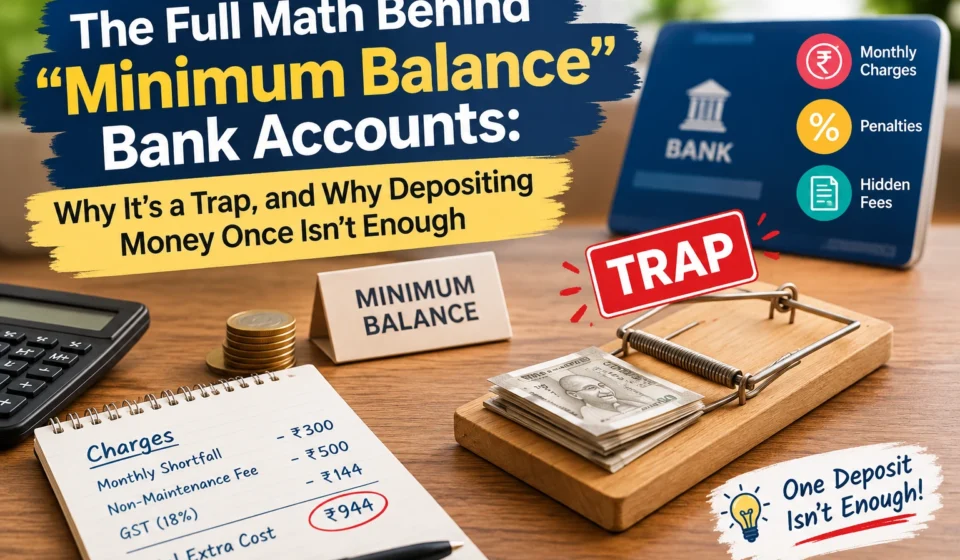
The Full Math Behind “Minimum Balance” Bank Accounts: Why It’s a Trap, and Why Depositing Money Once Isn’t Enough

By the FinanceChecks.com Editorial Team | Published October 2, 2026 | Last reviewed October 2, 2026 | 9-minute read
Here’s a sentence that trips up more people than it should: “I opened the account with the minimum balance, so I’m covered.” You’re not, and the gap between what people assume and what the bank actually requires has quietly cost Indian depositors over ₹26,100 crore in penalties across just the last four financial years, with ₹7,086 crore of that collected in FY26 alone. Almost none of that money was taken from people who never deposited the minimum balance. It was taken from people who deposited it once, and then let it slip, assuming a single deposit was the whole requirement.
This guide walks through the actual math banks use to calculate whether you’ve “maintained” your minimum balance, why a one-time deposit doesn’t protect you, what the real penalty numbers look like in 2026, and how to make sure this never quietly drains your account.
Quick Answer
Opening a savings account with the “minimum balance” amount is not a one-time requirement, it’s an average you need to maintain across the entire month, or in some cases, the entire quarter. Banks calculate what’s called the Average Monthly Balance (AMB) by adding up your account’s closing balance at the end of every single day in the month, then dividing that total by the number of days in the month. If you deposit ₹10,000 on day one and then spend it down to ₹500 by day 15, your average for the month could fall well below the required minimum, even though you technically “deposited the minimum balance” when you opened the account. Most government-owned banks, including SBI, have scrapped this penalty on standard savings accounts since 2020, but private banks like HDFC, ICICI, Axis and Kotak Mahindra still charge it, with penalties running into hundreds of rupees per month on standard accounts.
About This Guide
This guide was compiled by the FinanceChecks.com editorial team using RBI guidelines on minimum balance penalties, Parliamentary data shared by the Ministry of Finance in July 2026, and published fee schedules from major Indian banks. Because penalty structures and minimum balance requirements vary significantly between banks and change periodically, we recommend verifying your specific bank’s current Average Monthly Balance requirement and penalty schedule directly on their website before assuming any figure in this guide applies exactly to your account.
The Misunderstanding That Costs People Money
When someone says a savings account “requires a minimum balance of ₹10,000,” most people hear that as a one-time condition, like a security deposit. Put ₹10,000 in, and you’re done. That’s not how it actually works for the vast majority of savings accounts in India.
What banks actually require is an Average Monthly Balance, commonly written as AMB or sometimes MAB (Monthly Average Balance). This is not the lowest point your account hits during the month, and it’s not what you deposited when you opened the account. It’s a running average of your account’s balance across every single day of that month, and it resets every month. A large deposit at the start of the month that gets spent down by the middle of the month will not save you from a penalty if your daily balances, averaged out, fall below the required threshold.
The Actual Formula
Banks calculate AMB using a straightforward formula:
Average Monthly Balance = (Sum of your account’s closing balance at the end of each day in the month) ÷ (Number of days in that month)
Every single day, your account has a closing balance, the amount sitting in it at the end of that day, whether or not you made any transaction. The bank adds up all 28, 30, or 31 of these daily closing balances for the month and divides by the number of days. That resulting number is compared against your account’s required minimum, and if it falls short, a penalty applies.
You May Also Like To Read About:
- What Happens to Your SIP Autopay If Your Bank Defaults, Merges or Is Restricted by RBI, and How to Manage Your Autopays
- Your Rights When a Bank Charges Hidden Fees or Deducts Money Without Consent: Types of Hidden Charges and How to Spot Them
- Your Rights If You Are a Victim of UPI or Online Banking Fraud: RBI Zero Liability Rules and Reporting Timelines Explained
- Call Forwarding Scam: How It Works, How to Check Your Phone, and How to Stay Safe
- Cheque Bounce Rules in India: Section 138 and What It Means for You
- Recurring Deposit Interest Is Taxed Every Year, Not Just at Maturity, Here’s the Surprise Waiting at Tax Time
A Worked Example That Shows the Trap
Here’s where the math actually makes the trap visible. Say your bank requires an AMB of ₹10,000, and here’s what a fairly ordinary month might look like for someone who deposited the full amount on day one but then used the account normally:
| Period | Balance | Days at This Balance |
|---|---|---|
| Day 1-5 | ₹10,000 (just deposited) | 5 days |
| Day 6-15 | ₹6,000 (after rent/EMI payment) | 10 days |
| Day 16-25 | ₹3,000 (after other expenses) | 10 days |
| Day 26-30 | ₹8,000 (after salary credit) | 5 days |
Adding up the daily balances: (₹10,000 × 5) + (₹6,000 × 10) + (₹3,000 × 10) + (₹8,000 × 5) = ₹50,000 + ₹60,000 + ₹30,000 + ₹40,000 = ₹1,80,000.
Divide by 30 days: ₹1,80,000 ÷ 30 = ₹6,000 average monthly balance.
Even though this person deposited the full ₹10,000 requirement at the start of the month and never let their balance drop to zero, their actual AMB comes out to ₹6,000, a shortfall of ₹4,000 against the ₹10,000 requirement. That shortfall is exactly what triggers a penalty, calculated not on the lowest balance of the month, but on this averaged figure.
What the Penalty Actually Costs You in 2026
This is the part of the math that compounds the damage, because the penalty itself is calculated proportionally to how large your shortfall is, not as a flat fee regardless of the gap.
| Bank | AMB Requirement (Metro, Standard Savings) | Penalty Structure |
|---|---|---|
| SBI | No requirement | Penalty scrapped on savings accounts since March 2020 |
| Most public sector banks | Varies; many scrapped | 10 of 12 PSBs have discontinued the penalty as of FY26 |
| HDFC Bank | ₹10,000 | Up to ₹600 per month depending on shortfall |
| ICICI Bank | ₹10,000 | ₹100 plus 5% of the shortfall amount |
| Axis Bank | Varies by account type | ₹5 per ₹100 of shortfall, capped at ₹350 |
| Kotak Mahindra Bank | Varies by account type | Charged per board-approved policy, revised periodically |
Using the earlier example, a ₹4,000 shortfall against ICICI’s structure (₹100 plus 5% of the shortfall) would work out to roughly ₹100 + ₹200 = ₹300 for that single month. On an HDFC account, a shortfall of that size could land anywhere in the ₹150 to ₹600 range depending on exactly how far below the AMB the account falls. And this isn’t a one-time charge, it repeats every single month the shortfall continues, which is exactly how the national total reaches thousands of crores a year.
How This Adds Up Over Time
A single month’s penalty of a few hundred rupees doesn’t sound catastrophic in isolation, but the real damage comes from repetition. If an account falls short of its AMB by a similar margin for, say, eight months in a year, at an average penalty of ₹300 to ₹400 a month, that’s ₹2,400 to ₹3,200 gone over the year, not because the account was misused or overdrawn, but because the average balance quietly dipped below a threshold the account holder assumed they’d already satisfied by depositing money once.
Nationally, this pattern is exactly why private banks collected close to ₹4,949 crore in a single financial year (FY26) through these penalties, nearly 70% of the total ₹7,086 crore collected across the entire banking sector that year. This isn’t a handful of unlucky account holders, it’s a structural, widespread gap between what people assume “minimum balance” means and what the bank is actually measuring every single day.
The Good News: Real Protections Exist
A few things work in the depositor’s favour here, and it’s worth knowing them.
Most PSBs have dropped this penalty entirely. SBI scrapped minimum balance penalties on its standard savings accounts back in March 2020 and has not reinstated them. As of the government’s own data shared in Parliament in July 2026, 10 of India’s 12 public sector banks have discontinued this penalty on savings accounts, with the remaining two applying revised, board-approved charges rather than the older punitive structure.
RBI requires advance warning. Per RBI’s guidance, banks are required to notify customers via SMS, email or letter before levying a penalty, and customers are generally given time to restore the required balance before any charge is actually applied, rather than being penalised without warning the moment the shortfall occurs.
Your account cannot be forced negative purely by this penalty. RBI’s stance is clear that a bank cannot let your account balance turn negative solely because of minimum balance penalty charges, which caps the worst-case damage from a single missed month.
Zero-balance accounts exist and carry no penalty at all. A Basic Savings Bank Deposit Account (BSBDA), including accounts opened under the Pradhan Mantri Jan Dhan Yojana, has no minimum balance requirement whatsoever. Roughly 73 crore such accounts in India currently carry zero exposure to this penalty, by design.
How to Actually Avoid This
If you’re consistently falling short of your AMB requirement, a few practical fixes work better than hoping you remember to top up the account. Consider switching to a BSBDA or zero-balance savings account if you don’t need the additional features, like a physical chequebook, that standard accounts typically bundle in. If your employer offers a salary account, keeping it active and routing your salary through it typically grants it zero-balance status for as long as it remains your active salary account. If you want to stay on a standard account, set a recurring calendar reminder a few days before month-end to check your balance against the requirement, since the AMB is a monthly reset, not a one-time deposit, catching a shortfall even a week before month-end gives you time to deposit enough to bring the average back up, depending on how the specific month has trended. And if a specific month’s shortfall is genuinely unavoidable, some banks will waive a first-time or occasional penalty if you call and ask, particularly for long-standing customers with an otherwise clean record.
Common Mistakes People Make
The single most common mistake is treating the minimum balance as a one-time deposit requirement rather than a monthly average, which is the exact misunderstanding this entire guide addresses. Another is not checking which specific account type you hold, since many people don’t realise a zero-balance or BSBDA option exists and would suit their usage pattern better than the standard account they were defaulted into when opening it. People also frequently ignore the SMS or email notification banks send before applying a penalty, treating it as routine spam rather than a genuine, actionable warning with time attached to fix the shortfall. And many account holders never ask for a penalty waiver, assuming the charge is non-negotiable, when banks frequently do waive occasional charges for customers who ask, particularly if it’s a rare lapse rather than a recurring pattern.
My Take
What makes this particular trap so effective is that it doesn’t feel like a trap while it’s happening. Nobody experiences a “minimum balance penalty” as a dramatic event, it shows up as a small, easy-to-miss line item buried in a bank statement most people skim rather than read line by line. The ₹26,100 crore figure collected over four years isn’t the result of a few large losses, it’s the result of millions of small, repeated ₹100 to ₹600 charges that nobody noticed accumulating.
The fix genuinely is this simple: know whether your specific account charges this penalty at all, know the actual AMB requirement rather than assuming it matches whatever you deposited on day one, and if you’re someone whose balance naturally dips through the month due to rent, EMIs or regular spending, seriously consider whether a zero-balance account suits you better than fighting a monthly average you’re structurally unlikely to maintain.
Frequently Asked Questions
1. Does depositing the minimum balance once when I open my account protect me from penalties? No. Most banks require you to maintain an Average Monthly Balance (AMB) across the entire month, calculated from your daily closing balances, not a one-time deposit amount.
2. How exactly is Average Monthly Balance calculated? It’s the sum of your account’s closing balance at the end of every day in the month, divided by the number of days in that month.
3. Does SBI still charge a minimum balance penalty in 2026? No. SBI scrapped minimum balance penalties on its standard savings accounts in March 2020 and has not reinstated them.
4. Which banks still charge minimum balance penalties? Private banks including HDFC Bank, ICICI Bank, Axis Bank and Kotak Mahindra Bank generally still charge penalties on their standard savings account variants. Most public sector banks have scrapped the charge.
5. Can my bank let my account balance go negative because of this penalty? No. As per RBI’s stance, a bank cannot force your account into a negative balance purely due to minimum balance non-maintenance charges.
6. Will I get a warning before being charged a penalty? Generally, yes. Banks are required to notify customers via SMS, email or letter before levying the charge, and customers are usually given time to restore the balance first.
7. What is a zero-balance or BSBDA account, and does it avoid this issue entirely? A Basic Savings Bank Deposit Account (BSBDA), including Jan Dhan Yojana accounts, carries no minimum balance requirement at all, so there’s no risk of this penalty on such accounts.
8. Can I ask my bank to waive a minimum balance penalty? Often, yes. Many banks will waive an occasional or first-time penalty on request, particularly for long-standing customers with a generally clean account history.
9. Does my salary account require a minimum balance? Salary accounts typically carry zero-balance status as long as your salary continues to be credited into that account regularly.
10. How much do Indian banks collect from these penalties each year? In FY26 alone, banks collected approximately ₹7,086.63 crore in minimum balance non-maintenance penalties, with private banks accounting for close to 70% of that total.
Disclaimer
This article is for general informational purposes only and does not constitute financial advice. Minimum balance requirements, AMB calculation methods and penalty structures vary by bank, account type and branch location, and are subject to change. Readers should verify their specific account’s current requirements and fee schedule directly with their bank. FinanceChecks.com is not affiliated with any bank mentioned in this article.
Last reviewed and fact-checked on October 2, 2026 by the FinanceChecks.com Editorial Team.

Shuchi founded Finance Checks after spending 16+ years working in corporate, managing operations and distribution. She managed her own finances, learned and read regularly and helped people make sense of their savings, loans, insurance, and investments.
She started this site to offer the kind of clear, honest financial guidance she wished was more available when she was learning to manage her own money. Every article is researched personally, checked against official sources such as the Reserve Bank of India, SEBI, or the Income Tax Department, and revisited whenever regulations or figures change. She is upfront about how the site earns money through ads and select affiliate partnerships, and she does not let either influence what she actually recommends to readers.



[…] The Full Math Behind “Minimum Balance” Bank Accounts: Why It’s a Trap, and Why Depositing Mone… […]