
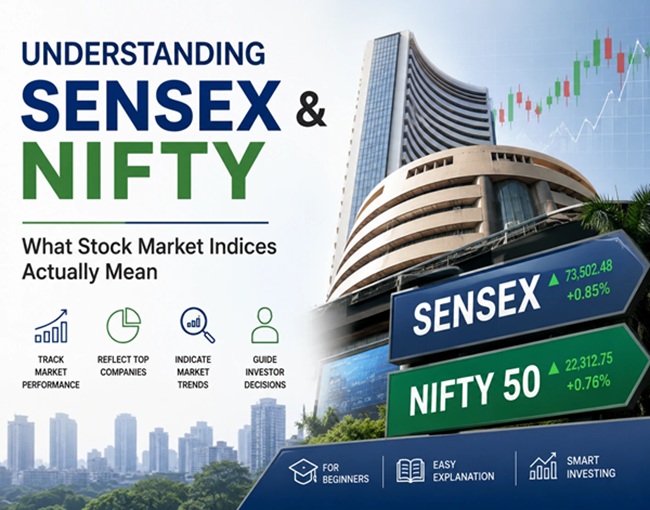
Understanding Sensex and Nifty: What Stock Market Indices Actually Mean

You’ve probably heard it a hundred times on the news — “Sensex closed 400 points higher today” or “Nifty ended in the red.” But if you’ve ever wondered what that number is actually measuring, or why it moves the way it does, you’re not alone. Most people use these words for years without knowing what’s really behind them.
This post breaks down exactly what Sensex and Nifty are, how they’re calculated, and why they matter even if you don’t personally own every stock in them.

What Is a Stock Market Index?
A stock market index is a number that represents the combined performance of a specific group of stocks, used as a single figure to track how that segment of the market is doing overall. Instead of checking hundreds or thousands of individual stock prices to get a sense of “how is the market doing today,” an index gives you one number that reflects the collective movement of a representative basket of companies.
Think of it like a class average on a test. You could look at every single student’s score, or you could look at the average and get a quick sense of how the whole class performed. An index does the same thing for a chosen set of stocks.
What Is Sensex?
Sensex (short for the Sensitive Index) is the benchmark index of the Bombay Stock Exchange (BSE), India’s oldest stock exchange. It tracks the performance of 30 of the largest and most actively traded companies listed on the BSE, spanning a wide range of industries such as banking, IT, energy, and consumer goods.
Sensex has been around since 1986, making it the oldest and most widely recognized stock market index in India — which is part of why it’s the number most commonly quoted in everyday news coverage, even among people with no direct stock market involvement.
What Is Nifty?
Nifty 50 is the benchmark index of the National Stock Exchange (NSE), tracking the performance of the top 50 companies listed on the NSE across major sectors of the economy. It was launched in 1996 and has since become the most widely used benchmark for professional fund managers and institutional investors in India.
Beyond the main Nifty 50, the NSE also maintains a range of sector-specific indices — such as Nifty Bank, Nifty IT, and Nifty Pharma — which track the performance of companies within a single industry, useful when you want to see how a specific sector is doing rather than the market as a whole.
How Are Sensex and Nifty Actually Calculated?
Both indices use a method called free-float market capitalization weighting. Here’s what that means in plain terms:
- Market capitalization is a company’s share price multiplied by its total number of shares outstanding — essentially, what the market currently values the entire company at.
- Free float refers to only the shares that are actually available for public trading, excluding shares held by promoters, the government, or other locked-in stakeholders.
- Companies with a larger free-float market cap carry more weight in the index, meaning their price movements influence the index’s overall number more than a smaller company’s would.
This is why a big move in a heavyweight company (a large bank or a major IT company, for example) can shift the entire Sensex or Nifty noticeably, while the same percentage move in a smaller constituent barely registers.
Why Do Sensex and Nifty Go Up or Down?
Index movement reflects the combined buying and selling activity across its constituent stocks, which in turn is driven by a mix of factors:
- Company-specific news — quarterly earnings, management changes, major business announcements from index constituents.
- Domestic economic indicators — interest rate decisions, inflation data, GDP growth figures.
- Global market cues — how major international markets performed overnight, since Indian markets don’t move in isolation.
- Foreign and domestic institutional investment flows — large-scale buying or selling by mutual funds, FIIs, and DIIs can move the index meaningfully.
- Broader sentiment — geopolitical events, policy announcements, or global risk appetite can shift prices even without a specific company-level trigger.
Sensex vs Nifty: What’s the Real Difference?
| Sensex | Nifty 50 | |
|---|---|---|
| Exchange | BSE | NSE |
| Number of stocks | 30 | 50 |
| Launched | 1986 | 1996 |
| Calculation method | Free-float market cap | Free-float market cap |
In practice, both indices tend to move in a similar direction most of the time, since many large companies are listed on both exchanges and appear in both indices. The difference in day-to-day movement is usually small, and neither is objectively “better” — they’re simply two different benchmarks tracking overlapping but not identical baskets of companies.
You May Also Like To Read About:
- How to Read a Stock Quote and Stock Chart: A Complete Beginner’s Guide
- Understanding Stock Market Indices
- How to Place Your First Stock Trade in India
- Demat Account vs Trading Account
- How to Open a Demat and Trading Account in India
- The Stock Market Glossary Every Beginner Actually Needs
- Why Should You Even Invest in Stock Market?
- What Is the Stock Market, and How Does It Actually Work?
- Stock Market Technical Analysis
Can You Invest Directly in Sensex or Nifty?
Not directly, since an index itself isn’t a tradable asset — it’s a calculated number. However, you can gain exposure that closely tracks these indices through index funds or ETFs (Exchange Traded Funds) built to mirror the performance of Sensex or Nifty, which is a common and popular way for beginners to get diversified market exposure without picking individual stocks.
Why Understanding Indices Matters, Even If You Don’t Own Every Stock In Them
You might own only two or three stocks, none of which happen to be in the Nifty 50 or Sensex. Understanding these indices still matters because they act as a benchmark — a reference point to compare your own portfolio’s performance against. If your portfolio is up 5% for the year while Nifty is up 15%, that’s useful information about how your specific choices are performing relative to the broader market, even if the comparison isn’t perfectly apples-to-apples.
Common Misunderstandings Beginners Have About Indices
- Assuming a rising Sensex means every stock is up. It only means the weighted average of its 30 constituents is higher — individual stocks, especially outside the index, can move in the opposite direction.
- Thinking a bigger index number is inherently “better.” Sensex and Nifty aren’t directly comparable in absolute number terms because of differences in base value and calculation history — only their percentage or point changes over time are meaningful for comparison.
- Believing index movement equally reflects all sectors. Because of market-cap weighting, a handful of large companies can disproportionately drive the index while dozens of smaller constituents barely move it.
Frequently Asked Questions
1. Can I invest directly in Sensex or Nifty? Not directly, since an index is a calculated number rather than a tradable security. You can get exposure that tracks these indices through index funds or ETFs designed to mirror their performance.
2. Why do Sensex and Nifty sometimes move in different directions on the same day? Because they track different, though overlapping, baskets of stocks with different weightings. A stock heavily weighted in one index but not the other can cause small divergences, even though both usually trend in the same broad direction over time.
3. How often is the Nifty 50 list of companies updated? The NSE reviews and rebalances the Nifty 50 constituents periodically, typically on a semi-annual basis, based on criteria like market capitalization and liquidity. Companies can be added or removed as their standing changes relative to other eligible stocks.
4. What are sector indices like Nifty Bank or Nifty IT? These are indices that track the performance of companies within a specific industry rather than the market as a whole, useful for investors who want to gauge or gain exposure to a particular sector’s performance specifically.
5. Is a rising Sensex always good news for my personal portfolio? Not necessarily. Sensex reflects the performance of its 30 constituent companies specifically. If your holdings differ from those companies, your portfolio can perform quite differently from the index, in either direction.
6. What time do Sensex and Nifty start and stop trading? Regular equity trading on both the BSE and NSE runs from 9:15 AM to 3:30 PM IST on trading days, with a pre-open session shortly before the main session begins.
Disclaimer
This article is for educational purposes only and does not constitute investment advice, a recommendation to buy or sell any security, or a solicitation of any kind. Index composition, weightings, and calculation methodologies are determined by the respective exchanges and index providers, and can change over time — always verify current details on the official BSE and NSE websites. Past index performance does not guarantee future results, and investments linked to index funds or ETFs are subject to market risk. Readers are strongly encouraged to do their own research or consult a SEBI-registered investment advisor before making any investment decisions. FinanceChecks.com and its authors accept no liability for losses arising from the use of this information.

Shuchi founded Finance Checks after spending 16+ years working in corporate, managing operations and distribution. She managed her own finances, learned and read regularly and helped people make sense of their savings, loans, insurance, and investments.
She started this site to offer the kind of clear, honest financial guidance she wished was more available when she was learning to manage her own money. Every article is researched personally, checked against official sources such as the Reserve Bank of India, SEBI, or the Income Tax Department, and revisited whenever regulations or figures change. She is upfront about how the site earns money through ads and select affiliate partnerships, and she does not let either influence what she actually recommends to readers.



[…] Understanding Sensex and Nifty: What Stock Market Indices Actually Mean […]
[…] companies in the country, the kind of businesses that are usually already part of the Nifty 50 or Sensex. These are companies with long track records, strong balance sheets, and enough market presence […]
[…] threshold universally agreed upon, but it’s generally characterized by indices like the Nifty or Sensex trending upward over an extended period, often measured in years rather than […]